

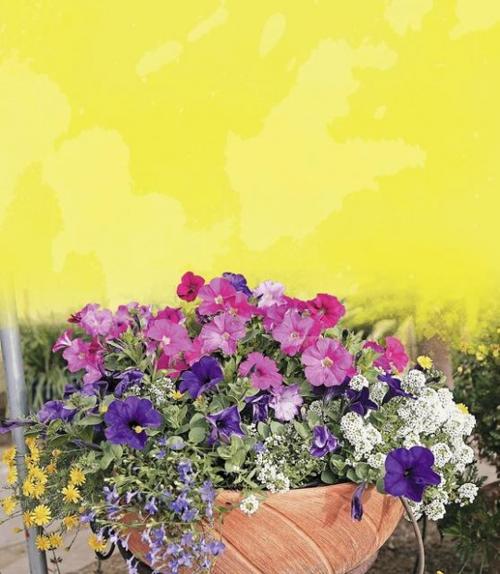
Flowers that have a natural tendency to cascade are some of the best for providing color in hanging baskets, planters, urns and pots of all shapes and sizes.
Some of the best annuals for winter color include cascading petunias, million bells, purple- or green-leafed lobelia, sweet alyssum and ageratum. All are tolerant of cold temperatures and will continue to grow and flower well into spring.
When planting cascading types of flowers in pots, you can angle them out over the edge of the container to encourage the stems to grow down over the sides of the pot. Don't be afraid to crowd flowers in the pot.
For winter planting, I recommend purchasing plants in smaller pot sizes. Cell packs (often referred to as "pony" packs) have six, sometimes eight, plants per tray. The small root-ball size allows for the placement of more plants in the pot. This crowding stimulates quicker establishment and more abundant flowering.
People are also reading…
In addition to the aforementioned annuals, there are also a number of colorful cascading perennials to choose from, including cupflower (Nierembergia), hearts & flowers (Aptenia), golden dyssodia, dwarf wormwood (Artemisia), and the silver-leafed, yellow-flowering woolly yarrow.
To have success with your cascading flowers it's important to grow them in quality soil. You can choose any potting soil, but because most are too heavy, I recommend adding perlite to lighten the mix for improved drainage and aeration. One part perlite should be mixed thoroughly with five parts potting soil.
Do not place drainage material, such as stones, in the bottom of the container. This will actually prevent excess water from draining freely out the bottom of the pot. Fill the container from the bottom up with soil mix, leaving a few inches at the top for watering.
When planting, lightly tease the roots along the edge of the root ball with a kitchen fork before filling around them with soil. Loosening the roots will encourage them to grow directly out into the potting soil. Don't worry if a few roots break off in the process; more will rapidly grow to replace them.
After planting, locate pots of cascading flowers in full sun on the south or west sides of the patio. The increased heat will stimulate root growth and increase flowering during the winter months. In addition, try watering your flowers with slightly warm water. The increase, albeit temporary, will help speed the rooting process.
Keep the soil evenly moist but not wet. It's easy to overwater in the winter months as cool weather slows evaporation and the plant's overall need for water.
Finally, during the cool season I recommend using a water-soluble plant food containing the nitrate form of nitrogen. Look on the ingredients statement. Nitrate is not dependent on the actions of soil microorganisms to be converted into a usable form for plants and thus can be directly absorbed by plants, even in cold weather.
Demonstrations
"Selecting and Planting Bare-Root Fruit Trees" will be the topic of this week's gardening demonstrations. Presentations will be on Wednesday at 1 p.m. at the Wilmot Library, 530 N. Wilmot Road; and Friday at 1 p.m. at the Oro Valley Public Library, 1305 W. Naranja Drive.
