

Agaves constitute one of the best- adapted groups of landscape plants for arid gardens.
Their stiff, sword-shaped leaves and bold rosette pattern of growth make them ideal accent plants. Besides being great landscape plants, they do just as well growing in containers on the patio.
Most people are familiar with Agave americana, the century plant, which grows an overpowering 6 feet in height and spread — too large for most garden spaces. But there are many small-growing agave species just right for growing in containers on the patio and planting in home landscapes with limited space. Some of the best include:
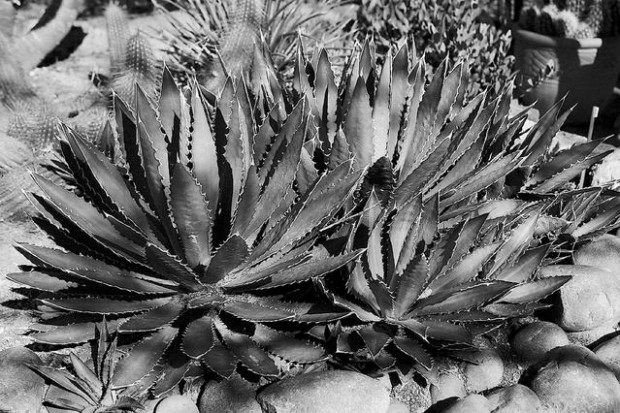
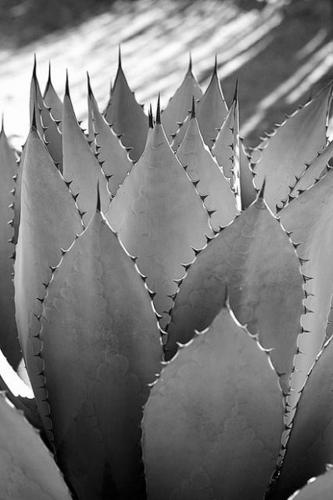
● Huachuca agave (Agave parryi huachucensis) grows 2 feet high and 3 feet wide. Its broad, gray-green leaves are edged with distinctive dark-brown spines. Individual plants grow in a dense rosette pattern. Another interesting feature is the patterned outlines of leaf edges left imprinted on the undersides of leaves. These impressions were formed when leaves were tightly pressed against one another in the bud stage. Hauachuca is cold-hardy in the low, middle and high desert regions of Southern Arizona.
People are also reading…
● Holly agave (Agave lophantha) is so named because of its rich, dark-holly-green leaves. Individual plants typically grow 18 inches high and wide but form numerous pups that expand the "colony" out, sometimes to 6 feet across. Pups can be removed to control the overall size of the grouping. Holly agave is hardy in the low and middle elevations of Southern Arizona.
● Queen Victoria agave (Agave victoriae-reginae) is a favorite among the small agaves due to its dense, perfectly rounded form and unusual triangular-shaped leaves edged in white. A slow grower, the Queen Victoria agave reaches 2 feet in diameter over time. It makes an ideal specimen for growing in bowl-shaped ceramic pots. This agave is hardy in the low and middle-elevation desert.
● Twin-flowered agave (Agave geminiflora) is unique among agaves because of its long, thin leaves. In many ways, it resembles a yucca, only in miniature, growing to a height and spread of 2 feet. It's an easy plant to maintain in a container, because unlike many of the other agaves, geminiflora produces no pups. It's one of the more cold-sensitive agaves and will suffer some leaf damage when the temperature is around 25 degrees, so it may need protection during cold snaps.
● Octopus agave (Agave vilmoriniana), at 4 feet tall, is a little too big to be in the small-agave class, but it's a striking plant worth consideration for home landscapes. Its arching and twisting dark-green leaves look like the arms of an octopus. Unlike other agaves, the Octopus agave has no leaf spines and is safe to use near sidewalks or other high-traffic locations. A profusion of plantlets will be produced from the flowering stalk and can be easily rooted to form new plants.
Agaves are succulents that have thick, water-storing leaves and roots. Most species need only a few inches of rainfall annually to survive. However, they look and grow better with once-a-month watering, especially during their most active growth cycles in spring and fall.
Although agaves have few problems, they are occasionally attacked by the agave weevil. Infested plants wilt and die suddenly. There is no chemical control for these pests; however, removal of the dead plant as soon as possible will prevent the insects from moving to nearby agaves.