

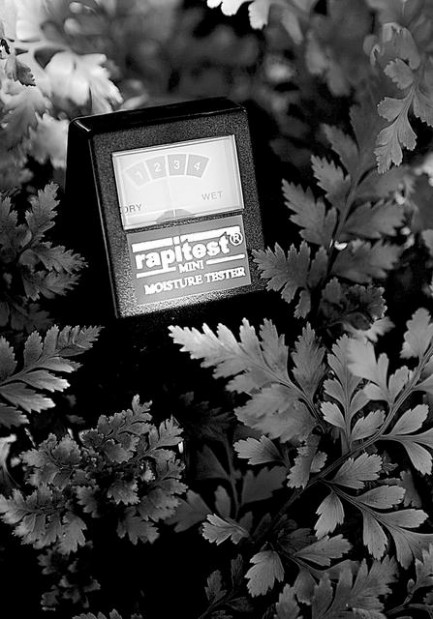
One of the most valuable and least expensive tools for desert gardeners is a moisture meter.
At a cost of around $5, these battery-powered devices are great for determining the moisture level of any potting or garden soil in containers, raised beds and garden beds of flowers and vegetables.
Moisture meters can be purchased at garden, home supply and hardware stores.
The moisture meter's 5-inch probe is inserted into the soil, and the needle gauge registers the moisture level in a range from bone dry to soaking wet.
For flower and vegetable gardens, watering should be done frequently enough to keep the moisture meter in the moist range, with the needle registering mid-way between wet and dry. This is also the case with most potted plants, with the exception of cacti and succulents. Their soil should be allowed to dry before watering, with the moisture meter needle registering in the dry range but not bone dry.
People are also reading…
It's important to use the moisture meter frequently enough to determine the schedule of watering. A moisture reading should be taken at the time of watering and then daily thereafter to determine the speed at which the soil loses moisture. When the needle begins to fall into the dry range of the gauge, then it's time to water again. The time it takes between the initial watering and the needle's drop into the dry range determines the frequency of watering required. If it takes three days, then watering every three days should be often enough to keep the soil evenly moist.
When there's a change in seasonal temperatures and humidity, the frequency of watering will need to be adjusted. When temperatures begin to drop as we head into autumn, the frequency of watering can be decreased. Again, the moisture meter can be used to determine any adjustments needed in the frequency of watering.
Moisture meters are not as effective when used to determine the moisture levels in desert soils. It's difficult to push the small probe in, and it doesn't go deep enough to determine the moisture levels for deep-rooted trees and shrubs.
The best way to determine the moisture level and the depth of wetting in desert soils is with a long metal rod, preferably 3 feet in length. A piece of concrete-reinforcing bar, available at home supply stores, is great to use for measuring the depth of wetting. A thick wooden dowel rod with a sharpened end may also be used.
The rod can be pushed down through moist soil but will stop when it strikes dry soil. By using the rod immediately after irrigation, you can determine the depth of wetting. For shrubs, the soil should be irrigated to a depth of 2 feet. For trees, the depth should be 3 feet. If the soil was not moistened deep enough with irrigation, increase the length of watering until the soil has been moistened to the proper depth.
Unlike moisture meters, rods cannot be used to determine the frequency of irrigation. Most desert landscape plants are relatively drought tolerant and do not need frequent irrigation. Check desert landscape plant reference books to determine the general frequency of irrigation.
● John P. Begeman is the urban horticulture agent for the University of Arizona-Pima County Cooperative Extension. If you have questions, call 626-5161 to reach a master gardener.