

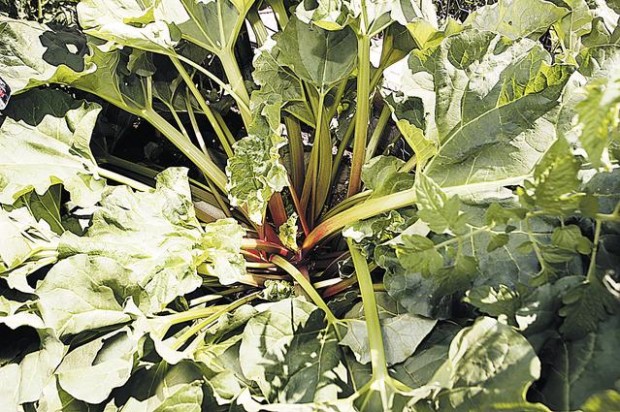
Rhubarb is an old garden favorite for many of us who grew up enjoying its unique tart flavor in pies, cobblers and sauces. But rhubarb is a northern-grown perennial, not adapted to subtropical regions like we have in Tucson. At least that was the conclusion I drew.
But then I stumbled on an article about growing rhubarb as an annual; planting it in the fall, growing it in the cool winter months and harvesting its tasty leafstalks in the spring. So, I thought we'd give it a try here at the UA Extension Gardens on Campbell Avenue.
We chose the rhubarb variety 'Victoria' as the literature indicated it was the best rhubarb for forcing (starting from seed) and growing to harvest in one season. Victoria produces a plant 3 feet wide and tall with large dark-green leaves. Its tart green leafstalks are tinged in red, extending up from the base. As many as 30 18-inch-long leafstalks can be harvested from just one plant.
People are also reading…
Our Victoria rhubarb seeds were purchased from John Scheepers Kitchen Garden Seeds in Bantam, Conn. It's the only seed source I could find for this variety and they can be ordered at: www.kitchen gardenseeds.com or by calling 1-860-567-6086.
Our seeds were planted in the second week of September in 4-inch pots in a mix of two parts vermiculite, two parts perlite and one part peat. Seeds germinated in seven to 10 days with even moisture. When the first true leaves formed, our plants were feed weekly with a water soluble plant food. By mid-October, plants were large enough to plant out in the garden.
Rhubarb requires a rich, organic soil. It can be planted in ground beds or raised beds. When preparing the area to plant, mix in lots of organic amendments, such as composted manure, topsoil rich in peat or bagged plant compost. Prepare the soil to a depth of 12 to 18 inches. Remove all rocks, stones and caliche. Our rhubarb was grown in raised beds; one filled with compost, the other with a mixture of soil, peat and composted manure. The raised bed with a mixture of garden soil and organic matter seemed to produce the best plants. At the time of soil preparation, also mix into the soil a fertilizer high in phosphorous and potassium such as 5-10-10 using about a quarter cup per plant.
Plants set out in October will grow and develop extensive roots systems, but only a limited amount of leafy growth. Through the fall and winter, rhubarb should be watered often enough to keep the soil evenly moist. Sometime in January or February plants will appear to die back nearly to the ground. This is normal. Continue watering to keep the soil moist. As temperatures warm in early March, plants that appeared to be dead will come alive and begin growing. In four to six weeks, the rhubarb will be nearly full size and ready to harvest.
With our experiment, we harvested all but one or two leafstalks to see if the plants would continue to grow. They did, and within a month of the first harvest we had a second crop of leafstalks nearly as large and numerous as the first. A word of caution for those unfamiliar with rhubarb, only the stalks are edible. The leaves are in fact poisonous if ingested!
The results certainly indicate that rhubarb can be grown successfully as an annual here in Tucson and other low and middle elevation locales in the Southwest. Not only that, but our rhubarb passed pie and cobbler taste tests with flying colors.
● John P. Begeman is the urban horticulture agent for the University of Arizona-Pima County Cooperative Extension. If you have questions, call 626-5161 to reach a master gardener.
Gardening
Advice by John P. Begeman