

In 1940, close to a half-hundred dude ranches dotted the Tucson valley and surrounding areas. • Ranches with melodious names like Carnila Ranchito, Silver Spur, Rancho Nezhone. • Today, the lure of "playing cowboy" seems to have diminished as much as the wide open spaces. • Only two true dude ranches still exist in Tucson. And it's no accident both sprawl at the opposite edges of town, buffered by thousands of acres of still-pristine desert. • Room enough to roam. Room enough to romance a vision of the West the way it once was — and the way it is today.
— Bonnie Henry
For more than 80 years, dudes have been jangling their spurs and soothing their saddle sores at the Tanque Verde Ranch.
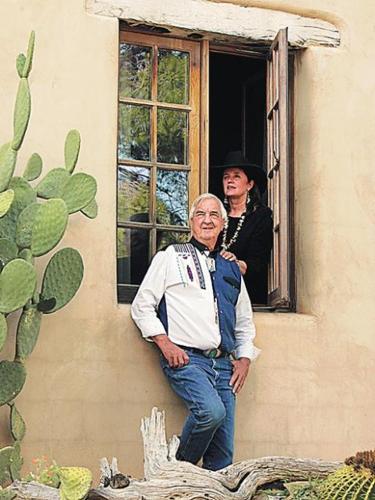
"It started as a cattle ranch," says owner Bob Cote, 74, looking out over a spread that Emilio Carrillo bought around 1870.
People are also reading…
In the 1920s, Jim Converse bought the place nestled into the far end of the road at 14301 E. Speedway. He turned it into a dude ranch, an idea that dates back to the 1880s.
"The problem with ranches was they had cash and labor problems," says Cote. "So they came up with the dude ranch to have people pay to do the labor."
Not any more. A quick spin through the place immediately backs up Cote's description of this ranch as both resort and spa — words still anathema to his competitors across the valley at the White Stallion Ranch — though there's not much difference in the amenities.
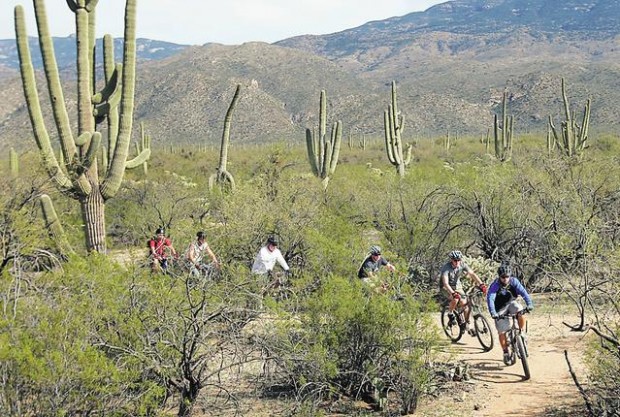
Here at Tanque Verde, those include nightly entertainment ranging from cowboy singers to talks on American Indian history, as well as indoor and outdoor pools and whirlpools, sauna, massage therapy, tennis courts, a conference center, a bike course, a catch-and-release lake, a history museum, and a nature center.
"We have two full-time naturalists who give walks in the desert and explain the plants and animals," says Cote. "Our philosophy is: You should learn about where you vacation."
Guest Debbie Landry, 47, and her son, Christopher, 11, seem to have taken that to heart, as they take in the nature center.
"The best part is the folks here are so knowledgeable. They make you love it even more," says Landry, who's from Maine and heard about it from friends. "It's our first time here and to Tucson, but we'll absolutely be back."
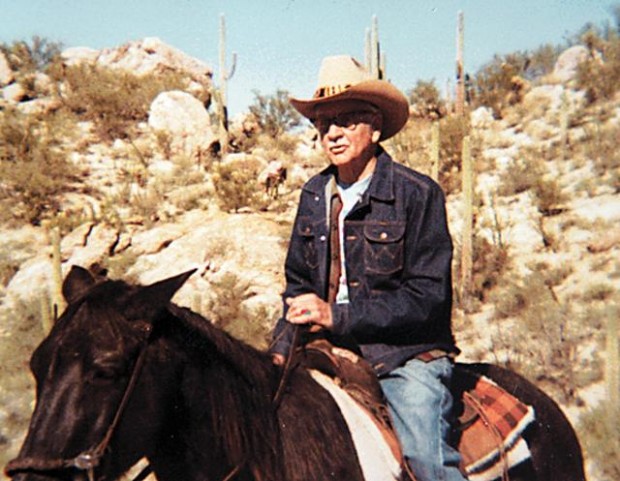
Besides visiting the nature center, Landry and her son also spent plenty of their six days here in the saddle, still the hallmark of the true dude ranch.
With 640 deeded acres and another 60,000 acres leased from the Coronado National Forest, there are plenty of trails for the myriad rides the ranch offers, seemingly dawn to dusk.
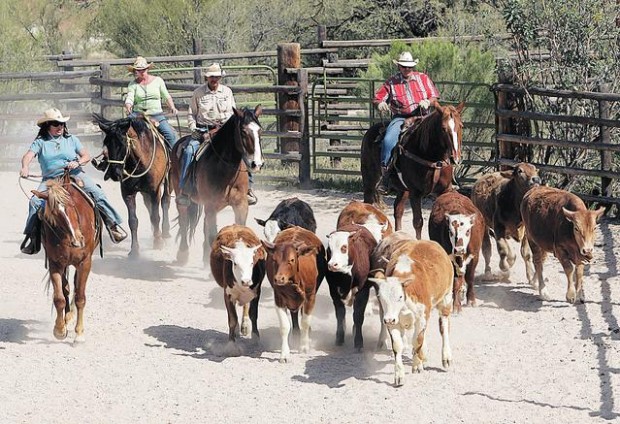
The ranch, also home to about 900 cows and calves and 50 or so bulls, puts on team penning events for the dudes, in which they drive calves into multiple pens.
"It's very slow-moving, very safe," says Cote, whose father, the late Brownie Cote, bought the ranch from Converse in 1957.
"He was very colorful," says Cote about Converse. Yes, indeed. According to old press accounts, Converse hosted javelina barbecues at the ranch and amused himself by shooting the hats off his cowboys.
The fun and games ended after Converse went to jail for accidentally killing one of his hands with a "trick" shot.
Originally an attorney who taught at the University of Minnesota, the elder Cote also worked as a counselor at a summer camp in Minnesota.
"He decided he wanted to be in camping," says Cote, whose father developed a camp for boys and one for girls that still exist in Northern Minnesota.
He also built a resort for visiting parents. "Every fall he closed up and needed a place for the staff to stay," says Cote.
In 1944, the elder Cote came to Tucson and soon bought the Desert Willow guest ranch, located on East Tanque Verde Road past Houghton Road.
"He had the staff go back and forth," says Cote. By the mid-'50s, the land around Desert Willow was being nibbled by civilization — a common death knell for dude ranches. "So Dad bought the Tanque Verde."
Even so, the elder Cote hung onto the Desert Willow until 1968. Meanwhile, his new ranch underwent considerable change.
"When my father bought it there was the ranch house and 10 or 12 guest units. It was very spartan. Some of the older units even shared a bath."
Since then, the ranch house was turned into meeting room, the dining room was expanded, and a main lobby was added, along with 28 new units, a pool and tennis court.
Today, the ranch, with a staff of between 130 and 150, boasts 74 rooms and can accommodate around 180 guests.
"You can have 200 people here and not see them until dinner, they're so busy," says Cote.
To ensure that, Tanque Verde, like White Stallion, offers no television sets in its guest rooms, though there are sets in a couple of common areas.
"People come in and say, 'Oh, God. No TV. What will we do?' " says Cote. "By the time they leave, they are thanking us. There are so many programs going on."
Besides the hiking, the riding, the nature walks, the tennis, the swimming, the fishing, the line dancing, etc., etc., the ranch also offers a "Ladies Only" program, as well as one for kids ages 4-11.
"It is tougher for teenagers," Cote admits. "We tried to put together a program but they don't like organized programs. So ages 12 and older, they do what the adults do."
Three years ago, Cote turned over his duties as general manager to wife, Rita, 55, though he still cooks on the breakfast rides and frequently dines with the guests. "Now I do all the honey-do's for free," he says.
The rich and famous still turn up occasionally — just as they did in the old days.
"Diane Keaton came here driving up in a little pickup with two kids," says Cote. "And Paul and Linda McCartney were guests here."
With air conditioning installed decades ago, the ranch has been open year-round since the '60s. "Europeans like it in the summer," says Cote. "They are looking for the sun."
Adds Rita: "We have rules and menus in German, Italian and French, and Bob speaks fluent French." He also speaks Japanese, learned while living in Japan during the 1960s.
Daily rates, which include everything but alcohol and the spa treatments, range from $275 to $350 per person.
As for the recession, "there's no question the current state of the economy is hurting our business," says Cote, figuring business is down 30 percent.
Even so, the ranch is not for sale, despite offers here and there. "This is a family business," says Cote.
DID YOU KNOW
In the late 1940s, noted Tucson photographer Ray Manley took photos of guests at the dude ranches, dollar a dude.