

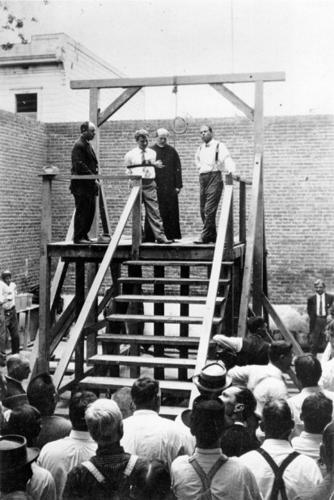

E. W. Hawkins was hanged on Aug. 14, 1908, for the murder of Albert Leonhardt on Dec. 23, 1907.
He had converted to Catholicism and was thought by many to be a changed man who calmly accepted his fate.
On the day of his death, Hawkins dictated a statement to a representative of the Star. It was published along with the article about his execution on Aug. 15, 1908.
When Hawkins was brought to the scaffold, he was given 30 minutes to enjoy some fresh air after having been cooped up in jail for several months. Witnesses were surprised to see that Hawkins was "as cool as a cucumber."
Following his half hour and a last-minute farewell message from his wife, Hawkins calmly stepped into place at the scaffold where the noose was put on followed by the black cap.
One of the more disturbing aspects of the hanging is that Hawkins’ neck did not break, so he didn’t die immediately.
People are also reading…
From the Arizona Daily Star, Saturday, Aug. 15, 1908:
E. W. HAWKINS EXECUTED AT 2:03 P. M. IN COUNTY JAIL
_____
His Neck Not Broken by the Fall and He Lived For Nearly Fourteen Minutes, Due to His Remarkable Vitality—Funeral Held Yesterday Afternoon.
_____
EXHIBITED A COOLNESS THAT WAS REMARKABLE
_____
Spent Half Hour on Gallows, Smoking, Laughing, Chatting With Friends and Talking to the Crowd—Received Message From Wife Just Before the Noose Was Adjusted—Expressed Both Gratitude and Repentance.
_____
At 3 minutes past 2 o’clock yesterday the trap was sprung, and 13 minutes and 40 seconds later the attending physicians pronounced life extinct in the body of Edwin W. Hawkins. Not a hitch occurred anywhere during the proceedings and the crowd behaved admirably. It will probably go down in the history of Arizona hangings as the most remarkable of them all.
In the court-yard, in the sheriff’s private office, on the scaffold and on the tops of the adjoining buildings were hundreds of men, there either because business or curiosity called them, yet none of them had the iron nerve and remarkable will power that Hawkins displayed. The developments in this case in the last hour of the man’s life make him a fit study for the criminologist. His brain should by all means have been turned over to a scientist for study.
From the day when he was taken into custody for the Flemming burglary until yesterday, the officers, newspaper men and all others who came in contact with him had spoken in wonderment of his great nerve, or the utter lack of it, whichever way seems to suit the case best. He was always cool and calm as an iceberg. But his utter sang froid on the scaffold and his real coolness deserve repetition. Perhaps the best way to appreciate it is to give the history of the day as it actually transpired.
He was up very early in the morning, and after a good breakfast fast read the morning papers. Several of these he later in the day gave to the Sisters and had them send to his people in Chicago. Then Father Timmermans came, remaining with him until the end. Never once during the entire morning did he show any sign of collapse, although at 9 o’clock he was attacked with a temporary derangement of the stomach. The greater part of the time from 11 o’clock till noon he spent in dictating into the phonograph a message to his wife and his mother. He shed a few tears and his voice broke a few times during this, but he soon got control of himself and made a new record, as he thoughtfully said later, “That they might not hear my voice break and feel badly when they listen to what I said.”
Early in the morning he received a telegram from Chicago stating that his wife and baby had reached there safely. He replied, and asked for a message to reach him before he went to the scaffold. In his telegram he asked his wife to repeat the Lord’s Prayer for him at 1 o’clock.
It was a little past noon when he sent for Sheriff Pacheco and asked for an extension of half an hour. The hanging had been originally set for 1 o’clock, but the sheriff readily granted this.
The public, however, began to come very soon after 12 o’clock and it was not loing until the interior of the jail was filled with the accredited witnesses. Major Neustatter acted as the guard and very efficiently performed his duties. The main body of the spectators were admitted to the court yard of the jail about the scaffold, while the newspaper men and a few attorneys were in the sheriff’s private office.
About 1 o’clock Hawkins sent for a representative of the Star and dictated the following statement:
I want to thank the sisters of St. Joseph and Father Timmermans for their many kindnesses to me. But for them I am sure that I never would be able to face what I am about to go through.
Had I been a Catholic in the years gone by, I never would have come to this.
The one thing of which I am glad is that out of this hanging I have made certain that my wife and baby will be taken care of. I am glad that I confessed, for it has freed my conscience of the only really great crime I ever committed and it has enabled me to make my peace with God. I am truthfully resigned to my fate.
Of course it is hard to die this way, but it seems that it had to be.
I am sorry for the killing of Leonhardt, more sorry than I can tell. As I feel now, I cannot believe that I was in my right mind when I did it. But I am repentant, and, thanks to the Sisters, I know that my repentance is accepted.
I am grateful to the sheriff and Mr. Meyer for all they have done for me and their kindness toward me, and in fact I am thankful to everybody for the good things they have done and the sympathy they have expressed for me.
I am going to pray for you all in Heaven, and I hope that they will stop to say a word or prayer for me.
I am going to walk up to the scaffold like a man, so as not to make any trouble or annoyance for the officers. I know that it is unpleasant for them but I have no hard feelings toward them.
At 1:30 Sheriff Pacheco and Deputies Meyer and Mills, accompanied by members of the press, went to the cell, where the death warrant was read by Meyer. Hawkins at this place had nothing to say. When asked if he were ready, he nodded his head and then lit a long, black cigar before starting in his last journey. His hands were then tied and the procession began. Father Timmermans led the way, followed by Hawkins, Meyer and Pacheco in the order named.
In a few seconds after he had mounted the scaffold he stepped to the railing and addressed the spectators as follows:
“Gentlemen:—I am perfectly resigned to my fate and I want you all to pray for me. I want you to pray a little word for me after it is all over. Will you? I am sorry for what I done. And I repeat, I want you to pray for me and I will pray for you in Heaven.”
The audience thought that this was all of it, but they were to be treated to a great surprise. The announcement was then made that Hawkins had asked for half an hour’s time on the scaffold. He had previously told the sheriff that, after being cooped up in jail for several months, he wanted to enjoy the fresh air, and the sheriff consented to allow him a half hour of liberty and life on the scaffold.
Then for fully 30 minutes, the people who were there saw something of which they never read before. Hawkins was as cool as a cucumber. He smoked his cigar, occasionally drank a glass of water, paced up and down the scaffold, recognized old acquaintances and smiled genially as he would notice them and tell them good-bye, would occasionally stop to thank some one for some little favor he remembered, and all the while wore a smile that was not that of braggadocio or mock heroism, but simply cool and calm as might be.
At one time in his walk he stopped again to speak to the crowd, saying: “I am sorry for what I have done, but I want you to pray. I am repentant. I want to thank the officers for all their kindness to me. I only wish that I had some way to show my appreciation.”
Then he walked over to the rail, laid his cigar down with his teeth, took another drink, asked the Father to pin the flowers on his breast more [lines are missing or garbled from copy in this and the next paragraph]
All the while the same quiet little later he asked Henry Meyer to roll him a cigarette, which the latter did.
A few minutes later he consulted Sheriff Pacheco as to how much time he had left, and then spoke again to the crowd. Just then the telephone bell rang. “I have been waiting for a message from my wife,” he said. “If there are any of you who know her I want you to pray for her. Maybe that bell ringing is the message from her now.” Two or three newspaper men stepped to the telephone booth and took the message, which had arrived just in the nick of time. It read:
“Good-bye dear. I can’t say any more,” and was signed “Bessie.”
Then with a smile and a quiet throwing away of his cigar, he stepped into place. He turned once more to the crowd and said: “Good-bye,” and the spectators, who had been aghast at his great calmness, with more sympathy than they had ever before had for him, responded almost unanimously. He kissed the crucifix in the hands of Father Timmermans twice before Mills fixed the thongs to his feet. Sheriff Pacheco adjusted the noose and Meyer put on the black cap.
And all the while the same quiet smile was on his face.
The trap was sprung at 2:03.
He fell straight as a die, but his neck was not broken. Such was his vitality that nearly 14 minutes of strangulation elapsed before he was pronounced dead by the doctors.
Hawkins' appearance on the scaffold was very prepossessing. There has been much talk of him as a degenerate, and he certainly was an habitual criminal, but the majority of the spectators who saw him for the first time were astonished at his general presence. He had a large head with a high forehead and fine features, curling brown hair and a very pleasant expression. His figure was straight and strong and muscular and he was in every way a really handsome specimen of physical manhood.
He wore to his death a fine silk shirt, a handsome brown cravat and a pair of grey trousers and cloth shoes of the same color.
After the body had been cut down it was taken to the Reilly mortuary. Services were held at 3:30 o’clock by Father Timmermans at the cemetery.
So ended the short life of Edwin or Edward or William Hawkins, who confessed his crimes to spare his wife and child and found peace with God at the end.
But there was still a bit more to the story.
From the Star, Sunday, Aug. 16, 1908:
SCAFFOLD HAS BEEN TORN DOWN AT JAIL
_____
Immediately after the legal execution of E. W. Hawkins Friday afternoon work was begin on the tearing away of the scaffold, which had stood in the court yard of the jail for nearly two months. The removal of the gruesome instrument of execution was a source of pleasure to every officer in the court house.
The shadow which has hung over the jail has been removed now and there was a perceptible air of relief on the face of every one, including the prisoners, yesterday. There were a good many visitors at the jail yesterday seeking for pieces of the rope and other uncanny relics, but, outside of that, all traces and evidences of the event had been removed.
Next: What happened to Mrs. Hawkins?




 Tim Steller’s column: Even territorial Tucson rejected public executions