What’s in a name? That which we call a rose by any other name would smell as sweet.
— Juliet Capulet, Act 2, Scene 2, "Romeo and Juliet"
But would a Rose Bowl, by any other name, sell as many seats?
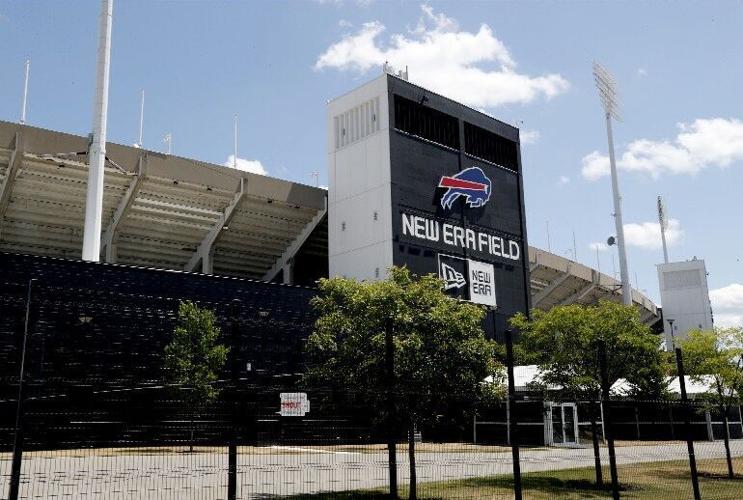
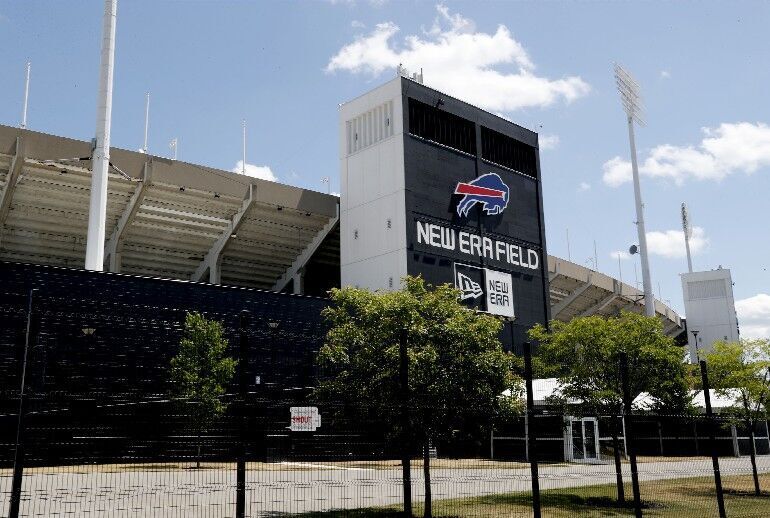
That’s the question these days around Orchard Park, where our old warhorse of a stadium is, once again, a horse with no name. We’ve been through this before. The new era of New Era Field is a lot like the old era of Rich Stadium: The fight over what to call it, in the early 1970s, was a dandy.
So while we wonder what comes next, here’s a look back at the names of stadiums that the Buffalo Bills have called home since their birth, in 1960.

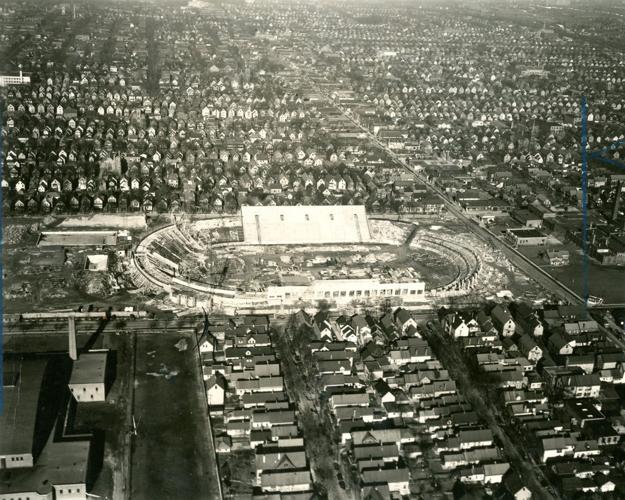
Dec. 22, 1936: Roesch Memorial Stadium under construction.
They played their early years at War Memorial Stadium — which, as Brock Yates wrote in Sports Illustrated, “looked as if whatever war it was a memorial to had been fought within its confines.”
People are also reading…
When it opened at Jefferson Avenue and Best Street, in 1937, it was called Roesch Memorial Stadium. Its namesake was Charles E. Roesch, a former mayor of Buffalo. You may know of his grandson, Charles W. Roesch — better known to beef on weck lovers as Charlie the Butcher.
That stadium was also briefly named for Grover Cleveland, another former mayor of Buffalo — and, not incidentally, a former president of the United States.
Photos: Remembering the Rockpile
Remembering the Rockpile

1938: Buffalo's Civic Stadium, much as it appeared a decade later, from the air.
Remembering the Rockpile

April 1, 1960: "Civic Stadium won't be ready for the start of the baseball season, but a second 'opening day' for the Bisons is scheduled May 16 when work is finished."
Remembering the Rockpile

May 21, 1960: "Civic Stadium, looking more and more like a baseball park: The outfield fence is now up, establishing the distances to all home-run barriers. Right field is, of course, the shortest, but that 30-foot-high screen (broken line) makes it a little tougher to put the ball into the stands. This view looks from the Jefferson Avenue end of stadium. Those are new field boxes along the first-base line."
Remembering the Rockpile

Aug. 5, 1961: "Pete Van Duleski looks toward where the first home run went out of stadium."
Remembering the Rockpile

May 9, 1962: An International League game in War Memorial Stadium.
Remembering the Rockpile

The old War Memorial Stadium, shown during a Bisons game: The last home in Buffalo itself to the Bills.
Remembering the Rockpile

Dec. 30, 1963: "The 33,044 in the Stadium Saturday, who now must wait till next year," reads the caption accompanying the photo.
Remembering the Rockpile

Oct. 23, 1964: "Steel rises 130 feet above Dodge Street for the 7,700-seat addition to War Memorial Stadium, which will increase its seating capacity to 43,000. The new high-level covered section will stretch from end zone to end zone."
Remembering the Rockpile

June 15, 1965: "The new $1.4 million section rising above War Memorial Stadium is 90 percent completed and is expected to be fully done by Aug. 1. Installation of seats, in progress today, will be finished in two or three weeks."
Remembering the Rockpile

Sept. 11, 1967: "Record 45,748 in War Memorial Stadium Sunday for Bills-Jets game: Another all-time record for professional football in Buffalo was set Sunday when 45,748 fans filled just about every square inch of War Memorial Stadium. This panoramic view was made by News Staff Photographer Richard W. Roeller, who made three separate negatives with a Nikon F. 35mm camera. The composite was made by News Chief Artist Barney Drees."
Remembering the Rockpile

Sept. 7, 1969: The stadium from the outside.
Remembering the Rockpile

Dec. 10, 1972: Fans bid farewell to the Rockpile at the Bills' final game in War Memorial Stadium.
Remembering the Rockpile

Dec. 10, 1972: Rowdy fans bring down a goal post at the end of the Buffalo Bills-Detroit Lions game. It was the Bills' last game in the Rockpile.
Remembering the Rockpile

Feb. 28, 1976: War Memorial Stadium.
Remembering the Rockpile

Feb. 28, 1976: "Memories of the Bills days linger at Gate 2 off Best Street."
Remembering the Rockpile

Sept. 9, 1989: "Ceremonial sledgehammers were working on tearing down War Memorial Stadium Thursday, but now wrecking balls and hackhammers are gnawing away at the Dodge Street entrance. The stadium will be torn down in a $5.9 million project and replaced with a new recreation complex."
Remembering the Rockpile

Oct. 4, 1989: "War Memorial's grandstands and field grudgingly yield to the wrecking crews."
Remembering the Rockpile

Oct. 4, 1989: "Officials walk through the only breach made so far in the Rockpile's tough wall."
Remembering the Rockpile

July 18, 1990: "A section of War Memorial Stadium stands forlornly amid rubble and inaction."
Remembering the Rockpile

July 10, 2014: The last remaining traces of the Rockpile can be seen in Johnnie B. Wiley Stadium.
Then, in the late 1930s, it was unimaginatively retitled Civic Stadium. That’s what it was called when the old Bills, of the All-America Football Conference, played there in the 1940s. It got the War Memorial moniker in 1960, when the new Bills, of the American Football league, began play there.
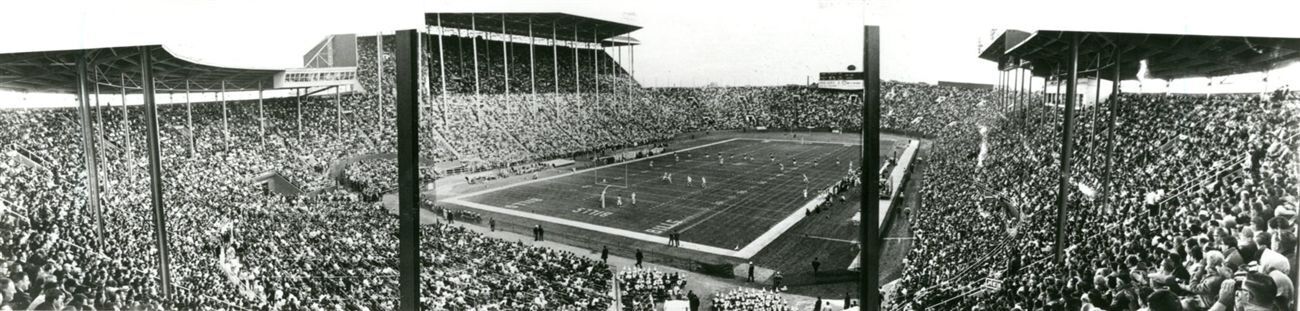
Sept. 11, 1967: "Record 45,748 in War Memorial Stadium Sunday for Bills-Jets game: Another all-time record for professional football in Buffalo was set Sunday when 45,748 fans filled just about every square inch of War Memorial Stadium. This panoramic view was made by News Staff Photographer Richard W. Roeller, who made three separate negatives with a Nikon F. 35mm camera. The composite was made by News Chief Artist Barney Drees."
Soon enough, though, fans began to call it, affectionately, the Old Rockpile. Those of us of a certain age still think of the stadium in Orchard Park as new. But here’s the thing: when the Bills left the Rockpile, after the 1972 season, it was only 35 years old. And now the field formerly known as New Era is ... 47 years old.
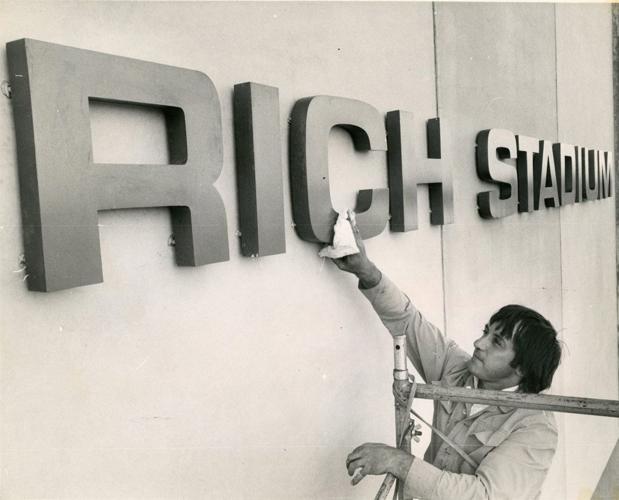
The fight over what to call it is even older. It began in the fall of 1972, when Rich Products Corp. stepped up to buy the naming rights from Erie County.
The notion of stadiums named for commercial entities is old news now, but it was a new era then. Schaefer Brewing Company — “Schaefer is the one beer to have when you’re having more than one” — acquired the naming rights for a new stadium, in 1971, in Foxborough, Mass., home of the newly renamed New England Patriots.
At first, Erie County had no takers for the naming rights. That’s when Rich Products offered $1 million over 10 years to call the place Coffee Rich Park, an homage to the company’s popular nondairy creamer. This seemed to augur headlines like: “Bills Cream Colts, 31-13.” (Note: actual score from Bills’ first season in new stadium.)
Robert E. Rich Jr., owner of the Buffalo Bisons, tells the tale of how Coffee Rich Park ended up as Rich Stadium in his 2011 book, “The Right Angle: Tales From a Sporting Life.” He says Bills owner Ralph C. Wilson Jr. agreed to Coffee Rich Park before objecting to it as “crass commercialism.”

The call on what to call it was up to the county, not the Bills, but the county and the company wanted the Bills to be happy with the name. Rich Products eventually changed its proposed name to Rich Stadium, while upping the ante to $1.5 million over 25 years.
“I can live with that name,” Wilson said at first. But then he found he couldn’t live with it — and told the county he would pay the same price to call it Buffalo Bills Stadium, while also asking for the right to resell the name if he so chose.
Later Wilson offered to pay the same price to call it Erie County Stadium, a name with about as much pizazz as Civic Stadium — though, to be fair, this was an era when the idea of commercial names on stadiums was still a novelty.
Steve Weller, wily sports columnist of The Buffalo Evening News, came up with several nifty names, including Schaefer Stadium; he called it the one stadium to have when you’re having more than one. His most inspired suggestion was for a particular coffee company: Chock Full o’ Nuts Stadium.
In the end, Erie County sold the rights to Rich Products — and Rich Stadium was born. But that isn’t the end of the story. The Bills proceeded to pretend the name didn’t exist. They called their home field “Orchard Park Stadium” on tickets and in media guides.
So Rich Products sued the Bills for tortious interference, which sounds more complex than pass interference. Depositions were taken, and the case appeared headed for court when, suddenly, it was settled. Rich writes in his book about how that happened. He says his father, Robert E. Rich Sr., sat down with Wilson — just the two of them — to talk about the suit.
“Here I have to rely on my father’s account,” Rich writes. “My father told him that the lawsuit could go away. All he had to do was to agree to use the stadium name on tickets and programs and not influence others not to use it.
“ ‘That’s all?’ Wilson asked.
“ ‘That’s all,’ Dad answered.”
Wilson, according to the book, then said he would get attorneys to draft something; Rich said there was no need — that Wilson’s word was enough. “The two generals shook hands, and so ended the Battle of Orchard Park.”
That’s a remarkable moment, as the stadium would be named for those two men — first for Rich’s company, then for Wilson himself — for more than four decades.
Here’s how Rich Stadium became Ralph Wilson Stadium: The Bills’ lease expired in 1998, at the same time as the deal on naming rights. And in renegotiating their lease, the Bills asked for and won future naming rights.
Which brings us to today. New Era is old hat. And now something new will take its place.
What’s in a name? Well, Juliet, when it comes to stadiums, the answer is millions of dollars. So you probably can’t afford to name our stadium for your boyfriend.
But maybe Alfa Romeo can.