
GUATEMALA CITY — Every 100th baby born in Guatemala grows up as an adopted American, making the Central American country the richest source of adoptees in the Western Hemisphere. But U.S. ratification of an international adoption treaty is likely to choke off the supply next summer.
Critics say Guatemala has become a baby farm where adoptions are too easy and prone to corruption. Defenders say it offers the children a better future and that legal corners are cut only to spare Guatemalan women the stigma of unwed motherhood or relieve them of another mouth to feed.
For now, willing parents can get Guatemalan babies by paying thousands of dollars to notaries who act as baby brokers, recruiting birth mothers, handling all the paperwork and completing the job in less than half the time it takes elsewhere.
The process is so streamlined that Guatemala outpaces all other countries in the percentage of its children put up for adoption in the United States.
People are also reading…
All this will likely end once the Hague Convention on Intercountry Adoptions takes effect in the United States. The U.S. will then require all foreign adoptions to meet tougher international standards, which Guatemala ratified in 2003 but has yet to implement.
"We don't want adoptions to stop, but we believe the current system does not provide enough protection to the child's needs," said John Lowell, the U.S. consul in Guatemala.
The treaty, also ratified by China, Russia and at least 39 other countries, aims to protect children, birth parents and adoptive parents from abuse, in part by requiring a government agency to regulate adoptions.
Guatemala still allows adoptions to be managed privately, without judicial approval. In many other countries, adoptions take more than a year. Guatemala can deliver children in as little as five months.
Berta Morales, 35, has given the last five of her 10 children to Americans.
"It would have been more of a sin to abort them," said Morales, who lives in Coatepeque, west of Guatemala City. "I'm poor ... but maybe one of them will become a professional."
Morales said she was paid only bus fare to Guatemala City, the capital, to sign the papers.
But Josefina Arellano, who directs the government office that ultimately approves each adoption, says women who give up multiple children in a row are probably getting paid.
"When you look at the time between pregnancies and how many children they have given up, you have to conclude they are doing it for money," she said. "What we're witnessing is a baby factory or farm, dealing with children that should not have been born or put up for adoption."
Susana Luarca, a notaries' association lawyer, also denied mothers are doing it for money. "What more help could they get," she asked, "than relieving them of the problem of their child's situation?"
Every profession has unscrupulous people, "but that does not mean everything is rotten," added Luarca, who is currently handling 40 adoptions. "Some people have tried to make the case that, just because a business is lucrative, it's bad."
It is lucrative: Notaries charge a "country fee" of up to $19,000. With U.S. paperwork and plane trips, the typical Guatemalan adoption costs as much as $30,000, adoption agencies say.
But in the last six months alone, the government has brought 30 criminal cases against notaries for falsifying paperwork, allegedly providing false birth certificates and even creating false identities to avoid having to involve the birth father or the parents of underage birth mothers.
Applications are surging as parents rush to take advantage of the current process, which will apply to any request filed before the treaty takes effect. Of the 4,100 cases pending in Arellano's office, more than 3,000 were filed this year.
Defenders say most adoptees are delivered from poverty into loving homes. "There are opportunities that a child could have in education, exposure to cultures, resources that they may not otherwise have had," said Megan Hendy, who directs the Joint Council for International Children Services, representing more than 200 international adoption agencies in 51 countries.
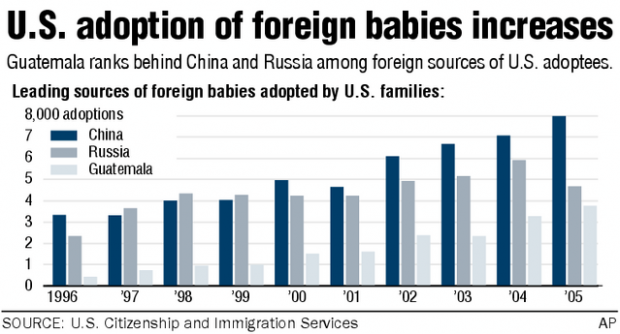
Americans have adopted 17,863 Guatemalan children in the last nine years, French couples 1,440 and Guatemalans 576. Americans adopted 3,748 Gua-temalan babies born last year.
Guatemala ranks behind China and Russia among foreign sources of U.S. adoptees, according to the U.S. Citizenship and Immigration Services.
But the 7,939 Chinese babies adopted by U.S. couples last year represented just 0.04 percent of that country's 17.3 million births, and the 4,652 Russian adoptees were 0.3 percent of Russia's births, while Guatemala's figure is 1 percent.
"Some people have tried to make the case that, just because it's lucrative, it's bad."
Susana Luarca
Notaries' lawyer



 Historic bank vault now new Tucson speakeasy