

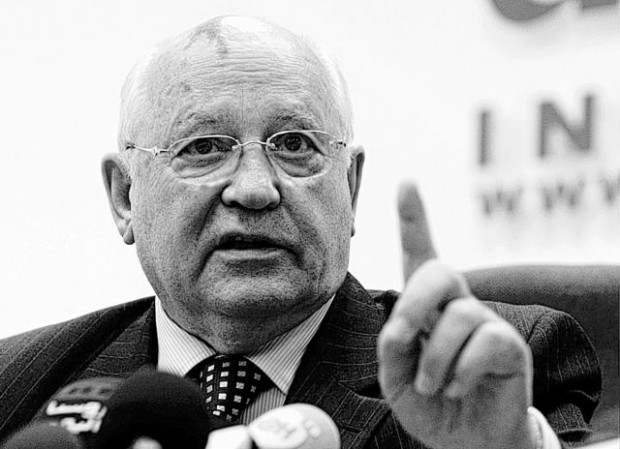
MOSCOW — Former President Mikhail Gorbachev said Friday that the fall of the Soviet Union, which he helped bring about, ushered in an era of U.S. imperialism responsible for many of the world's gravest problems.
Gorbachev is lauded in the West for bringing democratic reforms but widely despised in Russia for paving the way to the economic free-for-all of the 1990s, which brought fabulous wealth for a well-connected few while plunging much of the country into humiliating poverty.
He has since become a supporter of President Vladimir Putin's assertive foreign policy and resistance to American power — calling occasional news conferences to praise Putin's policies — but his criticism of the United States on Friday was especially harsh.
"The Americans want so much to be the winners. The fact that they are sick with this illness, this winners' complex, is the main reason why everything in the world is so confused and so complicated," he told the packed news conference.
People are also reading…
Instead of ushering in a new era of cooperation with the West, the Soviet Union's collapse put the United States into an aggressive, empire-building mood, the former leader said. Ultimately, he said, that has led the U.S. to commit a string of "major strategic mistakes."
"The idea of a new empire, of sole leadership, was born," Gorbachev said.
"Unilateral actions and wars followed," he added, saying that Washington "ignored the Security Council, international law and the will of their own people."
Gorbachev, 76, shared Putin's strong opposition to the U.S. war in Iraq.
Russia has fallen out with Washington on a host of other issues, pushing relations to a frosty state that some commentators have likened to the Cold War.
The Kremlin says the Bush administration's plans for a missile-defense system in Eastern Europe to guard against Iranian and North Korean missiles could spark a new arms race. It has refused to back Washington's draft Security Council resolution on Kosovo's independence and has suspended its participation in a key treaty on arms reduction in Europe.
Gorbachev, who won the 1990 Nobel Peace Prize for his role in ending the Cold War, echoed Putin's frequent endorsement of a so-called "multipolar world," without the perceived dominance of the United States.
"No one, no single center, can today command the world. No single group of countries … can do it," Gorbachev said.


 Tucson's newest Shake Shack gets neighbors


