

ATLANTA — A federal study of an X-ray alternative to the dreaded colonoscopy confirms its effectiveness at spotting most cancers, although it was far from perfect.
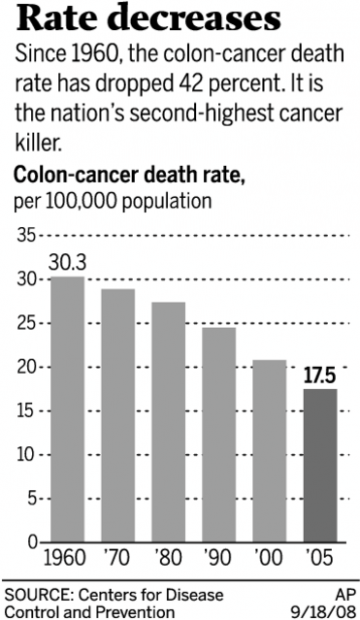
Medicare is already considering paying for this cheaper, less intrusive option that could persuade more people to get screened for colon cancer. And some experts believe the new method may boost the 50 percent screening rate for a cancer that is the country's second-biggest killer.
"We're talking about for the first time really screening the population," said Dr. Carl Jaffe, an imaging expert at the National Cancer Institute who was not involved in the research.
In the new study, the largest of its kind, the so-called "virtual colonoscopy" identified nine out of 10 people who had cancers and large growths seen by regular colonoscopies.
But there were flaws, too. Among them: The radiologists sometimes misread the X-ray, leading them to spot polyps that weren't there. That led to unnecessary follow-up testing.
People are also reading…
The X-ray test's real value may be in showing who really needs a colonoscopy — it was better at ruling cancer out than it was at detecting it, suggests the report in today's New England Journal of Medicine.
Colorectal cancer will claim about 50,000 lives this year. The point of screening, widely recommended at age 50, is to find growths before they turn cancerous.
The gold standard is colonoscopy, in which a thin tube equipped with a small video camera is snaked through the large intestine to view the lining. Any growth can be removed during the procedure. It involves sedation and a missed day of work, not to mention preparation that uses pills or liquids to clean out the bowel.
The study focused on CT colonography, also known as virtual colonoscopy. It's an X-ray of the colon that is cheaper and easier on the patient than traditional colonoscopies. It also requires the bowel clean-out and has a potentially serious drawback — radiation.
Colonoscopies cost up to $3,000. The X-ray test costs $300 to $800; most insurers don't cover it so far, but Medicare is considering it.
Some drawbacks to virtual colonoscopy:
● In about one in six of the patients, the X-ray found abnormalities outside the colon that led doctors to recommend additional testing or care. Some of those discoveries may be life-threatening, but others are not and investigation of them may prove expensive.
● The X-ray tests are not as good at colonoscopy at detecting flat growths on the colon wall that are more likely to be cancerous than the more familiar knobby polyps.
● Virtual colonoscopies, currently recommended every five years, expose people to repeated doses of radiation. It's half the dose of a standard CT exam, but the cumulative effects are not yet known. Colonoscopy is recommended every 10 years.


