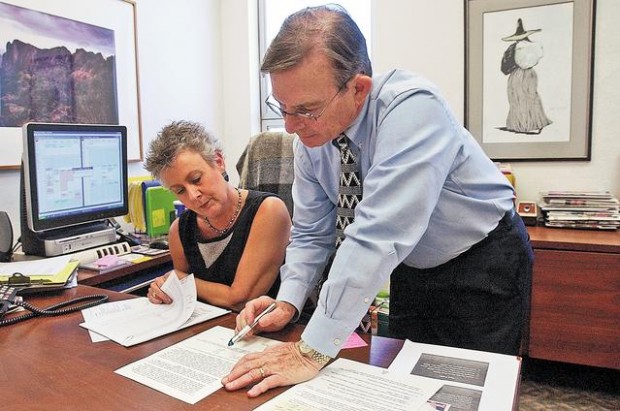
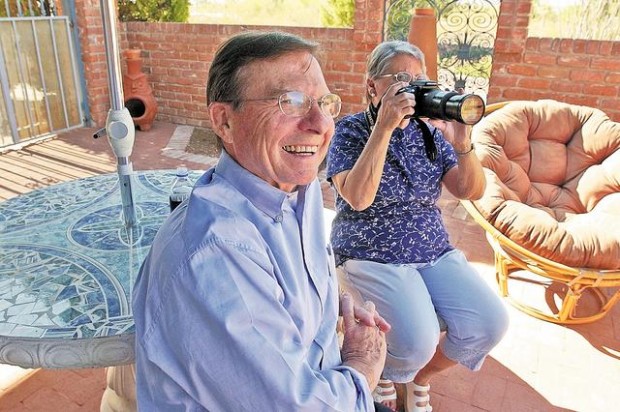
A fierce competitor from childhood, Peter Likins chooses a different trait to define his Arizona years — wisdom.
Arriving to lead the UA in 1997 after 15 years as president of Lehigh University, Likins had already exceeded the ambitions of the small-town boy who graduated high school at 16.
His quick-rising career, first as a rocket scientist and professor and later as a dean and provost, brought him to Lehigh at age 45, where he learned to manage a university's complexities and developed stronger notions of public service.
"All my life since my earliest childhood memories, I've been a hard-driving, striving person," Likins says. "I'm at a stage of life now in which I'm not competing any more. When I try to accomplish certain goals for the university … they're goals for the other people I'm here to serve, and that's been characteristic of my Arizona years."
People are also reading…
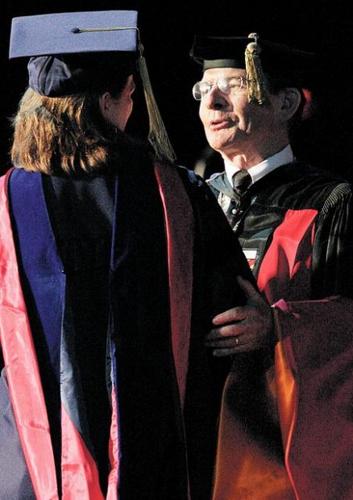
Likins retires on Friday after nine years as president of the University of Arizona, the last stop in a career he calls "incomprehensible."
College was far from a sure thing for the Tracy, Calif., native until he received a scholarship to Stanford University. Studying civil engineering, he envisioned a career working on bridges and other construction projects. In the summers, he was a road-crew laborer.
"That was a big deal for me, to go to college," he says. "Never, ever, did I imagine graduate school, let alone being a professor or a dean or a president. It was outside the reach of my imagination."
Likins is fond of telling incoming freshmen of struggles early in his own college career, facing the perfect storm of classwork he felt was over his head, poor quiz scores, arguments with his girlfriend and an uphill battle to make the wrestling team.
The message of perseverance is clear. In the end, as he tells the story, he "passed the class, made the team and married the girl."
Likins' years as UA president have been filled with rough patches as well, including a rocky start with student protesters, navigating a fundamental shift in the university's mission and enduring never-ending financial struggles.
But in the end, Likins can say he raised the $1.2 billion, built the new student union, weathered the state-mandated budget cuts, brought "focused excellence" to the university, laid the groundwork for a new UA medical school in Phoenix, improved student retention and increased campus diversity.
"One of the things I appreciate about him most was his coolness under fire," says Regent Jack Jewett. "As he was confronting a very difficult situation, he just had this ability to really steel himself to manage with a great deal of confidence and get through almost anything that could confront a university president."
Provost George Davis remembers Likins' inauguration speech in 1997, with a white-water river analogy describing difficulties on the horizon.
"He was basically announcing to the university that his leadership would be marked by direct acceptance and confrontation of those forces that are challenging higher education at this time. He demonstrated right away that he's not into reality denial," Davis says.
Likins' impact on the student body was immediate. Less than six months into his presidency, with protests against the university's Nike contract escalating and a contentious debate over a proposed fee for a new student union, the campus newspaper published an editorial headlined "Peter Likins — Arizona's new radical?"
He was described as a principled leader and a breath of fresh air for commenting freely on the university system's failings and a willingness to engage students in impromptu discussions.
"Students had been used to a different form of administrative leadership," says Student Regent Ben Graff, a recent UA law graduate who was a freshman during Likins' first semester. "Likins' predecessors were an accessible presence, but I don't think they had gotten down in the trenches as much as Likins did in the beginning."
When Students Against Sweatshops protesters took over Likins' office lobby in April 1999, he didn't boot them out or threaten arrest, instead engaging and negotiating.
"In general I try to respond to a crisis not by asking myself what people expect of me, but by asking myself what I expect out of myself. With the sit-in, I could've dithered, but that would be paralyzing," says Likins, who acknowledges some tense exchanges with the students. "I admired these kids. In general, their tone was civil and their cause was noble."
Likins was front-page campus news regularly during his first semester, including once just for showing up to a student Senate meeting.
"That was something brand new then," Graff says. "The president of the university in the last 10 years hadn't attended a student senate meeting. Those visits played out in a lot of direct results."
In one meeting, student parents and their children were lobbying for an increased child-care subsidy and Likins diverted from his own comments to pledge, on the spot, to help.
"Right away, students felt and other members of the community felt they had on some level a partnership with the university, with President Likins," Graff says.
"A teacher at heart"
In one corner of Likins' seventh-floor office is the barrier arm from a parking garage exit, signed by Lehigh colleagues as a going-away present.
The garage was closed on a weekend when someone needed to get out and campus police weren't available, so Likins kicked the barrier down, says Patti Ota, a former Lehigh professor and administrator who's now the UA's vice president for enrollment management.
"I've always said there are probably university presidents out there who may be as good, but certainly none who are better," she says. "I've never met anyone who I think is smarter than he is, but attached with the incredible intelligence is compassion."
Ota also remembers when a Lehigh football player who was being kicked out of school for failing academically pleaded with Likins for another chance, so he wouldn't have to return to his rough Philadelphia neighborhood. Likins asked the player if he was truly serious about coming back to school, then wrote a personal check to cover summer tuition.
"When he handed Richie the check, I'll never forget he said, 'It's not a loan, it's a gift, with the understanding that at some point in your life you'll help somebody out like I'm helping you out.' "
Likins has cherished deep personal relationships with students throughout his career, most visibly here with Shawntinice Polk, the late basketball star raised in the same part of California as Likins.
"I get that kind of chance connection with individual students and they matter to me for a lifetime," he said. "I'm put together in such a way that the students are always central to my life experience, at Lehigh, or Columbia, or UCLA or Arizona. After all, I'm a teacher at heart."
"Thoughtful and progressive"
When the Board of Regents gave Likins a large pay raise four years ago to match more closely the salary of Arizona State University's incoming president, he was embarrassed to accept the money at a time of layoffs and program cuts.
"What I said then is that I'll take a $60,000-a-year raise and I'll give it all back," Likins said. "Coming out of high school, I had no assurance I would go to college. … I've felt all my life that youngsters of limited financial means who have the talent and have the ambition somehow have to be funded."
Year after year, Likins has personally given to minority scholarships and summer programs to ease the transition for low-income freshmen.
"His soft spot is for the people who have the greatest challenges to overcome," said Lynette Cook-Francis, assistant vice president for multicultural affairs and student success. "He's a thoughtful and progressive person at a time when that's what we really needed."
John Munger, an attorney who was president of the Board of Regents and chairman of the search committee when Likins was selected, said Likins was "absolutely the right man for job," someone who could counter the political and economic power in Phoenix.
"He has been able to work with the Legislature in a way that few presidents have been able to do," Munger said. "He doesn't view the university as an isolated entity. He views the university as a major asset for the entire state."
Likins led the UA through a period of deep financial stress, restructuring the university with an unprecedented emphasis on private fund-raising and larger tuition increases as state funding dwindled.
"Nobody can be all things to all people. Peter Likins was not exempt from that," said Wanda Howell, a nutritional-sciences professor and chair of the faculty. "But he was absolutely the right man at the right time."
Howell said Likins is characterized by his impressive talent for extemporaneous speaking, which he can apply to virtually topic or setting.
"He really truly does have a gift of being able to organize his thoughts in a way that few of us can on the spot," she said.
Likins sees a bright future for the university and calls his successor, Robert Shelton, "exactly the right person to assume this presidency."
"I think Arizona is still very young in its development of its own potential and its future. In some sense, it has not grasped its own potential to be a nationally distinguished research university," he said. "But it has to be a place that works for men and women. It has to be a place that works for black and brown or white. It has to be that kind of institution or it will never realize its full potential."
Likins is leaving the university less than three months after emergency heart surgery, an experience he says made all his relationships — and life itself — seem more precious.
"We all know we're going to die, but we don't know that inside our gut in the way that I know it now. … I understand in a very deep way now how important it is to be loved by the people around you, whether it's family or friends," he said. "What I accomplish with budgets and buildings is less important, has always been less important, to me than what I accomplish with people."
Welcoming retirement
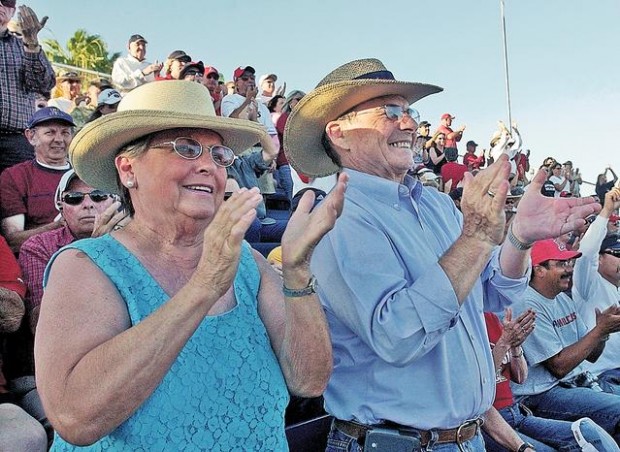
Likins says it's finally time for no responsibilities, time to take walks with his wife of 50 years, Pat, and to decompress.
"I want some time with my wife to do nothing at all, except hold her hand."
Most university presidents leave by death or dismissal, carried or run out of town, Likins says, proud to finish on his own terms.
"I was always trying somehow to demonstrate my worth, trying to overcome my insecurities, trying to do better than anybody else," Likins says. "But now I'm at an age, a stage of life, in which I can say I've run a good race. Whatever the hell I was trying to prove as a kid, I have to say I proved.
"I know I've given my best, for a lifetime, and that's good enough."
On StarNet: Watch an audio slide show as Likins discusses his career at Arizona and his future at www.azstarnet.com/metro