Ten months after the White House sent a higher education compact to universities listing political and ideological demands in exchange for preferential research funding, U.S. Education Secretary Linda McMahon is making a second push to get universities to publicly commit to Trump administration goals.
University of Arizona President Suresh Garimella said he will consult key stakeholders, including faculty groups and leaders, to prepare his response after receiving McMahon's “national call to action” letter sent to universities across the U.S. Monday.
Garimella added that the UA's “unwavering” commitment as the state’s land-grant university is to serve Arizona’s and the nation’s interests.
Unlike the compact last year, McMahon's letter did not prescribe any rewards or penalties. But it said universities have until the end of 2026 to publicly describe on their websites their commitment to “rigorous teaching, pathbreaking research, and national service."
People are also reading…

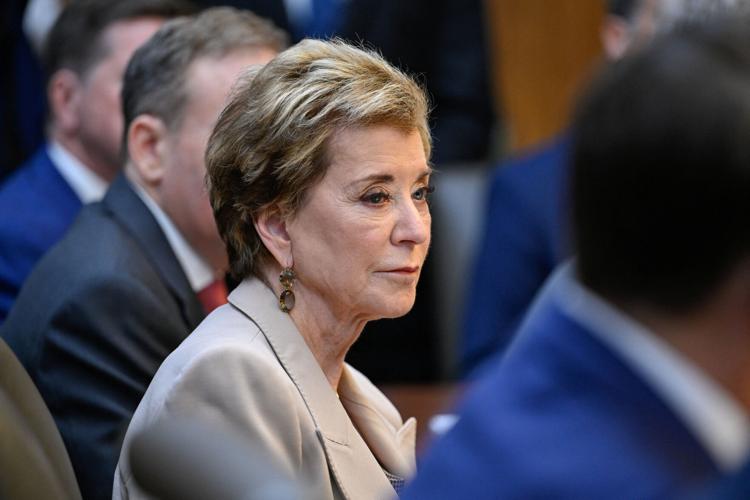
U.S. Secretary of Education Linda McMahon.
McMahon’s letter lists a series of questions for universities to answer about issues including admissions without what she calls “illegal discrimination;” free speech and open debate without “unruly and violent protestors” disrupting classes; “intellectual pluralism” and truth-seeking without disciplines leaning toward one side of the ideological spectrum; accessible and affordable higher education; prioritizing rigor and excellence in the age of artificial intelligence; and protecting academic programs and integrity of research from “foreign influence.”
McMahon also asked universities to address how their campuses and faculty can “advance American security interests, deliver academic programs that meet urgent workforce needs, and contribute materially to the Nation’s prosperity.”
“ ... As higher education has drifted from the principles that built up so much public esteem, Americans’ trust in universities has reached record lows,” McMahon wrote.
She said that for the “good of the Nation,” university leaders must enact reforms, which she said some have already started by “adopting positions of institutional neutrality and improving policies related to campus protests.”
In response Monday, Garimella wrote to the UA community and issued a news release, saying the UA “continues to play a leadership role on many critical national imperatives, including artificial intelligence, space sciences, mining and critical minerals, fusion energy, and the future of healthcare, all while supporting our national security.”
Garimella also encouraged university members to read his letter to the White House last fall in response to the “Compact for Academic Excellence in Higher Education,” in which he declined the Trump administration’s pact to get preferential access to federal research funding.
The compact was first sent to nine universities including the UA. While universities would have gotten preferential access to research funds if they signed onto it, the White House also contended those that didn't sign would lose federal benefits.
None of the nine universities signed onto the compact.
In declining to sign, Garimella wrote to McMahon on Oct. 20, 2025, saying, “A federal research funding system based on anything other than merit would weaken the world’s preeminent engine for innovation, advancement of technology, and solutions to many of our nation’s most profound challenges. We seek no special treatment and believe in our ability to compete for federally funded research strictly on merit.”
He also included a “Statement of Principles” in his response, which he stated the UA’s commitment to values including: fair admissions; equal treatment and non-discrimination; freedom of expression and civil discourse; financial affordability; and foreign engagements, international enrollment, and research security.

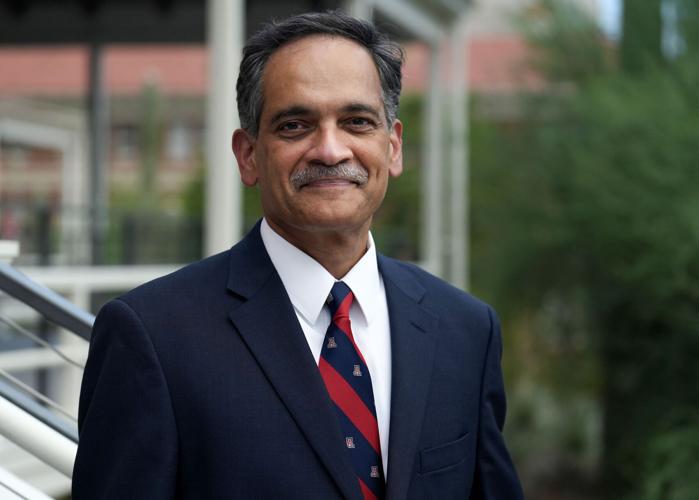
UA President Suresh Garimella
UA spokesperson Mitch Zak said the university had no additional information to share beyond Garimella’s communication Monday. Zak did not respond to the Star’s request for an interview with Garimella.
ASU President Michael Crow told the Star Monday in an email, “With this call to action, (universities) now have a significant opportunity to respond in ways that will enhance American economic and competitive success, while addressing some of the concerns that have become matters of significant public debate. Arizona State University is, and will remain, committed to being a national service university that strengthens American resilience, competitiveness and defense.”
NAU President José Luis Cruz Rivera didn’t immediately respond to the Star’s request for comment.
Megan Gilbertson, associate vice president of public affairs for the Arizona Board of Regents, which oversees the state’s three public universities, didn’t immediately respond to a request for comment.
'The devil is in the detail'
UA Chair of the Faculty Leila Hudson said introspection is fine but it’s important to not undermine the dynamics that made higher education in America great.
“We cannot curtail free inquiry, free expression, free exchange of ideas in pursuit of short-term or highly partisan political goals. That would be absolutely counterproductive,” Hudson told the Star Monday. “The paramount concern of affordability of higher education — it’s very good to see that recognized — but again, to prescribe or pre-select techniques across the board that should apply to any and all institutions is not the way to go. That limits creative approaches that might be taken by different institutions that have different priorities and serve different populations.”
Timothy Finan, a UA professor emeritus of anthropology who has been involved in UA research projects, said the call-to-action letter proposes objectives that “all of us can mostly agree with in principle” but that the “devil is in the detail” in how they’re used in concrete policies and actions.
Finan questioned if merit-based admissions means only evaluating students based on their test scores or grade point averages or if factors such as background, past experiences and personal statements are to be considered “merit.” He questioned if “intellectual plurality” is defined as representatives from a range of political positions, and argued that it’s actually achieved through “the diversity of the faculty and student body, including racial, ethnic, gender, etc. diversity.”
“In each of the proposed principles of the call-to-action, I fear an implicit agenda that would severely limit university decision-making and independence, including academic freedom as we understand it,” Finan told the Star Monday.
“I particularly suspect the last: Prioritizing American Interests,” he continued. “Who is positioned to define what those interests are? For example, the current stance of the government regarding environmental issues and climate change is one of rejection. Does the ignoring of climate change, diversity and equality serve American interests? I think not.”
Similarities of compact, new letter
The fall 2025 compact as well as the call-to-action letter sent Monday have certain overlapping Trump administration priorities.
One similarity is the call for equality and fairness in admissions, where in the call-to-action letter, McMahon says non-transparency of university admissions has caused “allegations of favoritism, unjust outcomes, and illegal discrimination” over the years.
She asked how universities will ensure their admissions criteria are “transparent and wholly described to prospective applicants,” and how they will ensure that admissions decisions are based on merit, achievement and the university’s educational purpose.
In his “Statement of Principles” in response to the compact, Garimella said the UA posts its admissions criteria and processes on the website and explicitly prohibits discrimination based on “race, color, religion, sex, national origin, age, disability, veteran status, sexual orientation, gender identity, and genetic information.”
The compact and the letter both ask universities to nurture a thriving marketplace of ideas through free speech and open debate. McMahon asked Monday how they will “protect the free exchange of ideas, wide-ranging debate, and open-minded campus discourse,” and make sure that “unruly and violent protestors do not harass students or disrupt classes, research, public lectures, and campus operations.”
To this, Garimella said last fall that the UA doesn’t “allow disruptions, intimidation, or vandalism that stifles speech, instruction, or participation in campus life,” has adopted the University of Chicago’s principles on freedom of expression, and holds a “Green” rating in the College Free Speech Rankings published by the Foundation for Individual Rights and Expression.
The compact and McMahon’s Monday letter also ask universities to make sure their institutions are offering affordable and accessible education. McMahon said the price of certain postsecondary degrees is out of reach for many American families, and the rates of student attrition and student loan defaults are too high. She said schools should be transparent about the ground value their degrees provide and should try to offer education that fosters employment.
Garimella said in his “Statement of Principles” that the UA will continue pinching administrative costs, also noting the university didn’t raise in-state tuition rates in the 2025-26 academic year.
Finally, both the compact and the letter said universities must safeguard against foreign collaborations, with McMahon saying this week that universities need to make sure their research enterprise is focused on advancing U.S. interests and not the interests of “our adversaries.” She said this can be done “by refusing gifts with problematic conditions and ensuring that foreign actors do not unduly influence academic programming, research personnel, researcher assignments, or student admissions.”
“Institutions must also ensure that malign foreign actors do not gain access to sensitive research or technology,” McMahon said.
To this, Garimella said last fall that the UA “values the rich contributions of international faculty, staff, and students who provide numerous intellectual and cultural contributions.” “The University also recognizes potential risks with certain foreign engagements and research security concerns and will continue to comply with applicable and lawful obligations and requirements of the federal government,” he wrote.
The call-to-action included a section on making sure the politicization of certain humanities disciplines doesn’t occur, saying when disciplines lean towards one side of the ideological spectrum, “the truth-seeking function of the university suffers and public trust declines.” McMahon asked how universities will encourage “intellectual pluralism” in all academic units and ensure that all relevant perspectives are taken seriously.
It also included a section on how universities will maintain the rigor and excellence of teaching and learning in education in the current age of AI, since McMahon said AI has “upended traditional methods of teaching and assessing student learning.”
Get your morning recap of today's local news and read the full stories here: tucne.ws/morning
Reporter Prerana Sannappanavar covers higher education for the Arizona Daily Star and Tucson.com. Contact her at psannappa1@tucson.com or DM her on Twitter.

Prerana Sannappanavar
Higher Education Reporter


 U of A’s fall enrollment down more than 20%, sources say