


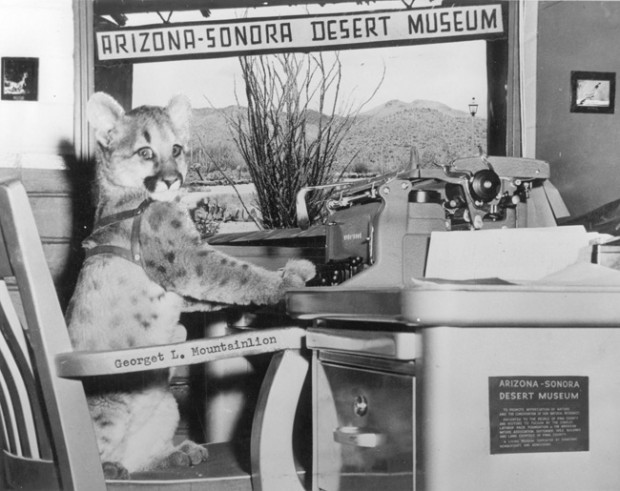
The Arizona-Sonora Desert Museum's resident mountain lion and newspaper columnist, George L. Mountainlion, was so popular that his public was a bit traumatized when he fell ill.
Elsie, his intended mate, had died in December, 1954, of a combination of gastritis and enteritis. In February, 1955, George became critically ill with the same ailment.
The Arizona Daily Star ran frequent updates on George's condition. From the Star, Feb. 12, 1955:
Mountain Lion's Condition Same
The condition of George L. Mountainlion ramains unchanged, and the popular Arizona-Sonora Desert museum animal, stricken with a liver inflamation last week, has a 50-50 chance to live, musuem officials reported last night.
Officials also reported, however, that the lion's slight fever has stopped and the infection give no signs of spreading further.
George is eating a little venison, milk and egg each day.
People are also reading…
Two days later, it was reported that his condition was improving, but over the next several weeks, headlines indicated that museum officials didn't have much hope. Star headlines included "Mountain Lion Not Expected To Live" and "Famed Lion Clings To Life."
George received letters from all over wishing him a speedy recovery. From the Star, March 3, 1955:
Fans of George L. Mountainlion From U.S., Mex. Show Concern
Museum Pet Receives Sympathetic Notes
By BERNIE ROTH
George L. Mountainlion was purring contentedly as he lay in his cage yesterday.
A veterinarian was selecting letters from a tremendous pile and reading them to his patient. And George took a hand in the matter occasionally to read the letters himself.
It's unusual for a mountainlion to receive mail, but George L. Mountainlion is a most unusual animal.
The four-year-old cat's popularity started when he becamse the number one attraction at the Arizona-Sonora desert museum. Then his fame spread as he became a Sunday "columnist" in the Arizona Daily Star.
Through his "ghost-written" column George's fame spread across the country and into Mexico.
Now George is a sick lion. His veterinarian says George is a very sick lion with less than a 50-50 chance of surviving.
When George's illness was reported, cards from well-wishers started coming to the musuem addressed to "George," and as his condition grew worse the volume of his mail developed into a steady stream of notes, suggestions and best wishes from all over the country.
Letters are coming from youngsters not yet in school, entire classes of school children have made George's well-being class projects, grown-ups are adding their best wishes, and even other members of the animal kingdom have sent along notes of hope to George.
In fact, it was a letter from two ordinary house cats that seemed to make George rally for a while.
This is what cats Spunky and Tiny Fraser had to say to George:
"Dear George:
"We know that you are a big, outdoor cat and that we are plain little old house cats, but we think we know why you are feeling so poorly.
"You see, every morning when our family gets up they let us cats out and the first thing we do is run for the sand pile, where we have a good time digging. Next, we roll and stretch in the dirt, then we stroll over to the garden patch where we have a choice of grass, clover, catnip or weeds to chew on.
"After more playing we find out what condition our stomachs are in because the green stuff either stays down — meaning all is well — or it comes up bringing fur balls, or whatever else is troubling us, with it.
"Then we know we are ready for breakfast, so off to the house we race and, golly catnip, what a meal we can eat."
And the nice lady from Castewood, R.I., also sent a note that cheered George.
"I was a visitor in your wonderful city recently and we visited you at the museum. Since my return home my son has been sending me the articles you write for the Star and I do love to read those articles very much. I know that of all the animals at the museum, you are the grandest of them all and I hope you will soon be well and strong again."
On March 8, 1955, shortly after 3:30 p.m., "a valiant 10-week battle for life ended ... for George L. Mountainlion."
George was buried at the Desert Museum in a plot across the path from his former home. "George Day" was proclaimed and a monument of native stone was erected in his memory.
George was important enough to the museum that his cage could not go empty for long. From the Star, March 28, 1955:
George Mountainlion II Arrives At New Home
George Mountainlion II arrived in his new home at the Arizona-Sonora Desert museum yesterdaay after a three-day trip from Berkeley, Calif.
The 2 1/2-year-old successor to George L. Mountainlion I, a famous Arizona personality who died March 8, was quiet and appeared in perfect condition as he arrived at his Tucson Mountain park abode.
Weighing 125 pounds and standing about two feet high, George II is more than six feet long. Two large, clear, grey eyes casually inspected everything about him at his new home.
Lew Walker, associate director of the Arizona-Sonora museum, brought the young lion toi Tucson from California. En route the big cat shredded a wool bathrobe, But Walker still called him the tamest mountainlion he has ever seen.
A few miles west of Eloy, George slipped his chain and crawled into the front seat of the station wagon with Walker.
"For a while there I didn't know who was going to drive," the tanned naturalist commented dryly.
The Morgue Lady will have to do some more research to find out of George II learned how to read and write as well as his predecessor. It seems he already knew how to drive.


