

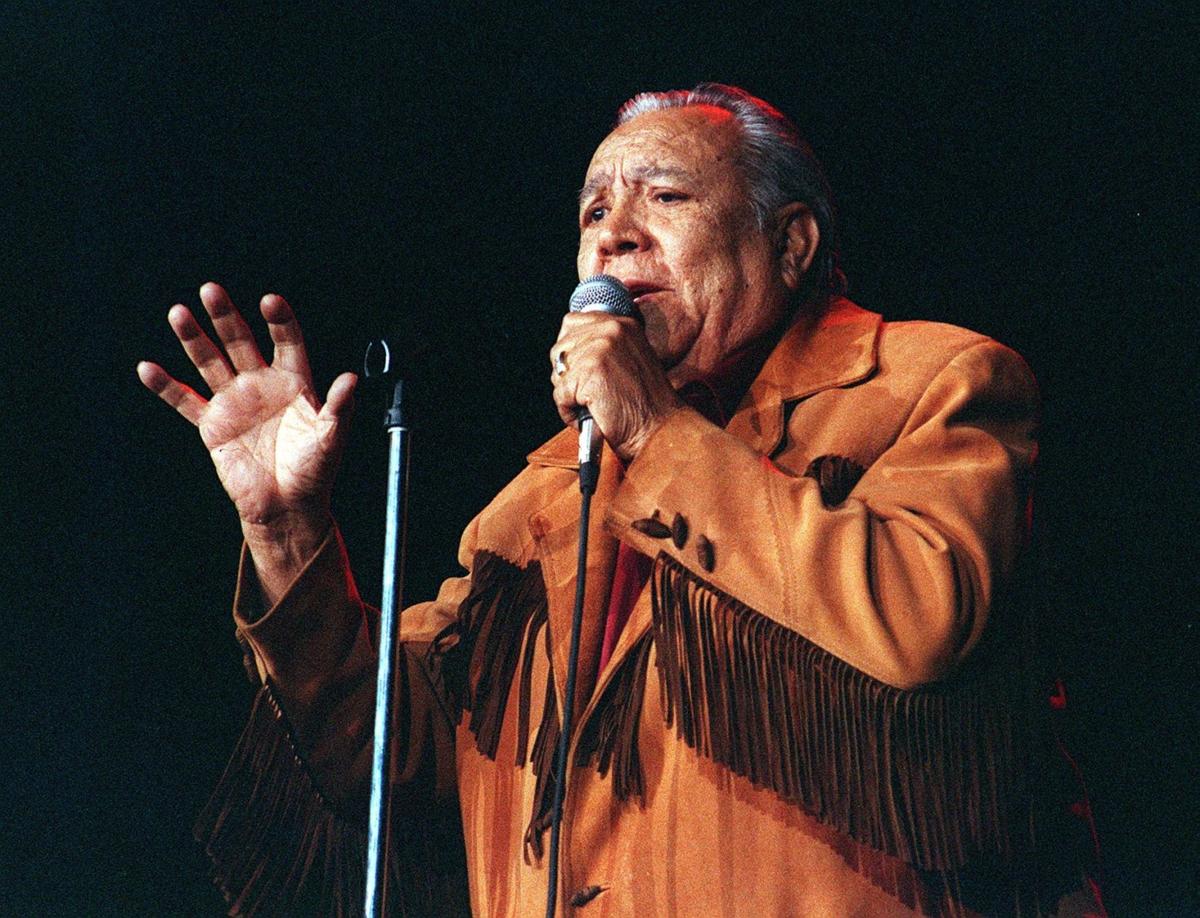
Lalo Guerrero was a huge influence on the Latin music scene, entertaining from the time he was a child. He also had a healthy sense of humor.
From the Arizona Daily Star, Oct. 6, 1978:
Sense of humor earns fame, fortune for Guerrero
By Pat Moran Benton
The Arizona Daily Star
Lalo Guerrero's baritone hummed over the telephone.
"I left my car in San Francisco. High on a hill, it's stranded there."
"I've always had a flair for comedy," interjected Guerrero, a pioneer in Mexican-American music and former Tucsonan who left town a long time ago to seek his fame and fortune. He found it in his sense of humor.
The affable Guerrero's parodies are well known. Who can forget "Pancho Lopez," a takeoff on "Davy Crockett"? Or "Sexteen Pounds — The Housewife's Lament"? Or "Tacos for Two"? Or what has become the Old Pueblo's Christmas standard, "Pancho Claus," Guerrero's funny border version of "The Night Before Christmas (A Visit From St. Nicholas)"?
Guerrero returns to Tucson tonight to appear at the Tucson Meet Yourself Festival at El Presidio Park, downtown. Festivities start at 7 and Guerrero is scheduled to appear about 9.
"Ethnic humor, to me — be it black or Mexican or Jewish — I just have a tremendous sense of humor. I don't mean to be immodest but I find humor in everything," he said.
"I hear a song and immediately to counter to it pops into my mind. It doesn't have to be ethnic. It can be any song."
Yet, despite the fame and money his parodies have brought him, Guerrero says that today he would hesitate to write "Pancho Lopez."
"I received a lot of criticism for that one," he said. "At the time I wrote it, there was no such thing as the Chicano movement. If I did it today, I'd probably get hung.
"But I don't think of it as being derogatory. I just think of it as funny."
The popular Mexican-American composer is also known for his ballads. "Nunca Jamas" has been a standard in Mexico for more than 20 years, made popular by the Trio Los Panchos. "Cancion Mexicana" is another well-known song of his. In all, Guerrero has recorded 200 songs and 20 albums.
Guerrero, 61, is also famous for his Pachuco songs, three of which are currently featured in the sellout Los Angeles hit, "Zoot Suit." The play, which will soon make it to Broadway and may be made into a movie, is set in a 1940s barrio. It is based on the "Sleepy Lagoon murder" that rocked Los Angeles during World War II. The three songs of Guerrero's in the play are "Vamos a Bailar," "Los Chucos Suaves" and "Chicas Patas Boogie."
"It's music typical of that era — swing music — with Spanish lyrics written by me," Guerrero said. The songs are known as Pachuco songs because they are written about Pachucos (Chicano zoot-suiters) and in calo, the Pachuco dialect.
"I was not a Pachuco myself," Guerrero added. "But I lived in that era and I had good rapport with them. I learned their ways and their lingo."
Guerrero was born in Tucson, one of 27 children (eight survived to adulthood and two sisters, Ramona Wood and Connie Abbott still live here). He grew up on Meyer Avenue in Barrio Libre, now also known as Barrio Historico.
"It was a rough neighborhood. Police never even dared go into that area it was so rough. That's why they called it Barrio Libre," Guerrero said.
When he was growing up, "there were only two barrios — that one and Barrio Anita. They were always fighting. But it was good, clean fighting — rocks or fists. Not knives and guns like today.
"But I never participated," Guerrero said. "I've always been a peace-loving individual. In fact, my first love was painting."
Not one for gang fighting, he would stay in and play the piano, which he had learned to play by ear.
A friendly, fun-loving person today, Guerrero said he was withdrawn as a youngster. His shyness was the result of a childhood bout with smallpox that left his face badly scarred. "I was only 5, but I can remember it vividly. They kept my hands tied so that I wouldn't scratch but I would rub my face against the wall, scraping off the scabs until my face bled.
"I nearly died. The first time I saw my face in the mirror, after I got well, I screamed." he recalled. The scars lessened with age but Guerrero remembers the years from age 6 to about 15 as "a very difficult time for me."
During those years, he learned to play the guitar from his mother, refining his technique when he and his family lived briefly in Mexico City.
Returning to Tucson during the height of the Depression, Guerrero teamed up with two other musicians to help support the family. The trio — Guerrero, Jose and Soledad Salas — was known as Los Hermanos Salas y Guerrero. Shortly thereafter, Gregorio Escalante joined the group and they became Los Carlistas.
Guerrero recalled that they'd pick a bar where the tipping was good. The dimes, quarters and half-dollars added up to $3 and $4, considered good money in those days.
The Carlistas decided to try their luck in Los Angeles, where they met with success and a bit part in a Gene Autry movie, "Boots and Saddles." After recording a few songs that didn't sell, they decided to return to Tucson.
The movie role had made them hometown heros and the Tucson Chamber of Commerce decided to send them to the Major Bowes amateur hour radio program in New York City. Los Carlistas also entertained at the Arizona pavilion at the 1939 World's Fair.
In 1939, Guerrero married Margaret Marmion, left Los Carlistas and returned to Los Angeles where he formed a duo and later a trio. After the death of one of the members, Guerrero returned to Tucson and went to work at El Charro for $5 a week plus tips. Again, the tips added up and Guerrero would take home anywhere from $10 to $15 a week, "good bread" for those times.
"But I really worked," Guerrero said. "I would sing from 6 p.m. to 3 a.m. six days a week. Nine hours may not be a lot when you're a clerk, but to sing that long really took a lot out of me.
"A lot of people thought I had had it after that," he said in his raspy voice, "but I'm still singing." One result is that he sings an octave or two higher than his speaking voice, he said, "somewhere between a baritone and a tenor."
A year and a half later, World War II broke out and Guerrero, now the father of a son, Danny, went to work "doing essential military work" at Convair in San Diego.
After the war, he and his family (It came to include a second son, Mark) stayed in California. Guerrero headed a band for the first time at La Bomba Club, formed another trio, which recorded for Imperial Records as El Trio Imperial, with Mario Sanchez and Jose Corta. It was during this period that Guerrero composed many of his songs including "La Pachuquilla" and "El Pachuco y El Tarzan."
About 1956, with the royalties from Pancho Lopez, which sold more than half a million copies, he bought a nightclub on Whittier Boulevard that he called "Lalo's Place." It was a successful East Los Angeles landmark for 12 years until he sold it in 1968.
He tried opening a club in Tucson but it failed and in 1973, he was invited to open a Mexican restaurant in Rancho Mirage, near Palm Springs. Guerrero has been entertaining there since then.
By then he and Margaret were divorced and in 1974 he remarried. Guerrero, his wife, Lydia, and her two children, Jose and Patricia, live in Palm Desert.
In 1975, Guerrero appeared at the Festival of American Folklife in Washington. He continued to record, especially children's records, which have proved enormously popular since he developed Las Ardillitas, a Spanish-language version of the Chipmunks.
People are also reading…
Guerrero's last public performance was in Tucson in October 2004, just a few months before his death. He died March 17, 2005, in Palm Springs.
From the Arizona Daily Star, March 18, 2005:
Guerrero dies; hero to Latin musicians
Gerald M. Gay
Arizona Daily Star
Tucson icon and popular Chicano musician Eduardo "Lalo" Guerrero died Thursday at a Rancho Mirage, Calif., convalescent home, the family announced. He was 88.
Dubbed "The Father of Chicano Music" for his extensive repertoire ranging from politically charged corridos to popular Latin-flavored parodies, Guerrero's influence was felt far and wide in the Latin music community.
But friends and family members remember him most for his relentless humor and tender spirit.
"He was a very good brother," said Guerrero's sister Connie Abbott, 80. "He was always so full of life and just a happy person. I think you can tell that in the music that he wrote."
Born on Christmas Eve 1916, Guerrero grew up with his parents and seven brothers and sisters on South Meyer Street just south of Downtown, in the part of Tucson known as Barrio Viejo.
A musical spirit early on, Guerrero learned to played guitar as a child from his mother, Concepción.
Abbott recalled some of her fondest memories of Guerrero were when he and their mom would play music together for the rest of the family.
"They would always make sure it was a happy household," she said. "They would sing together and play while my brothers and sisters danced. It was music and happiness all the time."
Lalo's son, Mark Guerrero, enjoyed the times he spent with his father as a child growing up in East Los Angeles. When Lalo wasn't performing at and running his L.A. nightclub, "Lalo's," he was an avid sports fan and would often take Mark to Dodgers and Rams games.
"He would always take my friends and I to the park to play football and baseball," Mark Guerrero, 55, said. "We got really close during those years."
Lalo Guerrero's friends and family were important to him, said Mark, also a guitarist who played with Lalo regularly throughout his life. But music is what drove the performer.
From his late teens up to his death, Guerrero was a major contributor to the soundscape of Latin music.
Songs like popular pachuco swing classics "Chicas Patas Boogie" and "Los Chucos Sua-ves" became staples in the Mexican-American songbook during the 1940s. Four of them were used in Luis Valdez's 1978 musical about the era, "Zoot Suit."
"Canción Mexicana," Guerrero's tribute to Mexican music, was a phenomenal hit covered by the likes of Lucha Reyes and Lola Beltran.
And songs like "Wake up Chicanos" and "No Chicanos on TV" exemplified the performer's social conscience during the Chicano movement of the 1960s.
Guerrero's career earned him much acclaim.
He received honors from the National Endowment for the Arts and the Smithsonian Institution, and in 1997 President Bill Clinton awarded him the National Medal of the Arts as part of a group that included Robert Redford and Stephen Sondheim.
His music also did its part to influence future generations of Latin musicians.
Los Lobos, the critically acclaimed Los Angeles-based Chicano and roots-rock band, recorded "Papa's Dream" with Guerrero. The album, released in 1995, was nominated for a Grammy Award.
Los Lobos considered Guerrero an inspiration and a musical hero, Cesar Rosas, Los Lobos' guitarist, said during an interview on KXCI-FM prior to the group's recent performance at UA's Centennial Hall.
Also influenced by Guerrero was Randy Carrillo of Mariachi Cobre. Guerrero performed with Cobre four times, Carrillo said from the Epcot Center in Florida where Cobre performs.
One of the first times was in Cobre's early years. Guerrero shared the stage with Cobre at Tucson High School in front of mainly friends and relatives. Another time, Guerrero joined Cobre when the mariachi celebrated its 25th anniversary.
The last joint performance was Oct. 9, 2004, at Casino del Sol's AVA when Cobre and Gue-rrero celebrated the 40th anniversary of the youth mariachi group Los Changuitos Feos. The show was Guerrero's last public performance.
"Lalo was one of the nicest, generous persons I ever met. And funny," Carrillo said. "He found humor where you'd least expect it."
Guerrero is survived by his wife, Lidia; sons Dan Guerrero and Mark Guerrero; three sisters; two brothers; and one granddaughter. Funeral plans have not been finalized.
Lalo Guerrero is one of our Tucson notables.


