


Have you ever heard of the "PEI-Estatales/El Chapo cartel"?
Of course not, at least till last week. Then Chandler police released its reports about the October 2010 beheading case there, and one document referred to the "PEI-Estatales/El Chapo Drug Trafficking Organization." None of the 151 pages, by the way, include the word cartel.
Nevertheless, voilá! A new "cartel" was born in the text and headlines of news stories published around the country. I complained about this on Twitter and Facebook, arguing that the label cartel shouldn't be applied willy-nilly to some previously unknown group, and that the word has become pretty much meaningless anyway.
People are also reading…
Ironically, when I co-wrote a story about the beheading case for Saturday's paper, the contested word appeared in the headline: "Chandler cops: Cartel behind Oct. beheading."
I can't stand the word cartel in reference to drug trafficking organizations for a couple of reasons. One is that by its main definition, a cartel is a group of businesses in the same sector that conspire to set prices. OPEC is the best known example. As many people have noted, the Mexican drug-trafficking groups don't do anything of the sort.
The best explanation of the misuse of "cartel" that I've found is in this article by Patrick Corcoran. He also points out what I consider the second major problem with the word as it's commonly applied to Mexican drug traffickers:
" 'Cartel' is equally misleading in its euphemistic form. When one mentions a drug cartel, the mind leaps to a hierarchical, pseudo-military band of assassins under the orders of one kingpin, a la Pablo Escobar's Medellín gang ... Today, the so-called Mexican cartels are highly fluid organizations that share little with the Escobar model beyond a profit motive and violent tactics. The prevailing scenario today is not a small group of quasi-armies fighting over smuggling routes, but a constellation of organizations making and breaking alliances according to the necessity of the day."
Still, headline writers and some police officers continue to use the term with abandon. In the case of headline writers, the explanation is pretty clear - the word is just six letters long, as compared, say, to "drug trafficking organization," the DEA term.
As to some law officers, they seem to use the term to convey a sense of threat or danger surrounding the drug dealers they're after. Sheriff Paul Babeu of Pinal County has been using the word frequently in recent months, as he announced a plan to take the fight to the cartel and predicted gunfights would result. He also has frequently mentioned a stabbing near Casa Grande as an example of a "Cartel Hit." Some wondered afterward when cartels started stabbing instead of blasting people with AK-47s.
It raises the question, how far down in the drug-trafficking chain can you be and still be referred to as a member of a cartel? If you have no idea whose drug load you're transporting, for example, are you still a member of the owner's cartel?
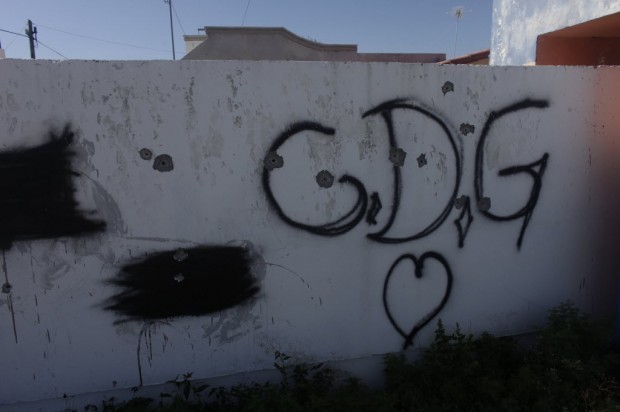
I wish we would drop the term altogether. Funny thing is, it seems to be spreading even further, losing meaning as it goes. In narco-banners posted around Mexico to send a message, drug traffickers have begun referring to themselves as cartels. Cartel del Golfo or "CDG", for example, as in this "narco manta" or narco banner.
What would we replace it with? Well, it has to be short enough for a headline and common enough language to avoid bureaucratese. In other words, "drug trafficking organization" probably won't work. Corcoran suggests drug gangs, smuggling gangs, mafias, syndicates. Those all work for me. What are your ideas?


