
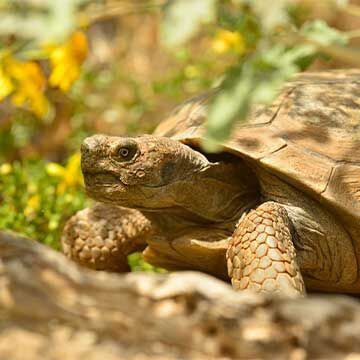
PHOENIX– The Arizona Game and Fish Department (AZGFD) is excited to highlight its work in tortoise conservation and the Tortoise Adoption Program during National Desert Tortoise Week, Sept. 28- Oct. 2, 2026.
Historically, National Desert Tortoise Week has been recognized by the U.S. Fish and Wildlife Service during the first week of October to educate the public about the iconic reptiles and celebrate tortoise conservation across the American southwest.
AZGFD leads the state’s conservation and management efforts for the Sonoran desert tortoise, Mojave desert tortoise and other native turtle species, whose populations face threats from drought, wildfires and invasive species, and are vulnerable to mortality from motorized vehicles.
Additionally, AZGFD’s Tortoise Adoption Program matches dozens of non-releasable desert tortoises with their forever homes every year, giving the opportunity for the public to aid in tortoise conservation by caring for a uniquely-Arizonan pet.
People are also reading…
To celebrate the week, AZGFD wants to share two exciting tortoise updates.
First, the story of a marked tortoise with an important message. Second, the details about a special event where you can learn all about bringing one of these desert dwellers into your life.
AZGFD reminds public to leave wild-born tortoises in the wild
Recently, personnel with the Tortoise Adoption Program noticed an unusual marking on a tortoise that had been brought to the department by a member of the public. The tortoise had been found roaming the streets of Tucson in an area that would have been impossible for the tortoise to reach naturally.
It was suspected that the tortoise had been removed from its natural habitat before being found in the residential neighborhood.
Based on the marking, AZGFD staff determined that the tortoise belonged to a study population within Saguaro National Park. Through coordination between AZGFD staff and Saguaro National Park, the tortoise was successfully returned to its home range within the park using recent tracking data.
“Situations like this are extraordinarily rare. In most cases, once a wild tortoise has been removed from its habitat, we have no way of knowing exactly where it came from and so cannot safely return it,” said Chad Rubke, AZGFD turtle projects coordinator.
“This situation provides an excellent opportunity to remind the public that wild tortoises should never be removed from the wild, and captive tortoises should never be released into the wild,” said Rubke.
The vast majority of tortoises that arrive at the AZGFD tortoise facility cannot be released into the wild, because captive tortoises can carry disease that could devastate the wild population.
Curious about adopting a desert tortoise?
On October 11, the Arizona Game and Fish Department is partnering with SummerWinds Nursery on a free event covering what it takes to adopt and care for this uniquely Arizonan pet.
Join AZGFD Tortoise Adoption Coordinator Tegan Wolf for a special presentation at SummerWinds Nursery’s Phoenix location (17826 N. Tatum Blvd., Phoenix, AZ 85032) on Sunday, October 11, at 1:00 p.m.
We’ll review how to create an enclosure, build a burrow, options for native plants to provide a healthy diet, and what to expect when adopting a non-traditional pet.
Tegan has over 13 years of experience working with captive Sonoran desert tortoises and can provide ideas and examples on how to create a unique habitat in your backyard.
Learn more about this event on the AZGFD website, or visit www.azgfd.gov/tortoise to discover more about the adoption process, burrow-building and tortoise care.