

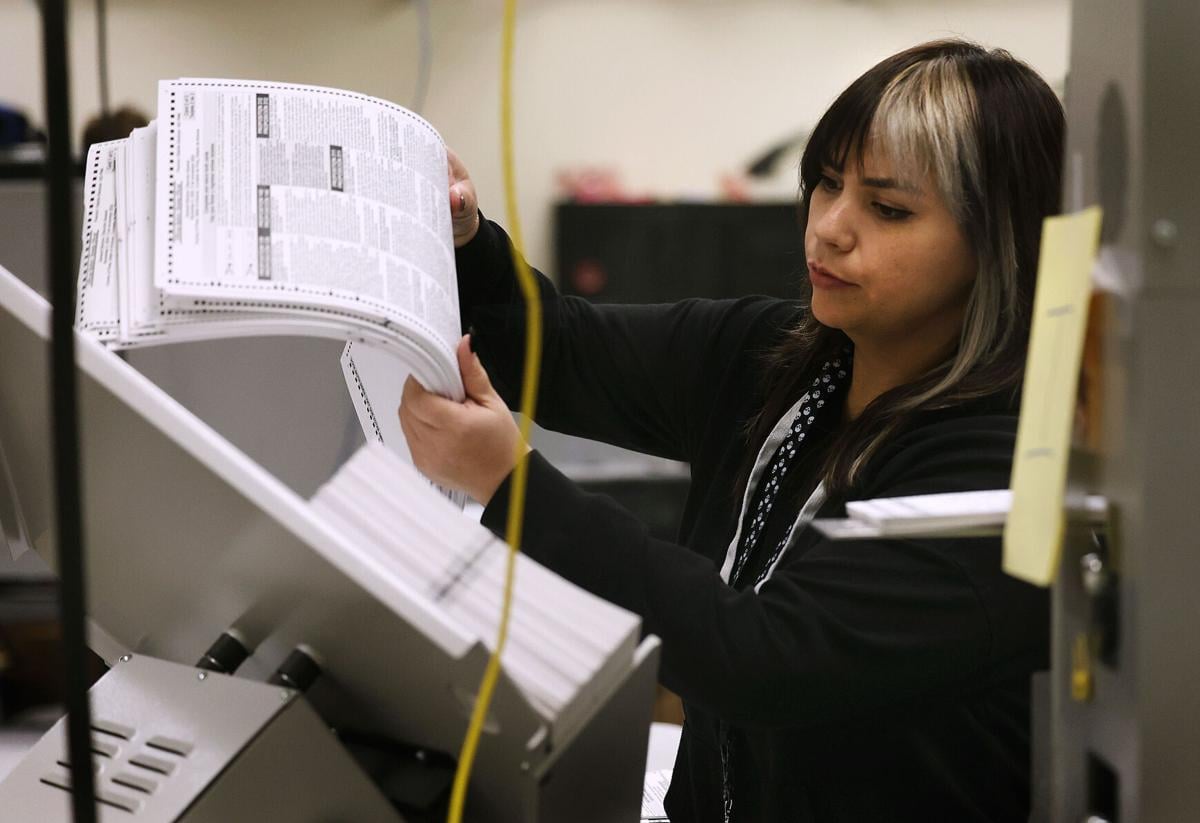
There's a new option in Tuesday's Arizona primary election for voters who got an early ballot by mail but didn't get it sent back in time and are dropping it off, if they want it to be processed faster.
First, we'll recap the procedures that have already been in place for voters dropping off their early ballots on Election Day, before we explain what's new.
The simplest method for such voters remains the same: If the envelope is signed, the ballot can be brought to a voting center or an election drop box run by their county — not a post office box, because by Election Day it's too late for that — and simply dropped off by 7 p.m. Tuesday, July 21. (See pima.vote online for drop-off addresses.)
But that's not the simplest for election workers. And it only gums up the works.
People are also reading…
The reason is that these "late-early'' ballots cannot even be examined until all the other votes are tallied, both the early ballots previously received, as well as those cast on Election Day at polling places.
Only then can election workers start looking at those dropped-off ballots.
The first step is comparing the signature on the outside of the envelope with records on file. Only if they match can the envelopes then be opened and the ballots tabulated.
But given the number of people who have used that option, that can delay for days getting final results.
Consider: There were 265,000 of these ballots dropped off on Election Day in 2024, all of which had to have signatures verified before they could be opened. And given how close some races have been in recent years, no winner will be formally declared until most of those late-early ballots are processed.
It can get even more complicated.
One reason that voters are asked to put a phone number on a ballot envelope is to allow election workers to reach out if the signature doesn't match county records. There are various options to "cure'' such ballots online or by phone; the deadline is normally five days.
This year, however, there's another option.
Voters holding one of those already-voted and already-sealed envelopes can go to a special desk at a polling place (see pima.vote for a list of the 120 voting centers that will be open in Pima County Tuesday) and present the same identification that would be needed to vote in person.
If it matches, the envelope is marked as having the ID verified, skipping that post-Election Day signature comparison and allowing the ballots inside to be processed along with those cast at the polls.
Valid IDs are an Arizona driver's license with a current address, or an identification card issued by the Motor Vehicle Division, a tribal enrollment card or similar ID, or other photo ID issued by federal, state or local governments.
Alternately, the law allows two non-photo documents that have a name and address. These range from recent utility bills and bank statements to voter registration cards, auto insurance cards, and anything addressed to the voter which has the "Official Election Mail'' logo.
Or, those with photo ID that doesn't include an address that matches their voter registration can show it along with one of the other documents mentioned above.
Howard Fischer is a veteran journalist who has been reporting since 1970 and covering state politics and the Legislature since 1982. Follow him on X, Bluesky and Threads at @azcapmedia or email azcapmedia@gmail.com.


