

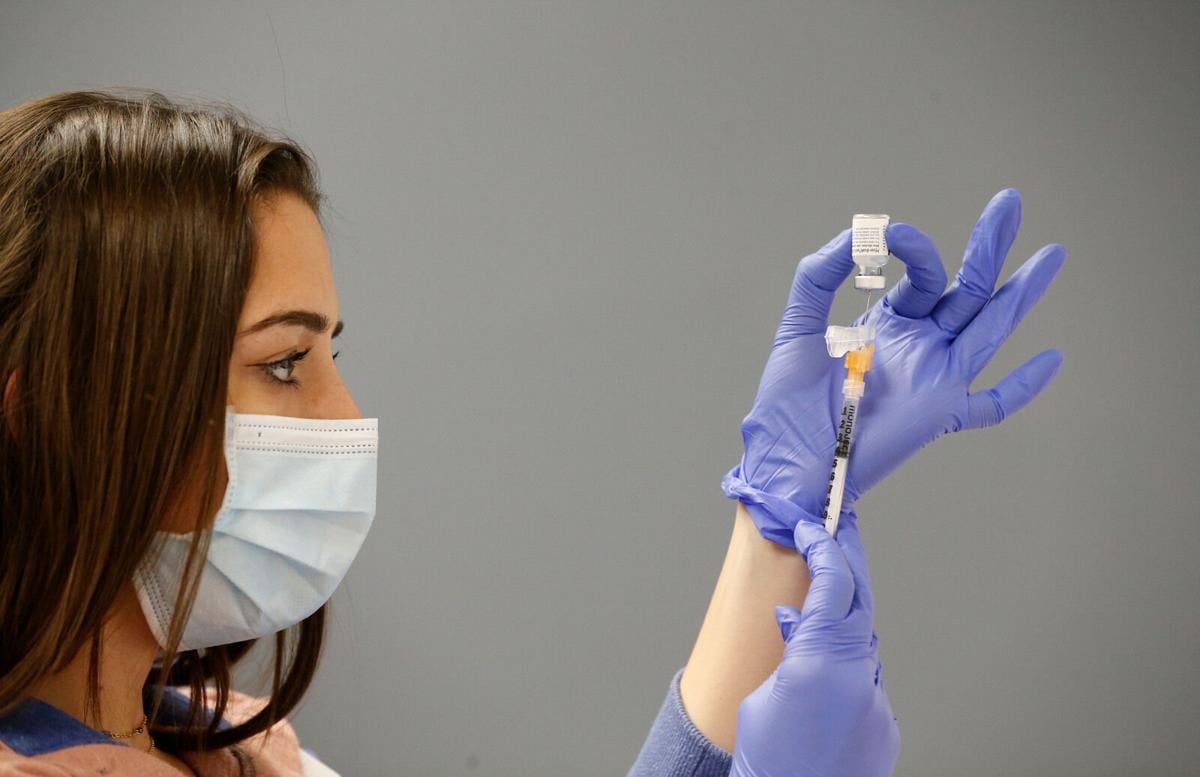
Rapid distribution of the Covid-19 vaccine grew yet more urgent this week, as New York state continued to battle some of its highest case counts of the pandemic and a new, more contagious B117 variant first detected in Britain continued its spread across the country.
For each of the past four days, Western New York has reported more than 1,000 new Covid-19 cases per day on a seven-day rolling average, a dramatic acceleration from the 650 to 750 new daily cases reported throughout much of the second half of December. Hospitalizations also remained elevated this week, yielding 143 Covid-19 fatalities in the first two weeks of January.
Read the full story from News Staff Reporter Aaron Besecker
State and local officials, already scrambling to distribute vaccines to the estimated 7 million New Yorkers who are currently eligible for them, have redoubled their efforts in light of the worsening statewide situation. The number of infections reported every day has grown sharply since Christmas, with almost 60% more new cases on average in the week ending Monday than in the week ending Dec. 21. Separately, the B117 variant of the novel coronavirus, which appears to spread more easily than the more common version, has now been detected in 10 states, including New York.
People are also reading…
These insights are part of a Buffalo News project to track and analyze critical Covid-19 metrics. The News is using data from the state and local county departments of health, as well as the state Department of Education and The New York Times’ national coronavirus database, to provide context and visuals to the still-unfolding story of Covid-19 in Erie, Niagara, Chautauqua, Cattaraugus and Allegany counties.

New York State will offer the Covid-19 vaccine to individuals 65 and older and "immunocompromised" persons, following a change in federal guidelines.
Those data show that while some metrics have plateaued or fallen back slightly from new highs a week ago, the winter surge continues in Western New York. New cases are still up almost 40% from before the Christmas holiday, and the average positive rate, or the share of tests that come back positive over a week-long period, remains elevated above December's levels. For the week ending Monday, the average positive rate was 7.7%, versus 8.6% a week before and 6.5% a week before that.
Hospitalizations also remain high, with some hospitals in Chautauqua County reporting last week that as many as one-third of total beds are now occupied by Covid-19 patients. The regional hospital census has hovered near or above 500 for the past 16 days, on par with a prior, early December peak.

Erie County was inundated with 18,500 calls Monday and Tuesday after the state wrongly gave people Erie County’s Covid-19 hotline number to schedule appointments.
That said, Western New York no longer numbers among the state’s worst Covid-19 hotspots – a reflection less of the region’s progress than of deteriorating conditions elsewhere. Covid-19 is now spreading more quickly in New York than in 34 other states on a per-capita basis, according to the Covid Tracking Project, and well in excess of projections by the U.S. Centers for Disease Control and Prevention. Positive rates have spiked particularly high in the Catskills, on Long Island, across the Finger Lakes region and in the eight counties around Albany, which on Monday all reported average rates at or above 9%.

Niagara County reported its deadliest day of the Covid-19 pandemic Tuesday, with 16 deaths in the preceding 24 hours.
It is in these last two regions that state officials have also announced four cases of the B117 variant, though the new strain is believed to be more widespread. On Tuesday, Gov. Andrew M. Cuomo said state laboratorians had uncovered an additional eight cases since Saturday. He did not specify where they found them.
Since Western New York recorded its first case of Covid-19 on March 14, more than 68,300 people have tested positive for Covid-19 in Western New York, and 1,614 people have died. More than half of those confirmed cases – and almost 40% of those deaths – occurred since Dec. 1.


