

The wait continues for Western New York commuters anticipating the proposed extension of Metro Rail to Amherst, even as the nation's new $1.2 trillion infrastructure package finances New York City megaprojects.
No direct funding for the $1 billion plan to reach the University of Buffalo's North Campus and beyond is slated in the new legislation, officials say, even as several billions are identified for big downstate projects like Amtrak's Gateway Tunnel under the Hudson River and extending New York City's Second Avenue subway.
But the Niagara Frontier Transportation Authority remains confident that construction of new rails to the University at Buffalo's North Campus and beyond could start as early as 2026, even as one transit analyst raises questions. Lawrence W. Penner, a retired Federal Transit Administration official who is familiar with the NFTA and often comments on its issues, calls it significant that the new bill will not directly fund the Amherst extension, while Senate Majority Leader Charles E. Schumer lists several projects in New York City.
People are also reading…
Combined with no mention from Schumer, Penner thinks concepts such as the Amherst extension or even an enhanced bus transit alternative have a long way to go.
"It looks like neither the NFTA's light rail extension nor bus rapid transit is on Schumer's radar," he said. "It tells you that (at this point) the odds of it being funded are equal to you or I winning the lotto.

A report issued by the Project for Public Spaces, based on input from throughout the area, foresees a facility with no single purpose, like shopping mall or food court, but a multi-use community asset with a "sense of place."
"You would think he would have something positive to say about the project," he added.
Schumer's office dismisses Penner's fears and says the new legislation enhances prospects for projects such as the Amherst extension. Spokeswoman Allison Biasotti notes Schumer secured about $156.5 million for the NFTA in the new legislation. She said the new legislation also significantly enhances the federal programs that fund new projects around the country, including one called Capital Investment Grants.
"This unprecedented Capital Investment Grants money is the pot NFTA will compete for this project," she said.
Schumer has never expressed specific support for the plan, telling The Buffalo News in 2018 that he was open to the idea, but only with "deep and broad community support." Biasotti said Friday he "eagerly awaits" results of the federal study.
"Sen. Schumer will await to see the results of the studies – ones that he secured federal funding for – are complete before making a determination on the expansion project," she said.
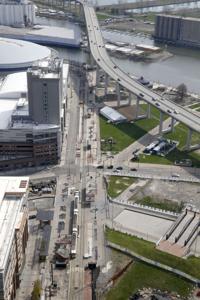
The community aim of restoring the Delaware, Lackawanna and Western Railroad Terminal to its former grandeur is beginning to take shape.
The senator continues to join Rep. Brian Higgins, D-Buffalo, in adopting a "wait and see" position on the project.
In the meantime, NFTA Executive Director Kimberley A. Minkel says the new bill addresses existing needs such as upgrading its fleet of 325 buses. Money for those purposes has doubled, she said, while the authority simultaneously fulfills all the federal requirements for eventual expansion funding – even if the process is long and complicated.
"We'll still be in competition with other communities across the United States, but I think the merits of our program remain strong," Minkel said.
Transit advocates' half-century-old dream of connecting downtown Buffalo to UB's North Campus was only partially fulfilled in 1985 when the NFTA completed its 6.4 mile line, but only to the South Campus on Main Street. Succeeding plans never advanced until the NFTA revived the concept in 2013.
Since then, the authority has embraced the idea, designating rail extension as its "preferred alternative" over a bus rapid transit system (also under study) that, while featuring enhanced service, would eliminate the advantage of rail's "one seat ride." Federal officials required the NFTA in 2020 to consider bus rapid transit as an alternative, which could feature extra long, jointed models and dedicated lanes with priority signals at a much lower price than rail.
The NFTA has always recognized its underdog status in competition with larger cities for a rail project, Minkel said, but has anticipated the eventual influx of "infrastructure" money promised by various federal administrations.
"We have been advocating the project for when this moment in time hit, so that we'd be in the best position to apply," Minkel said of the sweetened transit pot. "We've been prepared for this.
"I know the competition is fierce, but why not Buffalo?"
Minkel noted the growing need to connect three UB campuses, development of a transit-dependent Buffalo Niagara Medical Campus and a new population increase noted for the first time in 70 years.
Meanwhile, Higgins remains open to expansion, despite reservations about starting new projects before addressing needs of the existing – and aging – system. He also supports dedicating some of the incoming funds to the NFTA's redevelopment of the Delaware, Lackawanna and Western Railroad Terminal – including the station now under construction at Metro Rail's southern terminus.
"They should continue their process and we'll see where it takes us," he said of planning for Amherst.
"I would not slam the door, though I have expressed my priority for the current system," he added. "But this is encouraging, and I think the concerns I expressed three years ago perhaps influenced them to pay attention to (the current system). That should continue because, potentially, we could have both."
Minkel, meanwhile noted recent progress on Higgins' concerns such as rehabilitation of several aging stations, installation of new escalators and overhaul of all 27 Metro Rail vehicles. The congressman is also supporting the NFTA's vision for a revived DL&W Terminal at the foot of Main Street with rail service as a key component.
"The potential for that is really very exciting, but you have get people to the building," Minkel said.
Minkel also believes that significant declines in ridership aboard both Metro Bus and Rail, even before concerns about the Covid-19 pandemic slashed ridership about 50%, will not affect the authority's extension goal.
"We have concerns, but quite honestly, all transit systems across the nation have seen the same decline," she said, adding that Buffalo's relatively low rate of car ownership and soaring cost of buying cars may turn some commuters back to bus and rail.
She also noted the program will accelerate the authority's efforts to replace aging buses with zero-emission vehicles, and that the authority continues following the prescribed timeline for admission into the federal New Starts program. A required environmental review of the project is expected by spring, she said, followed by engineering and design work, as well as identifying a "non-federal" funding source.
Even if Washington eventually approves a rail project, she said earlier, no construction is envisioned until 2026 and service until 2030.


