



The U.S. National Weather Service says: “When thunder roars, go indoors!”
Although this is great advice for lightning safety, my colleagues and I don’t follow it. Instead, we are outside trying to understand why cloud-to-ground lightning strikes occur where they do.
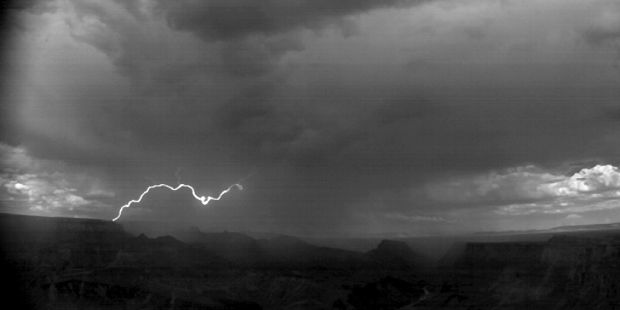
About half the time, an individual lightning flash strikes the ground in several locations, some as much as five miles apart. This finding contradicts the old thinking that five miles is a safe distance from a lightning strike.
Our recent work shows that small variations in terrain — as small as 50 feet in height over distances less than a mile — affect the frequency and spatial pattern of such multiple-ground-contact flashes.
Lightning is not just a safety issue. Cloud-to-ground lightning is a major cause of electric power interruptions, fires, damaged equipment and delays at airports.
People are also reading…
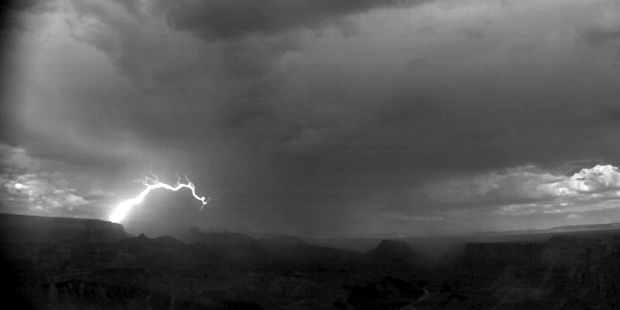
Most cloud-to-ground lightning flashes begin with bright electrical discharges moving from the middle of a cloud toward the ground in a step-like manner known as stepped leaders. They are usually branched, creating a root-like structure between the cloud and the ground. As the branches approach the ground, they can “attach” to several locations.
The strike’s location depends on the local terrain’s shape and slope plus characteristics of objects on the ground, including their height. The rotating blades of wind turbines seem to be particularly “attractive” to lightning. Electrical transmission line towers are also, because they are often near hilltops.
We study the nature of leaders’ attachment to tall objects and also gather detailed information about lightning’s behavior in complex terrain. To do so, we use electromagnetic measurements and high-speed cameras, which provide spectacular information and video imagery by capturing thousands of images per second.
Such measurements helped us figure out why very little lightning occurs inside the Grand Canyon.
Thunderstorms tend to dissipate as they travel over the open Canyon. In addition, the Canyon edges behave somewhat like a wall of tall towers. In some cases this effect is so strong that lightning can travel many miles horizontally from the center of the Canyon and attach to the rim.
To pinpoint lightning strikes over a large region, we use networks of hundreds of remote electromagnetic sensors. E. Philip Krider, a University of Arizona professor of atmospheric sciences, and I led the development of instrumentation for such networks, including the U.S. National Lightning Detection Network, owned by Vaisala.
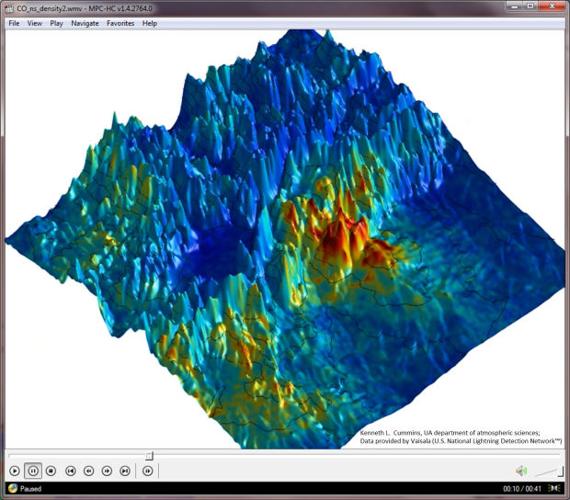
We count the number of times a flash occurs at each location to evaluate the relationship between a cloud-to-ground lightning strike and the terrain. We then “drape” that information over the terrain using computer mapping.
The Front Range of the Rocky Mountains is particularly interesting. To create lightning, moist air must be lifted well above the freezing level in a cloud. In the Front Range, large areas of uniformly upward-sloping terrain face the summer’s moist air flow. As a result, lightning frequently strikes near the peaks of the range’s tallest mountains.
We are now expanding our analysis to all of the continental U.S. and portions of east-central Brazil.

 Former Sam Levitz building sells for $8.6 million


