

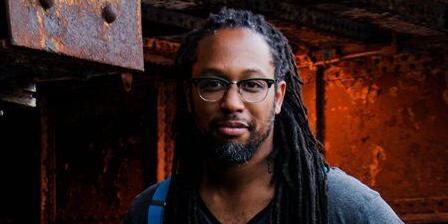
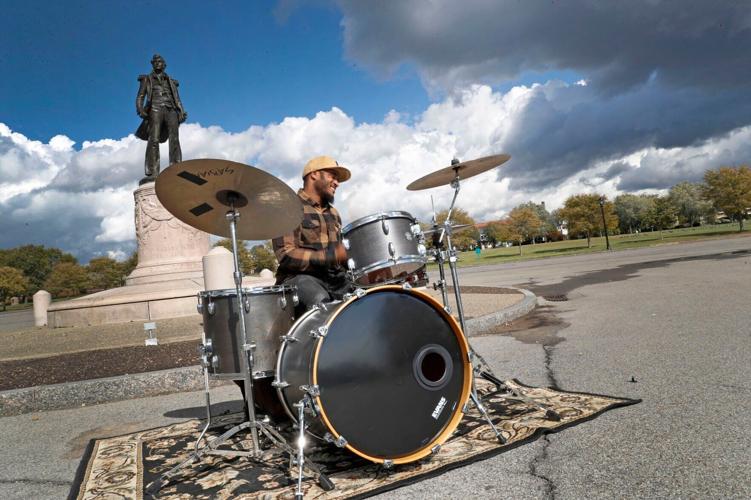
Over the past several years, Damone Jackson has earned a reputation as one of the most ferociously inventive young drummers in Buffalo, across a variety of genres.
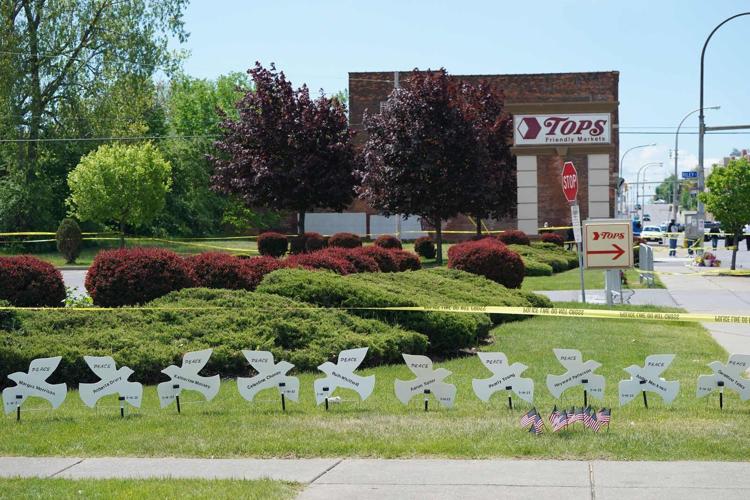
But he’s not focusing on music like he usually would. Not now. Not after May 14. Not after what happened at Tops.
“I’m not good. Most of my childhood was spent on Jefferson Avenue,” he said. “My church, still today, is minutes away from that Tops. This is my home.”
Jefferson Avenue is known for a lot of things, including the closeness of residents who live on and near it. The sense of community that permeates the Cold Spring neighborhood has been recounted over and over in the past week as neighbors explain their connection to each other and why the mass shooting that killed 10 and wounded three more was an attack on all of them.
People are also reading…
Jefferson Avenue also has come to symbolize poverty and neglect that has its roots in white flight and institutionalized racist practices that defined many northeastern cities in the 1950s and ‘60s.
But Jefferson Avenue also means music. It was famously the home of the Pine Grill, a focal point of the city’s jazz scene for decades, where countless musicians played or relaxed after a gig. Rick James, who lived on East Ferry Street as a child, connected his lifelong love of music to his early introduction to the Pine Grill.
All of which helps explain why Black musicians and members of the arts scene in Buffalo are both in mourning over what authorities have called an act of white supremacist terrorism. But for them, the grief is infused with anger over how vulnerable the victims were, thanks to what a recent study from University at Buffalo researchers called “the marginalizing of the East Side.”
Buffalo-based touring musician and artistic director of the Historic Colored Musicians Club Walter Kemp 3 lost his wife’s great aunt, Pearl Young, in the attack at Tops. He said listening to people praise Buffalo as the “City of Good Neighbors” has left him feeling hollow.
“We sit here and pretend, really,” Kemp said. “Yeah, I guess 80% or even 90% of us are good neighbors. But that 10% that’s not made up of good neighbors can cause hell on earth. ...
“This particular monster, this shooter, wasn’t from Buffalo, but there are white supremacist clubs and groups right here in and around Buffalo, too. It’s an open secret."
In 2021, the Southern Poverty Law Center tracked 35 hate groups in New York State, including a white nationalist group in Lockport. According to a map maintained by the Anti-Defamation League, there have been more than two dozen instances in which white supremacy propaganda has been distributed in the Buffalo Niagara region since 2016.
"Decades of redlining and segregation by design have created an East Side full of very vulnerable Black people," Kemp continued. "These communities – they’re just sitting there as targets.”
A 2021 University at Buffalo study led by Henry Louis Taylor Jr., director of the school's Center for Urban Studies, examined the realities of being Black in Buffalo. Researchers wrote that decades of systemic segregation had “trapped” African American residents in “low-value, marginalized and underdeveloped neighborhoods.”
The music community does not need to read research to understand reality.
“This tragedy shines a light on the major elephant in the room,” musician and educator Eric Crittenden said.
“That’s the fact that this (expletive) chose to come here to do this because it was a fish-in-a-barrel situation, with all of these Black people so densely populated in one area. This didn’t happen by accident. It happened because of systemic racism.”
The racial and economic divide between the East and West sides of Buffalo, made manifest by the construction of the Kensington Expressway in the 1960s, has created a kind of apartheid in the area’s music scene – a scene many Black musicians say is still plagued by racism in 2022.
Crittenden said he’s experienced racism while on tour, playing gigs “where the only Black people in an absolutely packed house were on the stage,” and that the scenario in Buffalo has been similar.
“You better believe I saw racism up close and personal,” he said. “In the way people treated me, sometimes in the way they used straight-out racial slurs against me, but also in the way I'd sometimes be passed over for gigs and bookings.
“This is a tough conversation to have, because I have so much love for so many musicians and artists in our scene, and we’re musicians, man – we don’t want to see color. Because on the bandstand, color doesn’t matter. But it’s time to be honest: There’s a reason why white artists dominate Black music in white areas. That’s segregation. That is a byproduct of white supremacy.”
Drummer John Kregg grew up in North Buffalo and attended Park School in Amherst. Both of his parents grew up on the East Side. Like Crittenden, Kregg recalled “getting used to being the only Black person at every gig I played” throughout the '90s, when he was a member of the popular jam band Mitch’s Infydels.
“It wasn’t a problem, because I knew my friends had my back. It never came up, amongst us. I recall maybe two times in my decades of playing where I had to confront racism head-on. That might be a function of the scene I was in, the jam band scene, because everyone knew me in the community. But even though it wasn’t often a problem for me, I was certainly aware that Buffalo was deeply segregated.”
Jackson said we can no longer afford to gloss over the truth with slogans and speeches redolent of wishful thinking.
“We need to be straight now,” he said. “We need to confront this. Because we tried being silent and looking the other way. It didn’t work. It was never going to work. I knew that from the minute I was born.
“We wanted to be silent, we wanted to turn and walk away, we wanted to stand in peace. We tried that. But when we turned the other cheek and turned to walk away, you shot us in the back.”


