
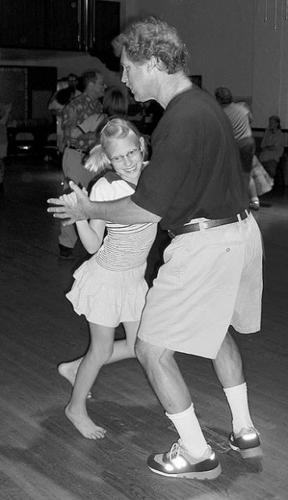
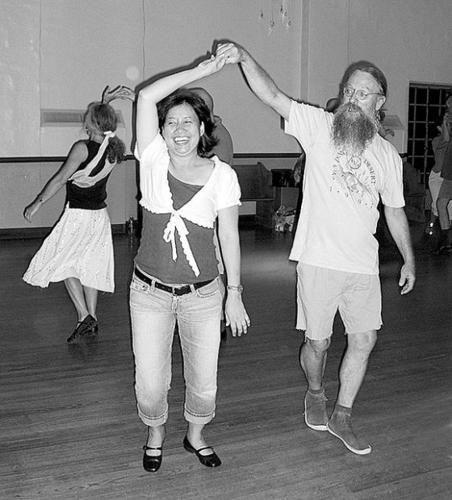
Forget about dancing shoes and party dresses.
The folks who gather several Saturdays each month near the University of Arizona to move their bodies in a form known as contra dancing come from all over, in all types of garb.
They come in flip-flops, sneakers, sandals, high heels — even barefoot — wearing shorts, slacks, jeans, and yes, also twirly skirts and dresses.
Contra dancing — also called contredanse — isn't about being fancy or highfalutin. It's about having fun, say long-time enthusiasts, many of whom are members of the 30-year-old Tucson Friends of Traditional Music.
"It's casual. It's fun. If people make mistakes, nobody gets uptight about it," said Linda Stacy, one of the mostly middle-aged revelers who showed up Saturday at First United Methodist Church, 915 E. Fourth St. "When the band is right, you just can't sit still."
People are also reading…
Stacy regularly drives up from Benson with her husband, Harry, to enjoy the festivities.
But it's not just an older crowd that spins and swings through the evening. A sprinkling of younger faces — some of them children, some college-age — stands out as the crowd begins moving.
"Contra dancing is the old, traditional, American dancing that was known in the 19th century as barn dancing, or just 'socials,' " said Dale Tersey, club president.
"Contra" refers to the way dance partners — usually of the opposite sex but not always — face each other.
Square dancing evolved from contra dancing, Tersey said.
All the steps are what he called "walking steps," which are unlike formal ballroom dancing where partners must know a lot in order to do it.
"It's fun dancing because it's very social," he said. "It's a level of interacting that you just don't see in modern American society."
Lessons for newcomers to each session begin at 7:30 p.m., and the dance floor starts cooking promptly at 8.
Dances always feature live music and a live caller to tell dancers where to go next.
Most of the time, the band comprises a guitar player, fiddler and mandolin player, but sometimes there's a bass player or someone with a tin whistle.
Last Saturday, there was a keyboardist, which is very rare, said Jorga Riggenbach, club newsletter editor.
"Once you watch it, you'll get the flow of it. You become addicted," said Herb Boskin, who got hooked 25 years ago in New England. He has danced at contra dances all around the country.
If you have ever seen a production of Charles Dickens's "A Christmas Carol," you might recall a scene in which Ebenezer Scrooge visits his happy past and peeks in at a festive dance where the floor shakes and people laugh and spin, arm in arm, endlessly skipping from one partner to the next. The fiddler roars on his instrument. Everyone smiles, many people laugh and occasionally the floor shudders under a thunderous, simultaneous stomp of everyone's feet.
That's what a contra dance looks and sounds like.
One song can last 10 to 12 minutes.
And a good caller is key, Boskin said.
"If you've called for a few years, you can call more dances," he said. "You can call advanced. You can call intermediate. You can make it complicated."
A good caller knows when to stop calling and let the crowd do its thing when everyone has the hang of it.
Don Copler, 55, mostly enjoys the dance, but he's a caller too when the occasion requires it.
He began square dancing in the early 1970s and picked up contra dancing in 1981. On moving to Tucson in 1984, he was unimpressed with the callers of the time.
"I thought, hell, I could call that good," he said. So he did.
In the time since, some of those callers have become quite good at it, he said.
Live music and live callers are important because they have "an energy and spontaneity that you don't get from recorded music," he said.
The group will come together again at the same time and same place this Saturday, with a different band and probably a few different faces.
But there's not likely to be any new pretension, Tersey said.
"People are there to have a good time. They're not there to worry about where their feet are going," he said. "Whatever goes on on the dance floor, stays there."
Central
What: Tucson Friends of Traditional Music contra dancing
When: First, third and fourth Saturdays of each month; fifth Saturday, too, if the month has one
Where: Varies, usually near the University of Arizona
Cost: $5 for students; $6 for members; $7 general admission
For more information, log on to www.tftm.org



 101 homes to be built on NW Tucson corner