

They’re back – in some places.
Heading into spring, the lifting of mask mandates across the United States and in New York came with a widespread caveat: Don’t throw them away. You’ll probably need your masks again.
Now, in some places, you do. As Omicron subvariants drive Covid-19 numbers in the Northeast and beyond, mask mandates in some places are being reinstituted or extended. Visit Philadelphia, and you’re once again required to wear a mask indoors. Universities from Columbia in New York City to Johns Hopkins in Baltimore and Georgetown in Washington, D.C., are once again requiring masks in classrooms.
The federal government, meanwhile, has extended its masking requirement for airplanes and other forms of public transportation into early May.
Truly, then, masks were never gone. Like Covid-19 itself, they’re an ongoing component of our lives. “We need to understand that living with Covid (which we will be doing for the foreseeable future) means making peace with the fact that protective measures may have to come back from time to time, and that demographics, resources and culture may mean one place has a different risk tolerance – and different policies – than others,” former Surgeon General Jerome Adams said in an email exchange last week.
People are also reading…
But will New York – which from the start of the pandemic has been aggressive in its mitigation measures – reinstitute an indoors masking requirement? This installment of Pandemic Lessons examines what we know.
How likely are mask mandates to return in New York?
The answer to that question is unclear, though it doesn’t seem imminent, or even likely, in the immediate Buffalo area or across the state.
Erie County Executive Mark Poloncarz’s authority to mandate masking came from the county’s state of emergency status, which expired in early March. When we asked what circumstances, if any, would warrant a return to indoor masking, Erie County Department of Health spokesperson Kara Kane referred us to the state.
Gov. Kathy Hochul’s office, in turn, referred us to comments she made last week in a pair of interviews with New York City television stations.
On Fox 5’s “Good Day New York,” host Rosanna Scotto asked Hochul, “You can't ever foresee closing down the state again for Covid, can you?”
“No,” Hochul answered. “I said I was going to protect the health of New Yorkers and the health of the economy. … We had some tough spikes, but as long as we can keep hospitalizations down, which is where we are right now, I'm not shutting down the city or the state. I'm just not going to do that. I can't do that.”
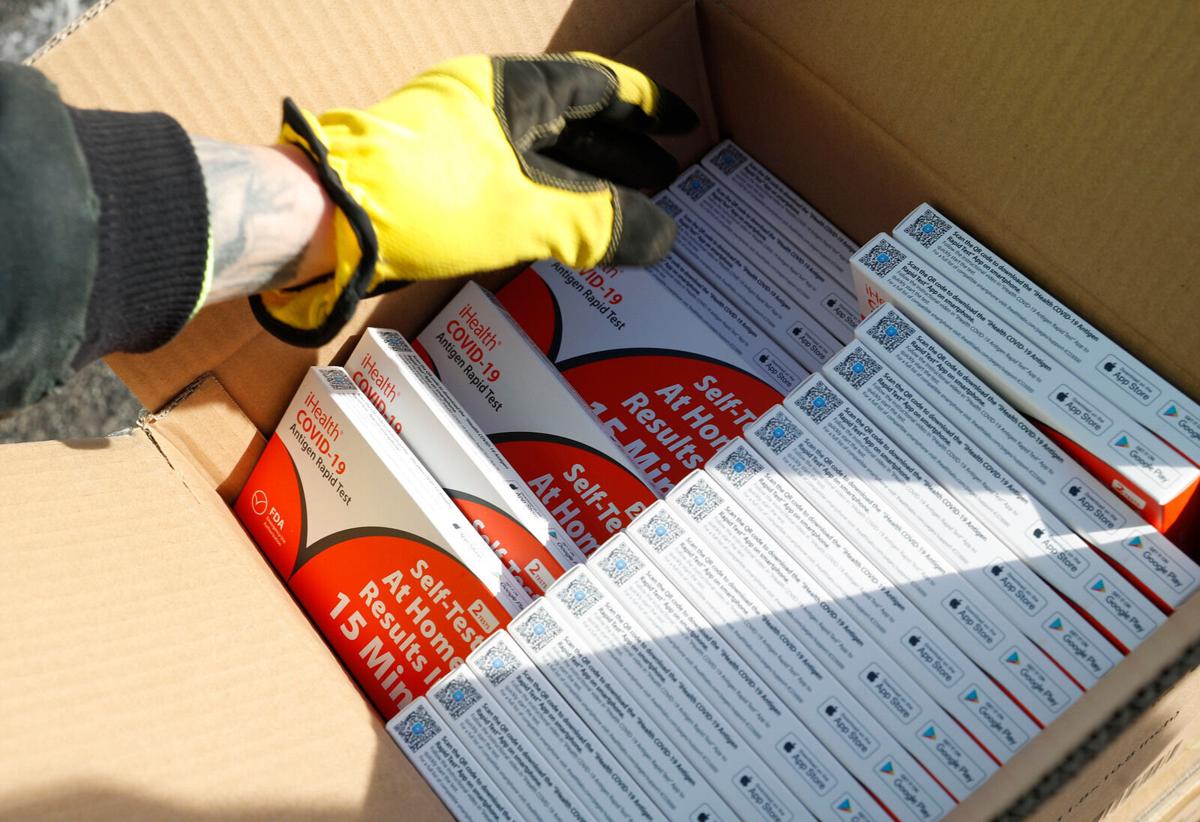
On a Pix 11 morning show interview, Hochul was asked by host Dan Mannarino specifically about bringing back indoor mask mandates, as happened in Philadelphia. She reiterated that state officials are “monitoring the numbers very closely” and pointed to the “many more tools” available now: home-testing kits (the state has distributed 70 million, with another 22 million in reserve) and second booster shots for people who are 50 or older, or immunocompromised.
When pressed her on mask mandates, Hochul said, “Everything's always on the table. I'm not taking anything off the table, but we're not there.”
What are the numbers?
This is a bad news-good news situation.
The statistic most widely used to gauge the presence of Covid-19 is cases per 100,000 people. Those numbers, both locally and across the state, are three to four times higher than one month earlier:
• On April 13, Western New York’s seven-day average for cases per 100,000 was 25.48, up from 6.57 on March 13.
• The statewide average on April 13 was 28.27. It was 8.25 a month ago.
But hospitalizations, which are a key indicator of the severity of infections, have remained relatively low and flat, both statewide and locally. Western New York’s seven-day hospitalization average was 59 people on April 13. That’s up from 39 at the start of April, but lower than the 92 people hospitalized one month ago. Hospitalizations do tend to lag behind positive-test numbers, and while they’re likely to rise, doctors and scientists aren’t expecting a surge.
Death numbers statewide have been relatively flat for the past three weeks, hovering in the single or low-double digits. By contrast, in late January during the wake of the Omicron wave, New York’s daily deaths at one point exceeded 300 people.
“Even though we’re seeing an increase in cases, because we’ve built a pretty good immunity wall through vaccination and that earlier Omicron wave, really, hospitalizations and deaths have been decoupled to the greatest degree we’ve seen at any time during this pandemic,” said Dr. Thomas Russo, chief of infectious diseases at the University at Buffalo’s Jacobs School of Medicine and Biomedical Sciences.
If you do test positive, what’s the best way to handle quarantining?
The short answer: Isolate for five days. Then, if you’re symptom-free, resume life. That’s the guideline from the Centers for Disease Control and Prevention, and it’s generally the rule being followed in most schools and workplaces.
But there’s a more nuanced and safer answer, one driven by a widespread concern among scientists that five days isn’t enough time to be assured that someone is no longer infectious.
In a series of tweets last week, Dr. Michael Mina, an epidemiologist and immunologist with the testing company eMed, pointed out that more than “70% of boosted people are still highly infectious” at the five-day mark. Mina advises taking a rapid antigen test, the type that is now widely available through government programs, school and community distributions, and stores.
“Anyone positive on a rapid antigen test should be considered a high risk of spreading the virus to others,” Mina tweeted.
In his posts and in an email for this story, Mina urged people not to emerge from isolation until they have a negative rapid test – whether that’s on day six, seven, eight or nine.
After 10 days – which was the long-held guideline – people can be confident that they are no longer infectious.
Another note on what to do if you test positive: Contact your doctor right away. In most cases, they’ll likely advise you on how to monitor your symptoms. But in some instances, they may want you to receive antiviral treatments, and those need to be administered in the first few days of the infection.
What about schools? Is it likely that we’ll see masks return in classrooms?
Just as businesses can do in the community, districts and schools can make individual decisions on this. Broadly, it seems unlikely to happen.
“Covid is largely, at this point, a preventable and treatable illness,” said Michael Cornell, president of the Erie-Niagara School Superintendents Association and superintendent of Hamburg Central School District. In a phone interview last week, he listed a series of considerations:
• Schools have “pretty much a fully vaccinated workforce and we serve the population least impacted by Covid symptoms,” Cornell said.
• Schools have access to thousands of at-home test kits and KN-95-style masks for both adults and children. “A mask can be worn at any time by anyone who feels that their circumstances require it,” Cornell said.
• Hospital numbers are low and older and at-risk people are largely vaccinated. (On the whole: About 87% of New Yorkers ages 18 and up are fully vaccinated, according to the state Department of Health, and that number doesn’t reflect immunity derived from natural infection.)
“I think when superintendents look at that list of objective facts, it makes it difficult for us to envision a logical, rational argument where you would mandate masks in a school at any point,” Cornell said.
Investments help here, too. Poloncarz announced earlier this month that Erie County is purchasing air filtration devices for 11,000 classrooms, which encompasses private, public and charter schools. Those machines, manufactured by Austin Air of Buffalo, are designed to lower the airborne viral load.
“Since we returned to in-person learning in September of 2020, the safest place for a young person to be in the Covid era has been their school,” said Cornell, who calls the air purifiers “an added layer that is one of many things that can help keep the air in a school safe.”
He added, “Those filters, I think, will have a greater long-term implication for kids who have asthma and allergies and other things.”
There’s a pandemic silver lining: The moves we’re making now may help improve health overall.
As we continually learn to live with Covid-19, this much is clear: Variants and subvariants will continue to emerge, and some of them will spike numbers. Or put another way: Covid is going to be here. How should we manage that in our day-to-day lives?
“We’re now in the era of personal responsibility,” said Russo, adding that he does not think another masking mandate is necessary. “We should remind people of their personal responsibility. Those that are high risk need to consider wearing masks in high-risk situations.”
Those at-risk groups include people who are in treatment for certain types of cancers (especially those impacting the blood and bone marrow), as well as organ transplant patients and those living with HIV/AIDS. Those immunocompromised individuals need to be particularly careful, and that responsibility extends to people who live, work or interact closely with them.
“Err on the side of caution,” said Dr. Brahm Segal, an infectious diseases specialist at Roswell Park Comprehensive Cancer Center. “You do have to realize that just because you’ve been vaccinated, that doesn’t mean that you won’t get mild Covid. Mild Covid, when it’s transmitted to someone who’s really immunocompromised, then becomes severe Covid.”


