

Mary Badami knew the day. She just did not know the time.
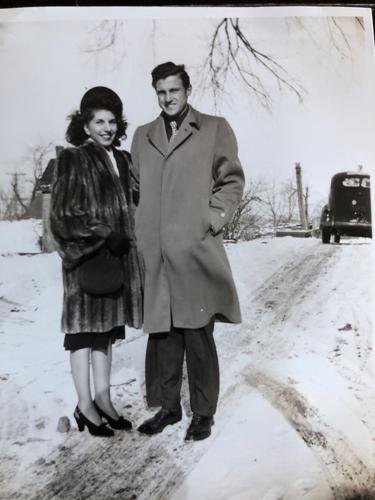
She traveled into Buffalo in spring 1946 from her home in Geneseo. Mary was about to meet her boyfriend, Dominic "Monte" Montemarano, who was coming home on a train after a couple of years away in World War II.
Joined by one of Monte's sisters, Mary went to Buffalo's Central Terminal. The young women were excited, but train after train arrived without Monte. "We kept thinking we were missing him," Mary said Wednesday.
She and Monte have been married 71 years. The wait at the terminal had such power she remembers it, exactly.
After a while, she and Monte's sister went to a nearby park to kill time.
"Finally, his parents came along," said Mary, now 94. They knew Monte would arrive on an evening train. Everyone went back to the terminal and settled in to wait until the train pulled in.
People are also reading…
"He got off with Andy Mastandrea, one of his buddies," Mary said. "I could recognize his voice before I saw him. Lo and behold there he was, with his duffel bag.
"Oh, yeah," she said. "I almost knocked him down, the poor guy. I slammed right into him."
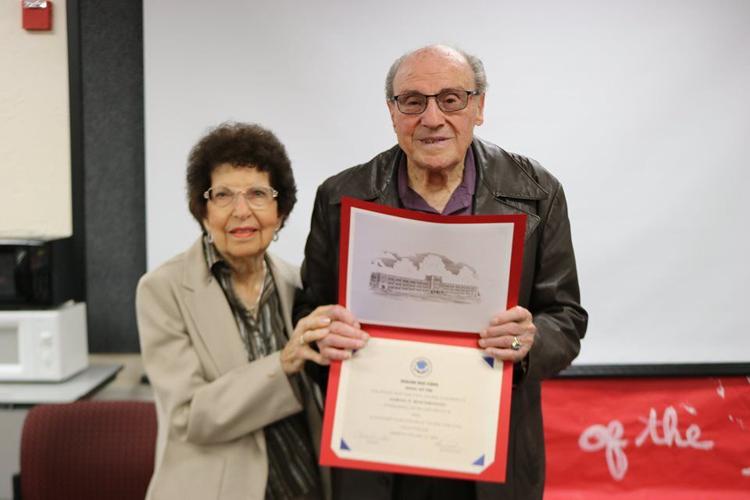
She and her husband — who may be the oldest brand-new graduate in the history of Buffalo's Burgard Vocational High School — are also intimate witnesses to the meaning of the grand old railroad station, which opened 90 years ago. A celebration of that milestone birthday continues on July 13 with a free daylong community festival, building into a 7:30 p.m. concert by the Buffalo Philharmonic Orchestra.
The tale of Mary, Monte and the terminal is among dozens I heard in recent weeks. This is a chance to thank the many readers who submitted beautiful and passionate memories. We will assemble them in a digital archive at buffalonews.com in time for the BPO festival, and we are planning a piece that spins off some of those tales for Sunday's paper.
As for the Montemaranos, I came to their story by chance, after a friend in the Buffalo schools mentioned how Monte was being honored at Mount Carmel High School in San Diego. I called the principal, Greg Magno, who offered this account.
A few days earlier, Magno presented Monte, at 93, with a diploma from Burgard, a school he last attended in 1944. Monte, a longtime volunteer at Mount Carmel, declined to accept the diploma at a formal graduation. Instead, he showed up a few days later at school, where Magno led him into a big meeting room.
Dozens of teachers stood and applauded.
“My God,” Monte said. “The hair was standing up on my head.”
He remains razor-sharp, and appreciates all this attention from Western New York — where he once worked as a copy boy for the old Buffalo Evening News. Still, he also offers this truth: While he grew up in the city, “I never really liked Buffalo,” Monte said.
That has nothing to do with the city itself. Even as a child, Monte preferred the country. He used to spend every summer at his grandfather’s farm in Cuylerville, near Geneseo. “He grew corn and beans and oats,” Monte said.
Eighty years ago this summer, he met Mary Badami at a nearby ice cream parlor. The story goes that she was dating a friend of Monte's whose name they decline to use, out of respect. The boys were playing dice behind a gas station, before going to the movies.
The friend's father caught them shooting dice, grabbed his son by the ear and told him he was shut down for the night. As the friend staggered away, he yelled back to Monte:
"Hey, Dominic. Take Mary to the show!"
Mary agreed to go with him. As Monte says, the rest is history.
They were already a couple when Monte was drafted for the first time, while in high school. He was deaf in one ear. The doctor who examined him told him to go home.
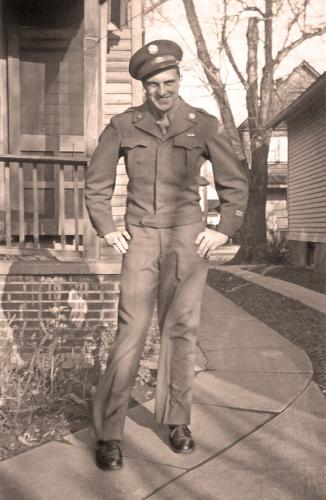
Yet the war was taking a harsh toll, and the Army changed its mind. Monte was called back. "They told me it’ll be limited service, no overseas duty,” he said.
Sure. He can laugh about it now.
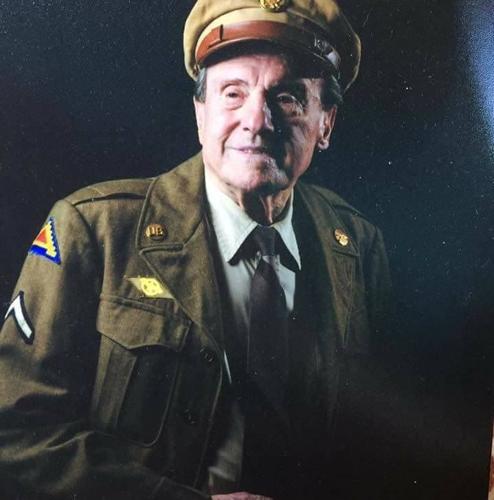
Before long, Monte was among the young GIs under withering fire at the Battle of the Bulge. He and his friends were ordered to "fix bayonets," and he does not go into detail about what came next. It was the most frightening experience of his life.
He made it out, but he said he was no longer a kid.
Eight months after the war ended, the Army sent him to New York City, where he made plans to go home. Monte even remembers the local soldiers, all from Buffalo, he traveled with: There was Mastandrea, and Sigmund Potembski, who later became art director at WKBW, and Dannie Aguglia, who died two years ago at 94 in Amherst.
They were on a train with a dining car, and Monte said the civilians were so grateful to see them they had free drinks all the way from New York City to Buffalo.
The four men were singing as they climbed off the train at the Central Terminal. Mary and his parents and his sisters were waiting, and even Monte does not have the words for what came next.
"Hugs, kisses, crying," he said. "Unbelievable."
Once home, he did not worry about going back for a high school diploma. Sure, he felt a little empty without it, “but I came back as a 21-year-old man, you understand?”
Before long, Monte took a job digging ditches with a company that became part of Rochester Gas & Electric, and he kept getting promoted until he was a foreman. He and Mary were married and settled in Geneseo. Monte thought from time to time about school, but he asked himself a simple question.
“I got a job,” he said. “Why all this for a sheet of paper? I said the hell with it.”
Maybe so, but he would hear people talking about their diplomas, or graduations, and somewhere deep inside he would feel this little ache.
Eventually, the couple's children, Kathleen and Richard, moved to California. In 1987, in retirement, Monte and Mary followed their kids. Twelve years later, a woman Monte knew at Mount Carmel asked if he would take part in a flag-raising ceremony.
Monte did. He started showing up to talk to students about the war. “He’s salt of the earth,” said Chris Vitous, a history teacher. “The kids love him, and he really is a good man.”
During those presentations, Magno realized Monte did not have a degree. The principal contacted the Buffalo schools and put together last month's ceremony in San Diego, more than 75 years after Monte last set foot in Burgard.
His daughter Kathleen fills in important pieces of the tale. She noted that Monte not only volunteers for Honor Flight – the annual pilgrimage that allows World War II and Korean War veterans to visit monuments in their honor in Washington D.C. – but he is part of a major fundraising effort for that program in San Diego.
Based on Monte's stories, she does not believe her father's decision about education is as simple as he explains it. He told his daughter he was “too nervous” to sit still in a classroom after the war, and she believes the teenager thrown into bloody combat at the Bulge endured some post-traumatic stress once he came home.
Monte kept going. Kathleen said he is a great husband and father, a guy absolutely capable at 93 of making high school students roar with awe and appreciation about how a game of dice changed his life, especially when they learn just how long he has been married to his wife.
As for Mary, all these years later, she brings it back to that one moment at the Central Terminal.
Even before she saw him, she heard his voice.
Sean Kirst is a columnist with The Buffalo News. Email him at skirst@buffnews.com or read more of his work in this archive.


