The countdown started just seconds before 6 a.m. Friday.
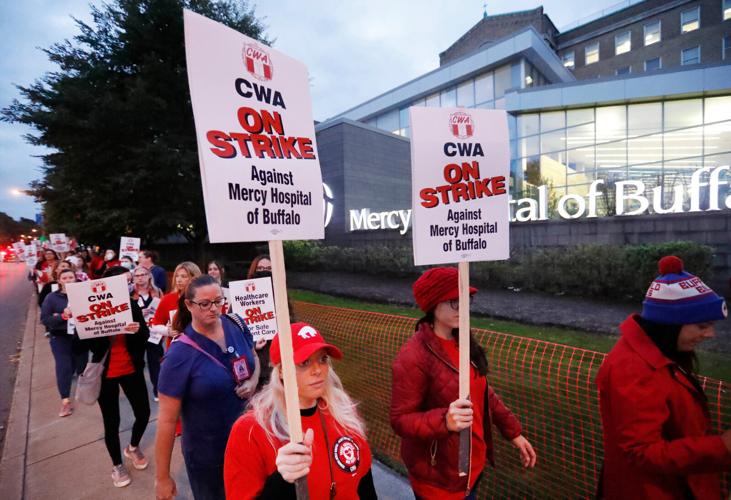
"Three, two, one ... " hundreds of workers chanted in unison, then cheered and walked together toward the main entrance of Mercy Hospital in South Buffalo to begin an anticipated strike.
"Here they come," one worker yelled as union members on the clock walked off the job and came out the hospital's front entrance.
There's no telling how long it will be before they come back.
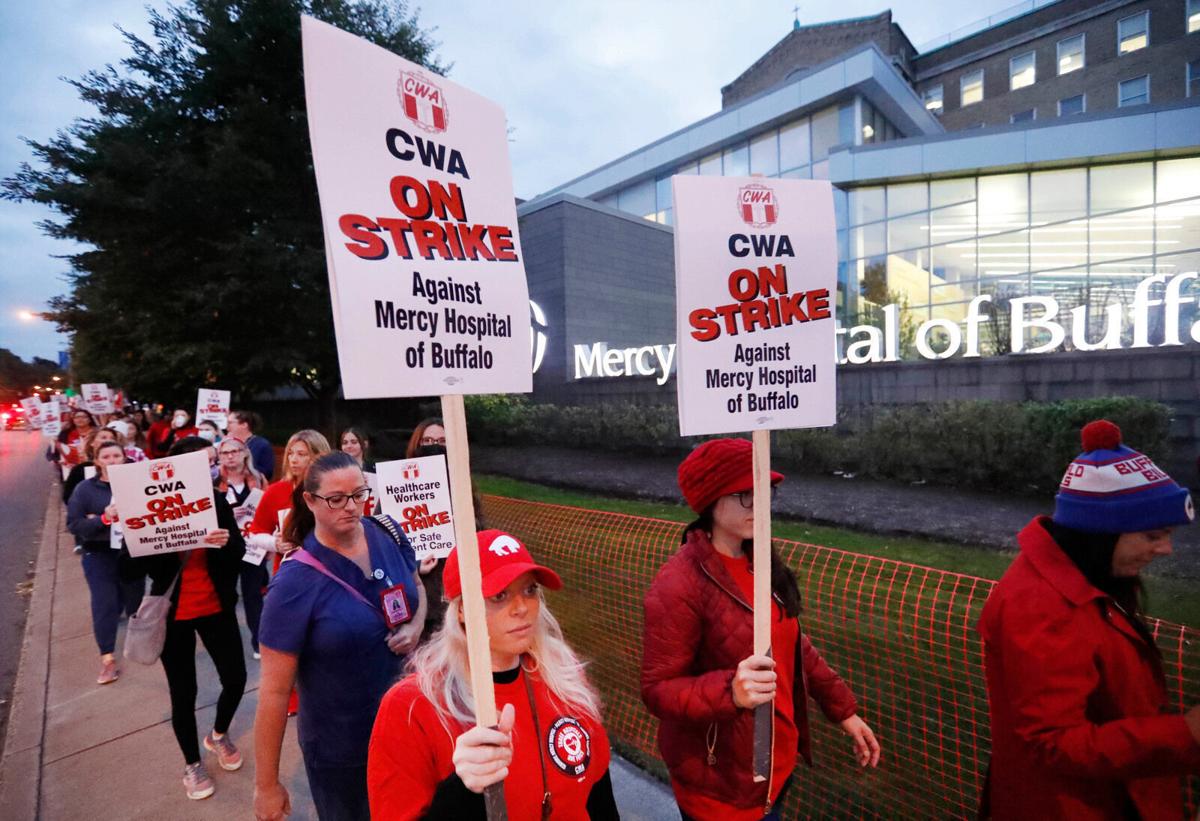
About 2,000 nurses, technical and clerical employees – about one-quarter of Catholic Health's payroll – began the strike after Catholic Health System and the union failed to reach a deal in talks that broke off a couple of hours earlier.
Debbie Hayes, upstate New York area director for CWA, explains the three issues at the center of the strike by Mercy Hospital nurses.
Both sides said they're eager to get back to the table, but progress has remained elusive in talks that began in February and heated up in recent weeks.
People are also reading…
Catholic Health’s CEO, Mark Sullivan, said Friday he thought a deal was close when the talks ended about 3:30 a.m.
Debora Hayes, the area director for the Communications Workers of America, said significant differences remained as morning approached.

"It's kind of a sad morning, because we hoped negotiations would result in an agreement, but it did not," said Debora Hayes, the CWA's area director.
It was unclear Friday afternoon when negotiations will resume. But both sides said they are committed to reaching a deal.
"As the CEO of Catholic Health, I have an obligation that’s about balancing fair and equitable wages and benefits for the associates with the future viability of Catholic Health," Sullivan said.
Hayes said the striking workers are willing to stay out for as long as necessary.
"We will not reach an agreement until we are sure that everything our members need is in the contract," she said.
What they are negotiating is a total of six labor contracts covering about 2,500 workers at Mercy Hospital of Buffalo, Kenmore Mercy Hospital and Sisters of Charity Hospital, St. Joseph Campus. A strike could only occur at Mercy Hospital, per a previous deal.
"There would have to be substantial movement at the table to bring people back," said Cathy Creighton, director of the Cornell University Industrial and Labor Relations School's Buffalo office.
Catholic Health provided its most recent offer to the union before the strike, a pitch that included a minimum average wage raise of 3% in the first year, with some jobs getting bigger increases, followed by 2% raises in the second and third years and 2.75% in the fourth.
While Catholic Health's proposal appeared to make progress on wage increases, it did not alleviate the union's concerns over staffing levels.
"We had a little movement, but honestly, they heard our words a little too late," said Cheryl Darling, an Immediate Treatment Assistant who is on the union's bargaining committee.
The union has maintained that Catholic Health has failed to agree to a "fair contract that would address the ongoing staffing crisis."

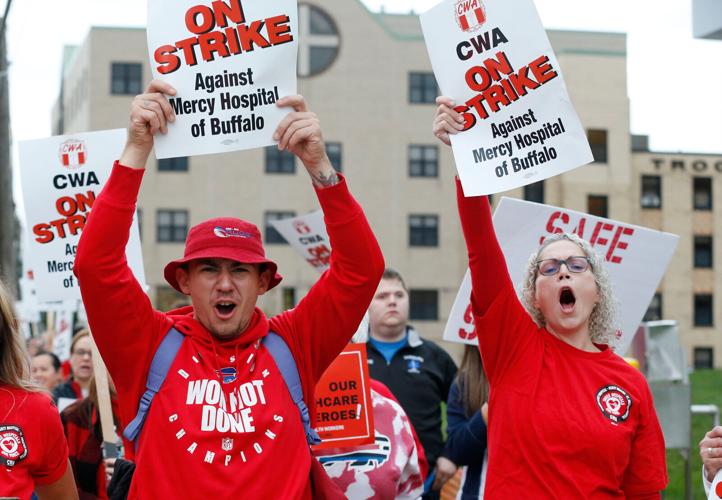
Nurses are vocal.
Catholic Health, Sullivan countered, proposed to increase staffing resources to 10% above average daily census for Kenmore Mercy Hospital and Mercy Hospital and add between 150 and 230 new employees in nursing, imaging and other service areas.
But there are no easy solutions amid a health care labor shortage, exacerbated by a tight job market where wages are rising in other professions and 18 months into a pandemic that has exhausted front-line health care employees.
“We know there’s a national staffing crisis," he said. "We know there’s a local staffing crisis. ... Those shortages cannot be addressed overnight."
Creighton, the Cornell expert who was a longtime union lawyer, said the wage and staffing discussions are closely related. Some of the lower-skill jobs at the hospital pay as little as $13 an hour, making it easy for those workers to switch fields and chase higher wages, especially with the minimum wage at $12.50 an hour and fast-food workers earning at least $15 an hour.
"Those jobs are paying wages that employees could make more money or earn a higher wage, maybe not the benefits, in a fast-food restaurant," she said. "If the wages are too low, then the retention rates are also low."

If a deal is not reached, it is expected that about 2,000 workers will be on the picket line in front of Mercy Hospital at 6 a.m. Friday.
Kathy Fidich of West Seneca, who has been a registered nurse at Mercy Hospital for 20 years, said the hospital's support staff, such as aides, dietary and other service workers, need to make more money, calling them "the backbone" of the hospital who keep the facility clean and running.
"The last year and a half has been hell," she said. "The staffing is atrocious."
With the strike ongoing, Sullivan said Mercy Hospital is operating and staffed by replacement workers who are certified professionals.
Catholic Health slimmed down several services at Mercy Hospital this week and contracted with Michigan-based staffing agency Huffmaster to provide replacement workers.
The positions listed on Huffmaster's website typically list a 60-hour deployment guarantee, and Sullivan said Catholic Health is spending "millions of dollars in installments" to the staffing firm, to bring in replacement workers. Sullivan said the health system had paid another installment on Friday, which will become a weekly expense for as long as the strike continues.
“It’s important to note that my family and I would come to this hospital today during the strike if health care was needed and of course in the future when our associates get back to work," Sullivan said. "The workers that you’re hearing outside are the soul of this hospital. They are the professionals that need to be back in the building caring for those in need.”
Sullivan said there were 200 patients at the hospital on Friday, compared to 322 on Friday. And as of mid afternoon, the hospital's emergency department had treated 52 patients, compared to 102 on Tuesday.
The union and its members said Friday that they had hoped to avoid a strike, but felt it was a necessary step to get the contract they want.
But that doesn't mean walking out and being away from patients doesn't hurt.
Amherst resident Amy Woods, a labor and delivery nurse at Mercy Hospital, was one of the employees who walked out the main entrance in the dark at 6 a.m. Friday, welcomed by colleagues busy drumming up honks from passing cars while clutching lit candles.
She's been working there for 20 years, doing the 6:45 p.m. to 6:45 a.m. shift. As she walked out Friday, she carried a sign that read, "Nurses rock."
"It was a very sad feeling, especially since I've worked here for 20 years. I had tears in my eyes," said Woods, pausing briefly as emotions bubbled up again. "We just want what is fair, especially after a rough year in a pandemic."
Sullivan acknowledged that the pandemic has been hard on Mercy's staff.
"We realize that our nurses, the caregivers you hear outside, are frustrated. They’re tired," Sullivan said. "They are the heroes of health care. There’s no contesting that."
Photos: Mercy Hospital nurses go on strike
Labor issue

Registered nurse Brianna Rodriguez walks the picket line.
United

More than 2,000 are striking outside the hospital.
Strike begins

Strikers cross the street as nurses leave the building at 6 a.m. and their strike begins.
Early morning strike

The nurses' primary issue with the hospital is short staffing.
A large presence

Strikers line the sidewalk around the hospital.
Picketing

Picketers along South Park Avenue.
Showing appreciation

One supporter shows appreciation for the nurses.
Nurses strike

Striking in front of the hospital.
Along South Park

Picketing along South Park Avenue.
Blocking replacements

Strikers block a van filled with replacement nurses from entering. They yell, "Go home scabs!"
Showing support

A passing car shows support.
Blocking the van from entry

Strikers block a van filled with replacement nurses from entering. They yell, "Go home scabs!"
No agreement

Nurses come out in mass to protest short staffing, among other issues.
Striker

Kerry Nowak is a registered nurse on the picket line.
Vocal opposition
Nurses are vocal.
Blocking replacements

Nurses block a van filled with replacements from entering.
Expressing opposition

One striker expresses opposition by putting his CWA sign up to the window of a van filled with replacements.
Walking around the building

Strikers along Choate Avenue.
Mercy Hospital strike

Strikers respond to support from passing cars.
Sending a message

Two strikers along Choate Street.