

This is a column about Rick Jeanneret.
It is also about Harold Arlen. And Harold Arlin.
Jeanneret you know.
Harold Arlen you should know. He is the Buffalo-born composer of “Over the Rainbow,” the greatest song of the 20th century. (Don’t take my word for it; the National Endowment for the Arts says so.)
Harold Arlin you probably don’t know — he was the world’s first sports broadcaster, 101 years ago, which makes him Jeanneret’s spiritual forebear.
When Arlin called the first baseball game on radio, on Pittsburgh’s KDKA, he didn’t even tell listeners his name. As the National Baseball Hall of Fame’s website puts it: “Stations preferred their announcers to be anonymous voices in those days in the fear that the on-air talent would become too popular.”
People are also reading…
They were right to see such popularity coming, but oh so wrong to fear it. Just look at Jeanneret: He is more popular these days than wings and weck and game-winning goals.
This week, RJ will broadcast his last game for the Buffalo Sabres. As it happens, his first Sabres broadcast came in 1971 — 50 years after Arlin used a converted telephone as a microphone to call a game from the box seats behind home plate at Forbes Field. (The Pittsburgh Pirates beat the Philadelphia Phillies, 8-5, on August 5, 1921.)
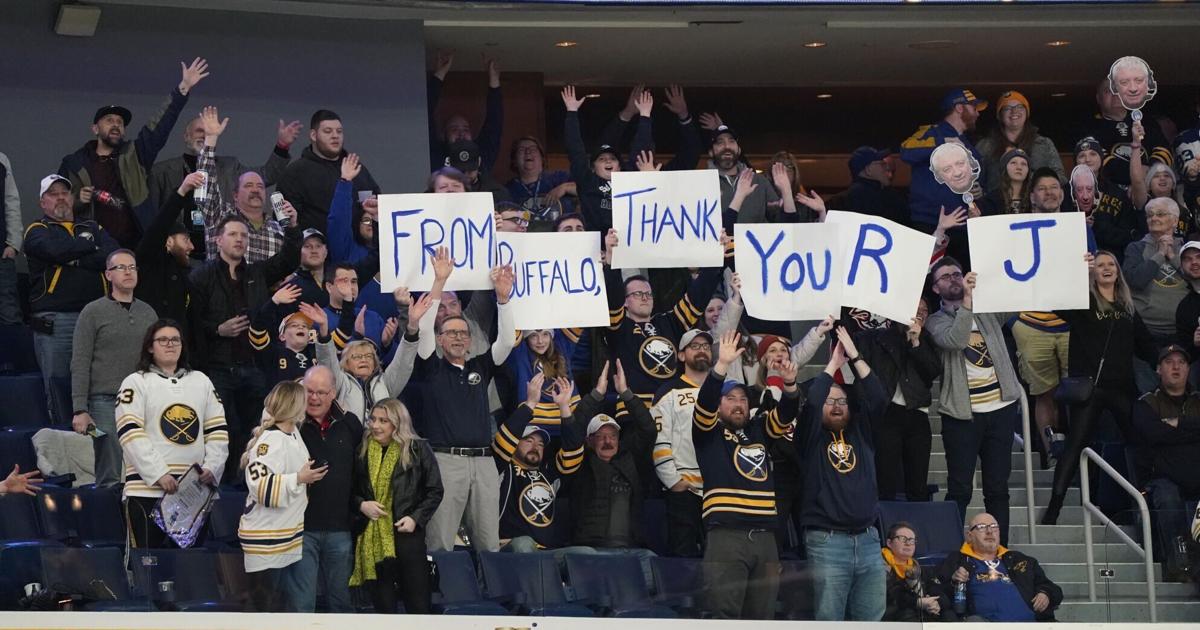
Jeanneret is a living embodiment of the reality that listeners fall for the voice of their favorite team. For proof, measured in decibels, one need go back only a few weeks, to RJ Night at KeyBank Center.
That night, he got to say goodbye to us. But how do we say goodbye to him? He’s like a member of the family. Jeanneret has been with us since the Sabres’ second season. He has seen them all, from Perreault to Power.
We love Sabres players, but they are at a remove from us: They play on ice, behind glass. It is different for longtime broadcasters. Rick is one of us. That’s how it feels. And, more important, how it sounds: His voice is as familiar as your father’s.
That voice surround-sounds our family rooms while we gather, and our cars while we drive. And it will stay with us long after his last call.
Van Miller died in 2015. He broadcast his first Buffalo Bills game in 1960, his last in 2003. Even now, when we hear him on old clips, Van’s voice offers a small thrill. The timbre brings us back to a time and place — from before the AFL title teams of the 1960s to beyond the AFC title teams of the 1990s.
It will be the same for RJ. He has been with us since before the Fog Game in 1975 through No Goal in 1999 all the way to Friday, when the Sabres host the Chicago Blackhawks in the last game of another lost season.
The Sabres offer real hope for next season, but we have run out of next years for RJ. This will take some getting used to. The kind of love we feel for him is of the kind that Nashvillians feel for Pete Weber, and that Los Angelenos felt for Vin Scully.
The intimacy of home markets allows that kind of bond. National broadcasters rarely reach that level of love. Joe Buck’s voice means Big National Game. Jack Buck’s voice, in St. Louis, meant root, root, root for the home team.
That’s what RJ’s voice means here. He understands the powers of observation and of memory. He tells us what he sees on the ice in the moment while reminding us of all those magic moments gone by.
Harold Arlin, 101 years ago, was not a sports broadcaster until the moment he became history’s first one. He was a 25-year-old electrical engineer who worked for Westinghouse, which owned KDKA, the nation’s first commercial radio station. Arlin’s bosses picked him to do that first game because he had a pleasing voice.
Harold Arlen was born in Buffalo in 1905 as Hyman Arluck. He composed songs for the 1939 film “The Wizard of Oz” with the lyricist Yip Harburg. Their masterpiece, of course, is “Over the Rainbow.”
Which, as it happens, is one way Rick Jeanneret commutes to Sabres games from his home in Niagara Falls, Ontario.
Over the Rainbow … Bridge.
Cue the music.
Somewhere over the Rainbow
Here comes Rick.
He’s got a voice that we heard tell
Tales of a hockey stick.
Somewhere over the Rainbow
There goes Rick.
And the games that he called are gone
From us much too quick.


