Two Oro Valley retirees are defending Christmas with a campaign they borrowed from Burma-Shave.
"All this commotion. Christmas is the legal holiday. We want to keep Christ in Christmas," said John Cieslinski, a 65-year-old member of Santa Catalina Catholic Church, 14380 N. Oracle Road, and the Santa Catalina Council of the Knights of Columbus, which is an organization of Catholic men.
"We're not just celebrating 'the holiday.' At New Year's you say Happy New Year. At Easter you say Happy Easter. We're celebrating Christmas," Cieslinski said.
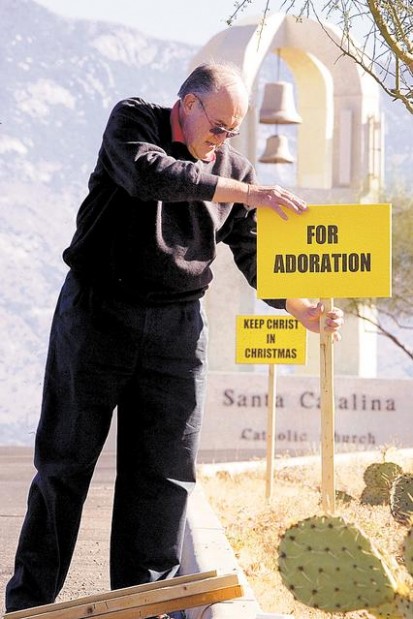
Each week since the beginning of Advent, Cieslinski and fellow Knights of Columbus member Maurice Weis, 77, with the help of Weis' wife, Lorraine, have been erecting a series of four signs in the driveway of their church. The final message of the signs is always the same: "Keep Christ in Christmas."
People are also reading…
Cieslinski is from Chicago and Weis is from Iowa, and they both remember the Burma-Shave signs advertising a brushless shaving cream that between the late 1920s and early 1960s blanketed the country with catchy slogans. An example: "His cheek was rough/His chick vamoosed/And now she won't/Come home to roost/Burma-Shave."
This week's series at Santa Catalina Church reads "Christmas is/A celebration/Now's the time/For adoration/Keep Christ in Christmas."
Sister Carole Ruland, administrator of the church, said she hasn't heard any feedback on the yellow-and-black signs, but Cieslinski and Weis say they've had some compliments and no complaints. They do admit that by putting the signs on church property they are preaching to the choir, so to speak.
The political correctness of the season has been fodder for public debate this year, triggered by religious conservatives who made an issue out of protocol in some department stores telling employees to say "Happy Holidays" rather than "Merry Christmas." Some conservative pundits went as far as to say Christmas is under siege.
Groups on the other side have since weighed in, noting that Celebrations of Hanukkah begin the night of Dec. 25 this year, and a growing group of non-religious Americans acknowledge the Winter Solstice, Dec. 21 this year.
The United States has also become more religiously diverse since the 1960s — about 77 percent of the country was identified as Christian in 2001, down from 86 percent in 1990, according to the City University of New York's American Religious Identification Survey.
Christmas Day itself has a curious history, as the early Christian community had no celebration for the birth of Jesus, since the date was unknown. In about the fourth century, Dec. 25 was designated as Jesus' date of birth because it had been the day of the pagan festival of Sol Invictus, which followed the Winter Solstice and acknowledged when the sun triumphed annually over the darkness of winter.
Cieslinski, who says "Merry Christmas" to store employees, said he's just trying to put in his two cents' worth.
"It's a cute reminder," he said. "The important thing is people are seeing our signs and reading them."
"We're not just celebrating 'the holiday.' At New Year's you say Happy New Year. At Easter you say Happy Easter. We're celebrating Christmas."
John Cieslinski
Church member


 Tucson's newest Shake Shack gets neighbors