


Here are some of Tucson's connections to 9/11 and its aftermath, recapped from an article by Arizona Daily Star reporter Henry Brean that was published five years ago to mark the 20th anniversary of the 2001 terror attacks.
U of A alum lost his life
Jeffrey Coombs grew up in Massachusetts, then enrolled at the University of Arizona because he wanted to experience someplace different far from home.
He met his wife-to-be, Christie, a Yuma native and fellow U of A student, at his fraternity house in 1978.
She told the Star in 2022 that Jeff was a “tall, funny, kind and goofy Bostonian,” who loved the outdoors.
He graduated with a business degree in December 1981, and she graduated with a journalism degree in May 1982. They got married in 1984 and briefly lived in Phoenix until a job opportunity drew Jeff back to Massachusetts with his new bride.
People are also reading…
On Sept. 11, 2001, he was supposed to fly to Los Angeles for a business conference. When he left for Boston’s Logan Airport that morning, he told Christie he would be home in time to celebrate their September birthdays together — hers on the 15th, his on the 18th. He would have turned 43 on that birthday.
A few hours later, Christie turned on the TV news and saw black smoke pouring from the North Tower of New York City's World Trade Center.
“It took a while to figure out that that was Jeff’s plane,” she said. An official from American Airlines called at just after 1 p.m. to confirm the worst.
“The hardest thing I had to do was tell the kids their dad wasn’t coming home,” Christie told the Star five years ago.
Their son was 13, and their daughters were 11 and 7 at the time of the tragedy.
That November, when Christie was still "trapped by the dark hole of grief," she and her children created the Jeff Coombs Memorial Foundation.
It was inspired by the enormous outpouring of support their family received after 9/11.
“So many people came out of the woodwork — friends, strangers, family, not just across Massachusetts but across the country,” she told the Star in 2022. “There were all kinds of nice gestures.”
Through an annual fundraising run in the Boston area held in Jeff Coombs’ memory from 2002 through 2022, the foundation raised and distributed more than $1 million to others in need, with a special emphasis on military families in the Bay State.
Ex-Tucsonan piloted plane in attack
There are 32 references to Arizona in the 9/11 Commission report, the government’s official, 585-page accounting of the events that led to the attacks. Tucson comes up four times, all in reference to people who lived here in the 1980s and early 1990s and were later linked by authorities to Osama bin Laden.
One of those men, Saudi-born Hani Hanjour, directly participated in the attacks. The 9/11 Commission identifies the 29-year-old as “the fourth pilot,” who steered American Airlines Flight 77 into the Pentagon.
A decade before that, Hanjour was a student at the University of Arizona’s Center for English as a Second Language and spent more than a year in Tucson, though he doesn’t appear to have left much of an impression.
In an exhaustive report in 2002, the Washington Post stitched together Hanjour’s movements leading up to 9/11 but found little to explain his turn toward extremism or his willingness to kill and die for the cause.
According to the Post, no one at the Islamic Center of Tucson recalled the man, and none of his instructors at the UA could pick him out of a photograph.
“An examination of Hanjour’s odyssey, drawn from interviews, flight training records, apartment rental applications and other documents, only deepens the mystery about his role,” the Post reported. “No one has been able to offer a definitive portrait of Hanjour, leaving unreconciled a number of seemingly contradictory facts about his life.”
Hanjour reportedly moved back to Saudi Arabia after studying at the U of A, but investigators say he returned to the U.S. in 1996 to attend flight schools in California, Florida and Arizona, where he lived for a time in the Phoenix area.
The eventual hijacker received a commercial pilot certificate from the Federal Aviation Administration in April 1999.
The 9/11 Commission concluded that Hanjour’s time in Tucson “may have been significant” because of the number of important al-Qaida figures who also attended the university or lived here in the 1980s and early 1990s.
That information comes from a CIA analysis titled, “Arizona: Long Range Nexus for Islamic Extremists,” which links Osama bin Laden to four former Tucson residents: Mubarak al Duri, Muhammad Bayazid, Wadih el-Hage and Wa’el Jelaidan.
Authorities say al Duri and Bayazid procured weapons for the terrorist leader. El-Hage served as bin Laden’s personal secretary and is now serving a life sentence at a federal Supermax prison in Colorado for plotting the 1998 bombings of the U.S. embassies in Kenya and Tanzania.
Jelaidan was president of the Islamic Center of Tucson from 1984 to 1985, then left the country in 1986 — with the tacit blessing of the U.S. government — to fight the Soviets in Afghanistan.
Two years later, he joined bin Laden and others to found al-Qaida.
Resulting war hit local school hard
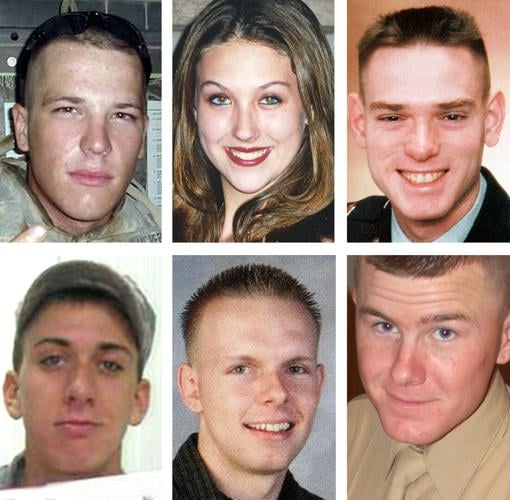
One Tucson-area school lost more than any other in the fighting that followed the terrorist attacks.
Six former students from Mountain View High School died while serving in the military after 9/11.
Three of the fallen came from the Class of 2004 and died in Iraq within 2 years of each other.
Army Pfc. Sam Williams Huff, 18, and Navy Hospitalman Chadwick T. “Chad” Kenyon, 20, were both killed in roadside bomb attacks — she on April 17, 2005, he on Aug. 20, 2006. Army Spc. Alan McPeek, 20, was killed in action on Feb. 2, 2007, on what was supposed to be his last day in Iraq.
Army Sgt. Kenneth Ross, a 24-year-old who graduated from Mountain View in 1999, served in Iraq and then died in Afghanistan when his helicopter crashed on Sept. 25, 2005.
A roadside bomb in Iraq killed Marine Lance Cpl. Budd M. Cote, 21, on Dec. 11, 2006. He attended Mountain View for his junior year and part of his sophomore year in 2002 and 2003.
Army Spc. Nathan Spangenberg, 21, survived a 15-month tour in Iraq, only to be found dead in his barracks in Hawaii from an illness on Sept. 8, 2009. He attended Mountain View from 2004 to 2006 and joined the military in 2007.
No other high school in the United States is known to have lost so many former students.
The school’s grim luck made national headlines. After McPeek was killed, the San Francisco Chronicle called Mountain View “war’s chosen high school.”
The Military Order of the Purple Heart, a service organization of and for wounded veterans, raised $5,000 for a permanent memorial at Mountain View.
The brick and concrete bench was installed next to the school’s flagpoles in the fall of 2014. The dedication ceremony included a salute by four riflemen.
The simple monument includes metal seals from each branch of the military and a plaque that talks about sacrifice.


