Dr. Robert Newman — member, technical counselor and former president of Ocean County's Experimental Aircraft Association Chapter 898 — has contributed to building over 12 airplanes throughout his lifetime.
His most recent feat, however, differs from the rest. It's the first that he, or anyone in aviation history, has constructed an airplane specifically for pilots without arms.
A retired school superintendent and experienced builder across mediums, "Bob the Builder" said he's been with the EAA chapter for over 35 years, building planes and helping fund aspiring pilots' flight lessons.
In 2020, the first-ever licensed pilot without arms, Jessica Cox of Tucson, wanted to find a tangible way to continue to spread the message that "disability does not mean inability." After conceptualizing the idea to build an aircraft modified specifically for armless pilots, her husband Patrick Chamberlain said they met with airplane manufacturer Van's Aircraft that November, who provided the kit to build the vehicle.
People are also reading…

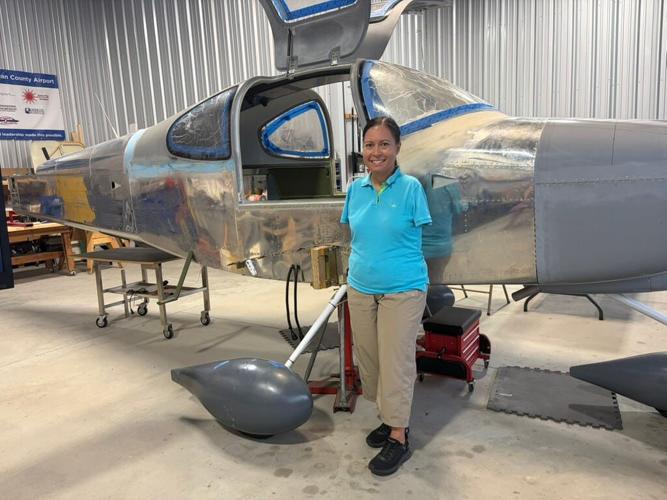
Tucson's Jessica Cox, the first armless licensed pilot, stands in front of "The Impossible Airplane" at Ocean County Airport in Berkeley, New Jersey. She said the first aircraft designed specifically for armless pilots is about six months from completion.
A couple of years later, after Cox flew into John F. Kennedy International Airport in New York City in her vintage ERCO Ercoupe, the plane was jet-blasted after landing. In need of an Ercoupe mechanic on the East Coast, Cox and Chamberlain called Gene Bunt, a member of EAA Chapter 898. When the duo told Bunt about wanting to start building the armless aircraft, Bunt suggested they get in contact with Newman.
After Cox called him with the idea to help construct what's been dubbed "The Impossible Airplane," he agreed to take it on as a project for the chapter.
Cox and her husband visited Newman's home in June 2022 to get to know each other, and the team then got to work on constructing a four-seater RV-10 aircraft with modifications to make armless operation intuitive to its design. Four years later, the plane is nearing completion, with Cox expecting it will be finished within the next six months.
"The first parts of this airplane came in a crate to my house and were delivered on June 27 (2022) — I know the date," Newman said. "I have pictures of her with a hammer tapping on this new box of parts that became the tail section."
Learning to build an airplane
Chapter 898, he said, began building planes about 10 years ago, when someone at a chapter meeting at Ocean County Airport mentioned the idea. Prior to building airplanes, he said the group focused on initiatives such as conducting flight safety seminars and providing free flights for children.
The New Jersey group purchased aircraft blueprints guiding the construction process, and has been continuously constructing planes throughout the decade. Each plane takes around three years to complete, he said, and he is planning to start a new one at the airport in the upcoming weeks.
"There are a lot of good people here who really just love to build. And a surprising number of the people here who build are airline pilots, or military pilots, and they fly planes, but this is the only place where they have a chance to actually build some," Newman said. "Building is not flying, flying is not building, so it offers a good outlet to receive skills and camaraderie."

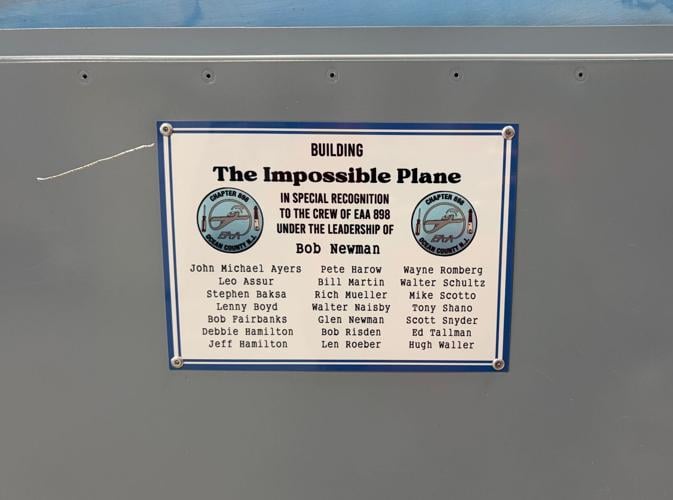
A placard located inside "The Impossible Airplane" honors the EAA 898 building team, which is building the aircraft.
Earlier this month, dozens of people gathered outside the chapter's hangar at the Ocean County Airport in the Bayville section of the township, barbecuing and photographing to celebrate the achievement of EAA Chapter 898 and Cox's nonprofit. The Rightfooted Foundation focuses on uplifting children without arms and spearheading projects like "The Impossible Airplane" and a dressing hook. Cox plans on flying the plane to visit aviation and disability events and facilities in the future, amplifying her foundation's message and furthering their impact.
Addressing the group, Newman said the process of building Cox's aircraft has been a "win-win" for all people involved, with volunteers willingly dedicating hours of their weeks and generous donations making the initiative possible.
The materials for the plane itself, Cox said, were primarily donated by manufacturers like Van's Aircraft and Lycoming, who provided the kit and engine, respectively. She said the overall dollar value of the plane is between $300,000 and $400,000.
Newman said this project marks a new, exciting moment for the chapter, with upcoming projects allowing the association to acquire money to put toward its scholarship fund.
"We really are education-based," he said. "We're here for pilots who are flying and want to stay safe and do what we can in terms of programs. We're here for young people who want to get their first flight in an airplane."
From fearful flyer to pilot
Cox, who was born without arms, acts as a motivational speaker to spread the message of adaptability and chasing your dreams. Cox said she used to be "terrified" of flying and thought the best way to get over her fear would be to learn how to fly herself. Starting in 2005, she said she began taking flight lessons.
In 2008, Cox earned her Sport Pilot Certificate, marking a historic win for aviation enthusiasts with disabilities. Now, as "The Impossible Airplane" prepares to leave Bayville and head to her home state of Arizona for final assembly and other finishing preparations, she said this aircraft will further heighten accessibility and ingenuity in the field.
Cox learned to fly using a 1946 Ercoupe, a two-seater plane and a rare example of an aircraft that does not use rudder pedals — meaning both of her feet can be used to operate the yoke and throttle without having to operate pedals.
However, the aircraft was not designed for the purpose of flying using one's feet. "The Impossible Airplane," she said, will feature modifications, like an updated yoke, that will make flying more comfortable for armless pilots.
"For example, the yoke — it's kind of like the steering wheel of the airplane — instead of a yoke would be typically, it's going to be like a shoe or a slipper, and I'll be able to put my foot in there and use my foot to control it, like a custom shoe," she said.
Surrounded by the team of over 20 volunteers, Cox stood alongside Chamberlain, who acts as Rightfooted Foundation's inclusive engineering director, and thanked the team for the thousands of hours and "blood, sweat and tears" put toward building the aircraft. The pilot personally signed certificates for all members of the building team by foot, a gesture commemorating her gratitude for their continued support, time and dedication.
"As a kid, I just remember being told so many times, 'You don't have arms, you can't do it,'" she said. "But now we have living proof that this is possible."
She said the creation of the aircraft will act as a symbol for children with disabilities to tangibly recognize that their aspirations are attainable and that the doubt and criticism they receive from others can be countered and challenged.
"We travel the country, we travel the world, and I don't see community like this. This is marvelous. And I thank you from the bottom of my heart," she said. "Patrick and I are going to have incredible hours flying this plane, knowing that you all made this possible, and sharing that message that disability does not mean inability."