

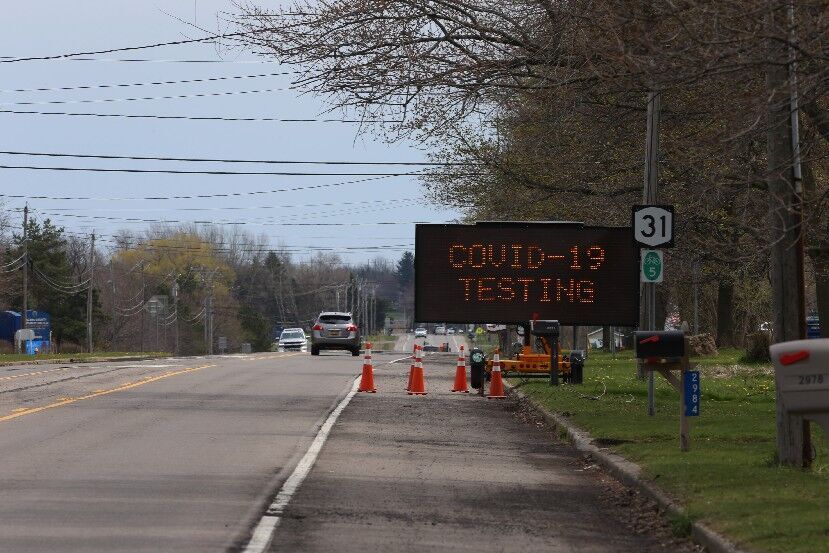
Epidemiologists, politicians and public health officials battling the Covid-19 pandemic track more than a dozen different metrics to gauge its spread. But in Western New York, one number has recently attracted particular attention – the “percentage positive” rate, or the share of the region’s Covid-19 tests that come back positive.
For the past nine days, Western New York’s rolling positive rate has strayed above 1%, the highest in the state. On Saturday, the state Department of Health deployed what Gov. Andrew M. Cuomo called a regional “SWAT team,” which will conduct free same-day Covid-19 tests at eight new sites in Erie, Niagara and Chautauqua counties.
Public health officials are particularly attentive to the positive rate because the metric is sensitive to early changes in transmission. An uptick in the positive rate often, though not always, precedes an increase in hospital and intensive-care unit admissions.
People are also reading…
On Friday, 1.2% of Western New York’s Covid-19 tests came back positive, yielding a seven-day average of 1.49% – both higher than the daily statewide rate of .67%.
Those rates still fall well below the threshold that both the state and World Health Organization use as an indicator that a community has contained the spread of the virus, though state and county officials urged precautions.
"For Western New York, we have a caution flag out," Cuomo said Friday, "and we're going to fly it a little bit higher today."
The emphasis on positive rates represents a shift from the start of New York State’s reopening, when the measure did not even appear on dashboards used to make reopening decisions. Positive rates only provide an accurate snapshot of community spread when testing is widespread and fast enough to represent present conditions.
But as the state’s testing infrastructure scaled up – running an average of 78,000 tests per day over the past week – the positive rate has become the closest thing health officials have to a real-time measure of Covid-19 transmission.
Testing generally identifies Covid-19 patients far earlier in the incubation of the disease than do other important metrics, such as new hospitalizations and ICU admissions. Those hospital numbers indicate the local healthcare system’s capacity to handle additional cases.
They do not, however, provide the early warning the positive rate does, because even severe cases often don’t appear in hospitals until two weeks after the patient’s initial exposure, according to the Centers for Disease Control and Prevention.
“The key numbers are the number of patients with Covid-19 in the hospital … and the positivity rate,” Dr. Peter Winkelstein, executive director of the University at Buffalo Institute for Healthcare Informatics, told The News earlier this month. “That number you want to keep as low as possible.”
But how low is low enough? The World Health Organization has recommended that governments hold off on reopening until positive rates in their respective regions fall below 5% for 14 consecutive days. Winkelstein called that threshold “reasonable.” New York State has since adopted it for reopening schools. According to state health department data, Western New York’s positive rate last exceeded 5% in May.
Still, politicians and public health officials say they are on guard against an increase, in part because much of the country has not adopted similar thresholds or experienced a similar reduction in spread. According to Johns Hopkins University, 30 states still have positive rates above 5%, despite a dramatic increase in testing. As of early Saturday morning, the positive rate for the U.S. as a whole hovered just under 6%.
“You may be over the pandemic, but the pandemic isn't over,” Erie County Executive Mark Poloncarz wrote on Twitter Thursday. “We are seeing an uptick in new COVID-19 cases, so now is not the time to be complacent.”


