
Members of the University of Arizona Navy ROTC will gather in the outline of the USS Arizona near Old Main on Saturday morning to mark the 83rd anniversary of the Pearl Harbor attack.
This year’s ceremony will be held at 9 a.m. at the USS Arizona Mall Memorial, just south of the U of A Student Union.
It will include a uniformed honor guard and remarks by Cmdr. Angela Gonzales, a naval science instructor and the Navy ROTC’s executive officer, and Andrew Desautels, secretary emeritus of the USS Arizona Reunion Association.
Rarely seen photos of the USS Arizona, sunk Dec. 7, 1941, in Pearl Harbor
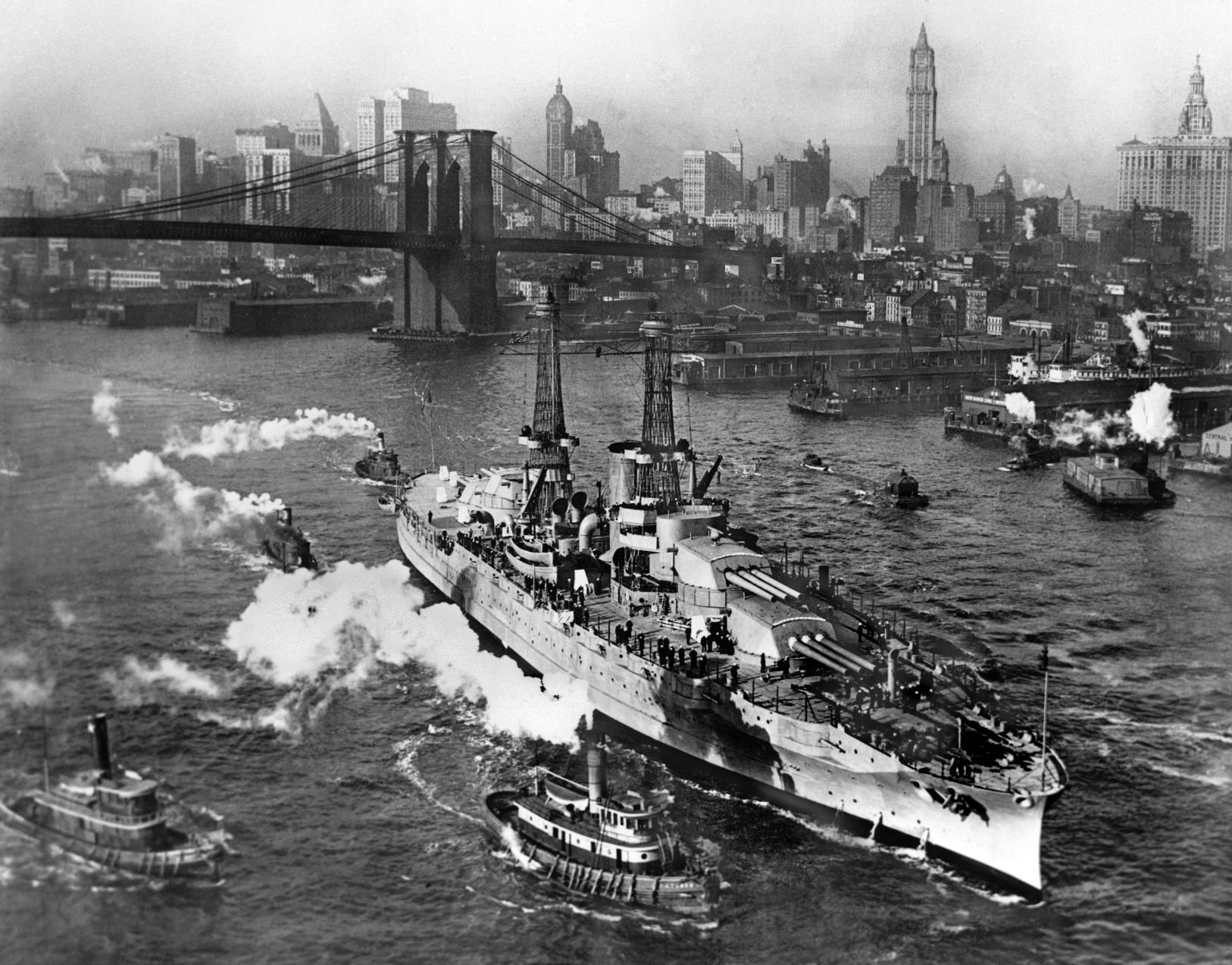
USS ARIZONA taken from Manhattan Bridge on the East River in New York City on its way back from sea trials. Note Christmas trees on both lookouts atop cage masts. December 25,1916.

View of Assistant Secretary of the Navy Franklin D. Roosevelt and Commandant Rear Admiral Albert Gleaves, USN, at the keel-laying of USS ARIZONA (BB-39) in 1914.

View of Waterfront Looking North from Top of Building Number 6, U.S.S. Arizona at Brooklyn Navy Yard in 1911

USS Arizona, Arrival of Sponsor, Brooklyn Navy Yard, New York, in 1915

The propeller shaft and aft cradle of the USS Arizona the day before its launch in 1915.

Launch of USS Arizona at the New York shipyards in June, 1915.

This is a hand out photo of the Arizona delegation at the christening of the ship on June 19, 1915 from the Life and Legacy of the USS Arizona exhibit at the University of Arizona Special Collections in Tucson. The photo includes Eva Behn, Mrs. W.W. Ross, Sec of Navy Josephus Daniels, Gov. George W.P. Hunt and Esther Ross who christened the ship. Note the rope still attached to the champagne bottle used in the christening. Courtesy of UA Special Collections

This is the remains of the champagne bottle and the rope that was attached to it that was used to christen the ship on June 19, 1915 from the Life and Legacy of the USS Arizona exhibit at the University of Arizona Special Collections in Tucson., on Nov. 23, 2016.

This is a detail of the champagne bottle used to christen the ship on June 19, 1915 from the Life and Legacy of the USS Arizona exhibit at the University of Arizona Special Collections in Tucson., on Nov. 23, 2016.

This is the remains of the water bottle used to christen the ship on June from the Life and Legacy of the USS Arizona exhibit at the University of Arizona Special Collections in Tucson., on Nov. 23, 2016.

This is a commemorative medal worn by the ship's sponsor, Esther Ross, during the christening of the ship on June 19, 1915 from the Life and Legacy of the USS Arizona exhibit at the University of Arizona Special Collections in Tucson., on Nov. 23, 2016. Note, the metal is from a casting from a cannon on the USS Maine which was sunk under mysterious circumstances in Havana, Cuba in 1898.

This is the reverse side of a commemorative medal worn by the ship's sponsor, Esther Ross, during the christening of the ship on June 19, 1915 from the Life and Legacy of the USS Arizona exhibit at the University of Arizona Special Collections in Tucson., on Nov. 23, 2016. Note, the metal is from a casting from a cannon on the USS Maine which was sunk under mysterious circumstances in Havana, Cuba in 1898.

The leader Arizona passing 96th St. Pier in great naval review at N.Y. City. Ca. 1918. Paul Thompson. (War Dept.) Exact Date Shot Unknown NARA FILE #: 165-WW-334A-4A WAR & CONFLICT BOOK #: 477

USS Arizona steaming with other Atlantic fleet battleships during gunnery practice, 1917.

A Sack race Recreation on board a battleship, circa 1916-1917. This ship is either USS Pennsylvania (Battleship # 38) or USS Arizona (Battleship # 39). The original image, copyrighted by N. Moser, New York, is printed on post card (AZO) stock.

The USS Arizona at sea on Dec 16, 1918 from the Life and Legacy of the USS Arizona exhibit at the University of Arizona Special Collections in Tucson. Courtesy of UA Special Collections

View of number 3 turret, with a Nieuport 28 airplane on the flying-off platform, at Guantanamo Bay, Cuba, circa spring 1921. Note: airing hammocks and mainmast details.

Firing 14" guns broadside during battle practice, 1920s.

U.S.S. Arizona in lock, Panama Canal, 1921

Pushing a peanut by blowing on it, during a shipboard competition on board USS Arizona (BB-39), circa 1923-1925.

Ship's complement posing on her forecastle, forward turrets and superstructure, circa 1924. The officer seated in the second row, 4th from right, is Ensign Arleigh A. Burke. Collection of Admiral Arleigh A. Burke, USN, 1977. U.S. Naval History and Heritage Command Photograph.

A 1922 Christmas program from the Life and Legacy of the USS Arizona exhibit at the University of Arizona Special Collections in Tucson. "At 'Em, " as in term Up and A'tem, was the ship's slogan.

U.S.S. Arizona in 1924
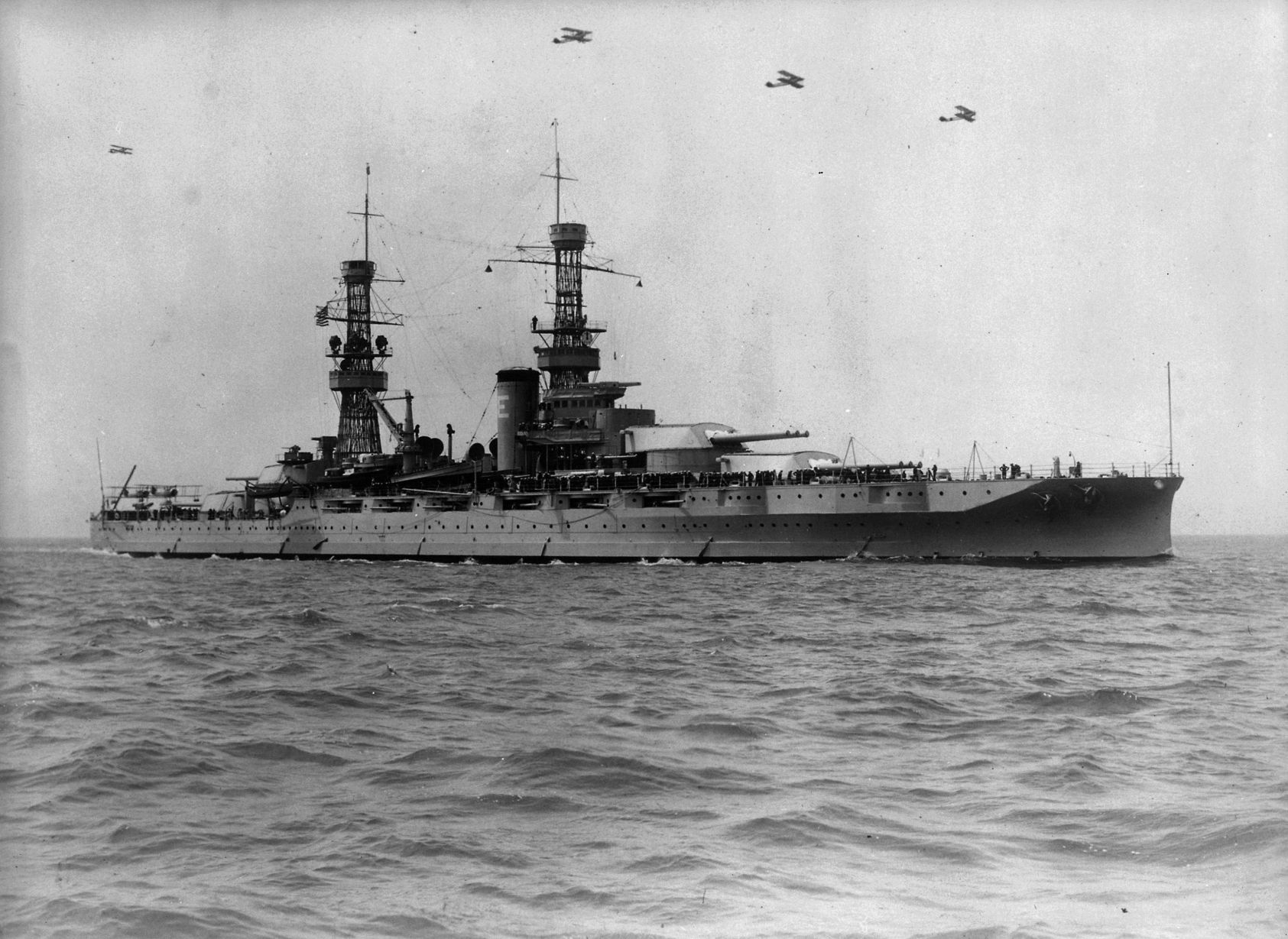
USS Arizona (BB39). Starboard bow, underway with aircraft overhead in 1927.

The ship's engineering crew posed by one of the gun turrets circa 1928 from the Life and Legacy of the USS Arizona exhibit at the University of Arizona Special Collections in Tucson. Note, a couple of African-Americans on the crew. Courtesy of UA Special Collections

USS Arizona's crew cleaning forward section near gun turrets #1 and #2, late 1920s.

An amphibious airplane rests on the catapult of the ship circa 1927 from the Life and Legacy of the USS Arizona exhibit at the University of Arizona Special Collections in Tucson. Courtesy of UA Special Collections

Aircraft are perched on the fantail of the ship while at anchor which may have have been taken in 1927-28 from the Life and Legacy of the USS Arizona exhibit at the University of Arizona Special Collections in Tucson.. Courtesy of UA Special Collections

Around 1929, an airplane is catapulted from the deck of the ship from the Life and Legacy of the USS Arizona exhibit at the University of Arizona Special Collections in Tucson. Courtesy of UA Special Collections

Crew members of the ship sweep the deck circa 1927-1928 from the Life and Legacy of the USS Arizona exhibit at the University of Arizona Special Collections in Tucson. Courtesy of UA Special Collections
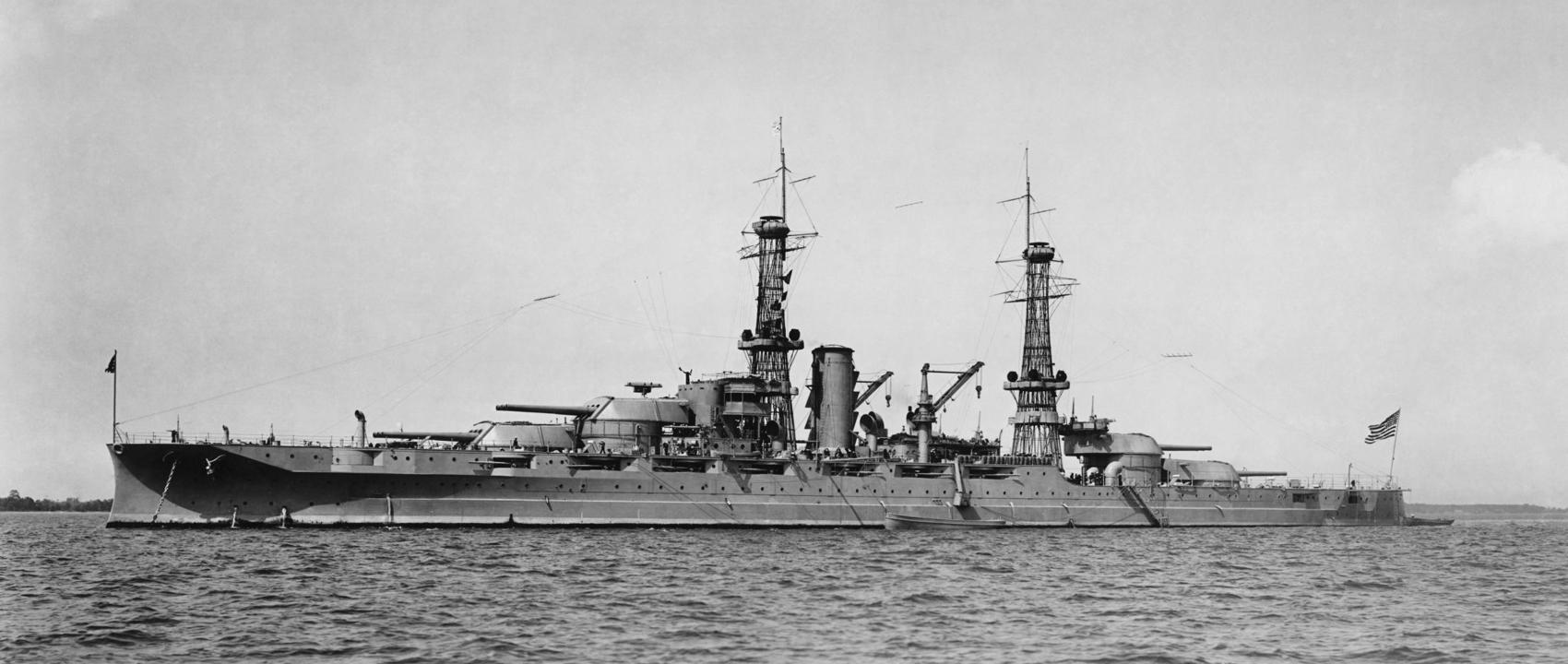
Arizona (BB39) port bow, before being modernized at Norfolk Naval Shipyard between May 1929 and January 1930. Photo taken between 1917 and 1929

Starboard rear quarter view of the U.S. Navy battleship USS Arizona (BB-39) in the Norfolk Naval Shipyard in Portsmouth, Virginia (USA), in March 1931 following her modernization. To the right are the destroyers USS Blakeley (DD-150) and USS Biddle (DD-151).

After being modernized the ship takes President Herbert Hoover, left, on a vacation cruise to the Caribbean as he walks with Secretary of War Patrick Hurley in March 1931 from the Life and Legacy of the USS Arizona exhibit at the University of Arizona Special Collections in Tucson. Courtesy of UA Special Collections

Dines at sea on board USS ARIZONA (BB-39). Captain Charles S. Freeman, Commanding Officer of BB-39, is fourth from the left. President and his party were embarked in ARIZONA for a 10 day tour of Puerto Rico and the Virgin Islands, beginning 19 March 1931.

Description: Underway with President Herbert Hoover on board, March 1931. The Presidential Flag is flying from her mainmast peak.

In drydock at Pearl Harbor Navy Yard, Oahu, T.H., 3 March 1932.

USS Arizona, Upon Completion of Modernization, Norfolk Navy Yard Ports, Virginia, Serial No. 140-31

Pitching in heavy seas during the 1930s. after modernization. Official U.S. Navy Photograph, now in the collections of the National Archives.

In early March 1933, the ship was sent to Long Beach, Calif., after an earthquake struck the area and the ship provided a shore party that helped patrol the area, communcations, set up first aid stations and food and shelter for the victims of the tremor from the Life and Legacy of the USS Arizona exhibit at the University of Arizona Special Collections in Tucson., on Nov. 23, 2016. Courtesy of UA Special Collections

USS Arizona central galley interior, 1930s.
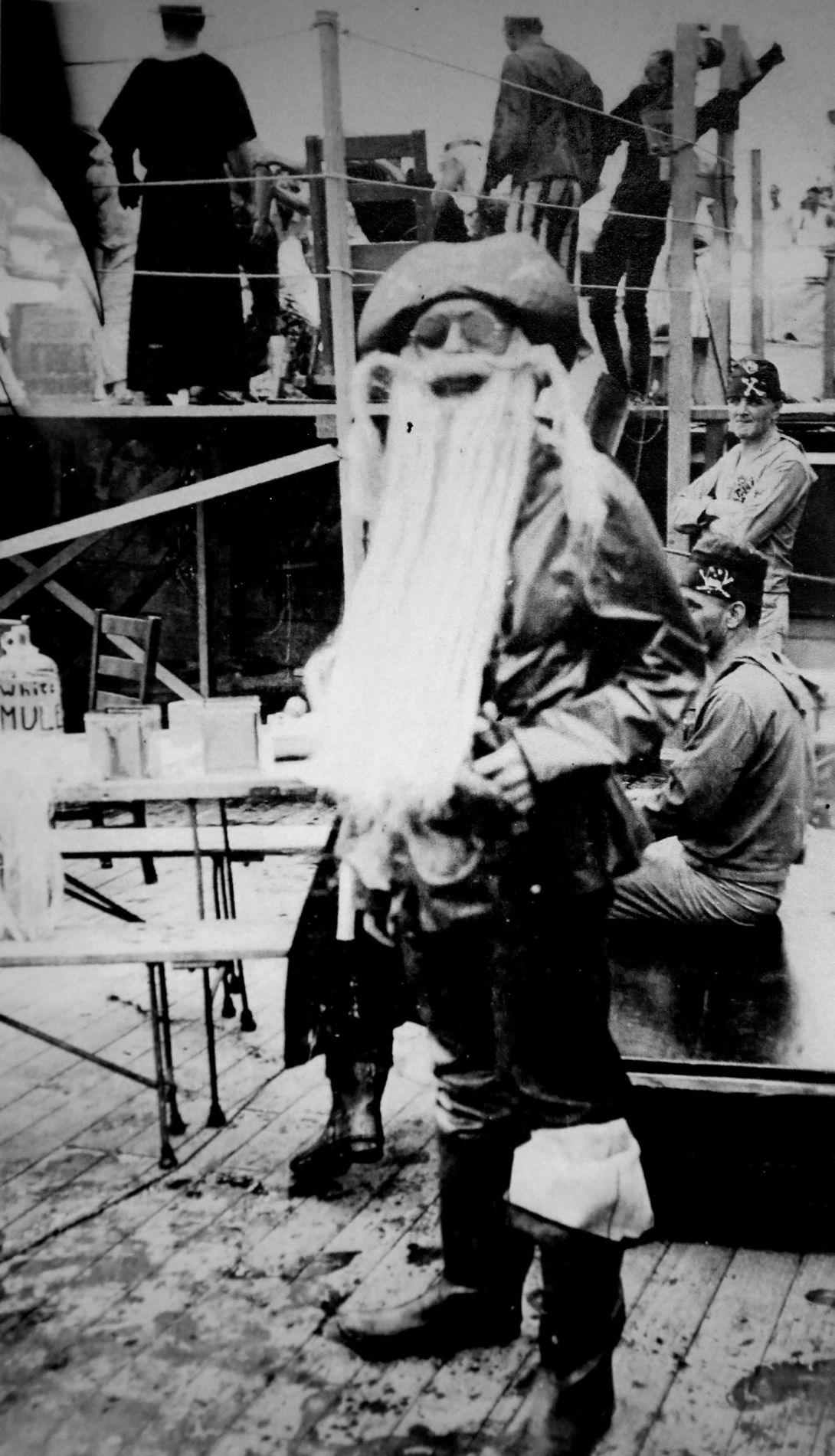
The naval tradition of the "crossing the line" ceremony is a long-standing ritual involving initiation rites of passage for new recruits crossing the equator for the first time as this 1936 photo of a sailor dressed as Davey Jones from the Life and Legacy of the USS Arizona exhibit at the University of Arizona Special Collections in Tucson. Courtesy of UA Special Collections

These are a couple of pages from William Charles Austin's scrapbook from the Life and Legacy of the USS Arizona exhibit at the University of Arizona Special Collections in Tucson. The book contains 96 pages of documents, black and white photographs of sailors, relatives and friends, US Naval battleships, the Arizona's athletic teams and interior views of the ship and aircraft from 1930-31. Courtesy of UA Special Collections

The ship's baseball team took batting practice wherever they could including at sea in this circa 1931-1938 Navy propoganda photo from the Life and Legacy of the USS Arizona exhibit at the University of Arizona Special Collections in Tucson. Courtesy of UA Special Collections

The ship's whale boat team in 1941 was the Pacific Fleet runner up from the Life and Legacy of the USS Arizona exhibit at the University of Arizona Special Collections in Tucson. Only two member of this team survived the attack at Pearl Harbor. Courtesy of UA Special Collections

Members of the USS Arizona band, known as Navy Band Unit 22, perform on Nov. 22, 1941, in the semifinal round of the Battle of Music at Bloch Arena at Pearl Harbor. They finished second and advanced to a final competition that would never be held. Everyone in the band died onboard the Arizona during the Japanese attack on Dec. 7, 1941. U.S. Navy photo by Tai Sing Loo

Aerial photograph from 2500 feet altitude, looking southward, showing the U.S. Fleet moored in the harbor on 3 May 1940. This was soon after the conclusion of Fleet Problem XXI and four days before word was received that the Fleet was to be retained in Hawaiian waters. There are eight battleships and the carrier Yorktown (CV-5) tied up by Ford Island, in the center of the harbor. Two more battleships and many cruisers, destroyers and other Navy ships also present, most of them moored in groups in East Loch, in the foreground. A few of the destroyers are wearing experimental dark camouflage paint. In the distance, center, is Hickam Army Air Field. The Pearl Harbor entrance channel is in the right distance.

Vertical aerial photograph from 17,200 feet altitude, looking directly down on East Loch and on the Fleet Air Base on Ford Island. Taken on 3 May 1940, after the conclusion of Fleet Problem XXI, and just prior to the 7 May receipt of word that the Fleet was to be retained in Hawaiian waters. There are eight battleships and the carrier Yorktown (CV-5) tied up along the island's southeastern side (toward the top), with two more battleships alongside 1010 dock at top right center. Two light cruisers and two destroyers are among the ships moored along Ford Island's northwestern side. Seventeen other cruisers and over thirty destroyers are also visible, mainly in East Loch. At the seaplane base, at the southern (top right) tip of Ford Island, are at least 38 PBY patrol planes.

Vertical aerial view of Battleship Row, beside Ford Island, during the early part of the horizontal bombing attack on the ships moored there. Photographed from a Japanese aircraft. Ships seen are (from left to right): USS Nevada; USS Arizona with USS Vestal moored outboard; USS Tennessee with USS West Virginia moored outboard; USS Maryland with USS Oklahoma moored outboard; and USS Neosho, only partially visible at the extreme right. A bomb has just hit Arizona near the stern, but she has not yet received the bomb that detonated her forward magazines. West Virginia and Oklahoma are gushing oil from their many torpedo hits and are listing to port. Oklahoma's port deck edge is already under water. Nevada has also been torpedoed. Japanese inscription in lower left states that the photograph has been officially released by the Navy Ministry. Donation of Theodore Hutton, 21 September 1942. U.S. Naval History and Heritage Command Photograph.

USS Arizona (BB-39) ablaze, just after her forward magazines exploded. At right, shrouded in smoke from the fire, are the main and foremasts of USS West Virginia, which is listing sharply to port after she was torpedoed. Upright mast further to the right is the mainmast of USS Tennessee (BB-43), moored inboard of West Virginia. The bow and foremast of USS Vestal (AR-4), moored outboard of Arizona, are visible at the left. Official U.S. Navy Photograph, now in the collections of the National Archives.

Vertical aerial view of Battleship Row, beside Ford Island, soon after USS Arizona was hit by bombs and her forward magazines exploded. Photographed from a Japanese aircraft. Ships seen are (from left to right): USS Nevada; USS Arizona (burning intensely) with USS Vestal moored outboard; USS Tennessee with USS West Virginia moored outboard; and USS Maryland with USS Oklahoma capsized alongside. Smoke from bomb hits on Vestal and West Virginia is also visible. Japanese inscription in lower left states that the photograph has been reproduced under Navy Ministry authorization. U.S. Naval History and Heritage Command Photograph.

Aftermath of the Japanese sneak attack on these three stricken U.S. battleships; from left to right: West Virginia (BB-48) (severely damaged),Tennessee (BB-43) (damaged), and the Arizona (BB-39) (sunk). (click on image to zoom in)

The USS Arizona (BB-39) burning after the Japanese attack on Pearl Harbor, 7 December 1941. USS Arizona sunk at en:Pearl Harbor. The ship is resting on the harbor bottom. The supporting structure of the forward tripod mast has collapsed after the forward magazine exploded.

The forward magazines of the U.S. Navy battleship USS Arizona (BB-39) explode shortly after 08:00 hrs during the Japanese attack on Pearl Harbor, Hawaii (USA), 7 December 1941.

Front page of the Arizona Daily Star on the morning after the Pearl Harbor attack in 1941.

Burned out and sunk in Pearl Harbor on 10 December 1941, three days after she was destroyed during the 7 December Japanese raid. Ships in the background are USS Saint Louis (CL-49), in center, and the hulked minelayer Baltimore (CM-1) at left. Official U.S. Navy Photograph, from the collections of the Naval History and Heritage Command.

Battleships moored off Ford Island in Pearl Harbor after the Japanese attack on Dec. 7 1941.
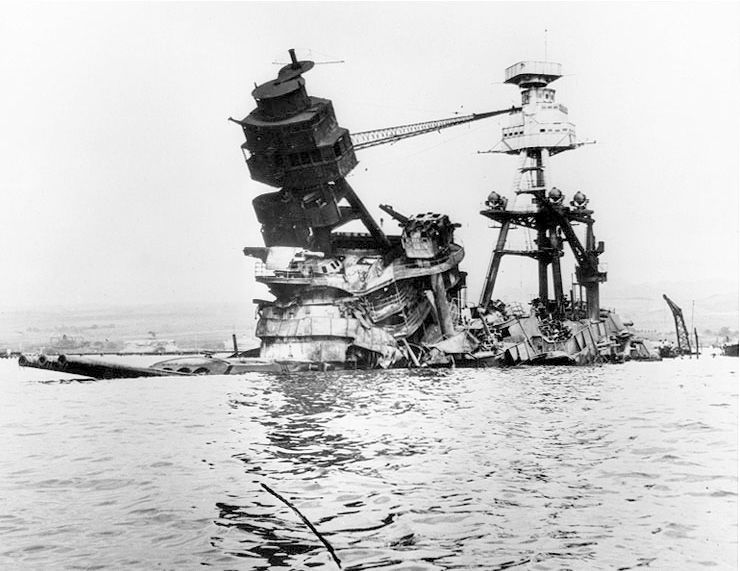
Burned-out wreck of USS Arizona, at Pearl Harbor, December 1941
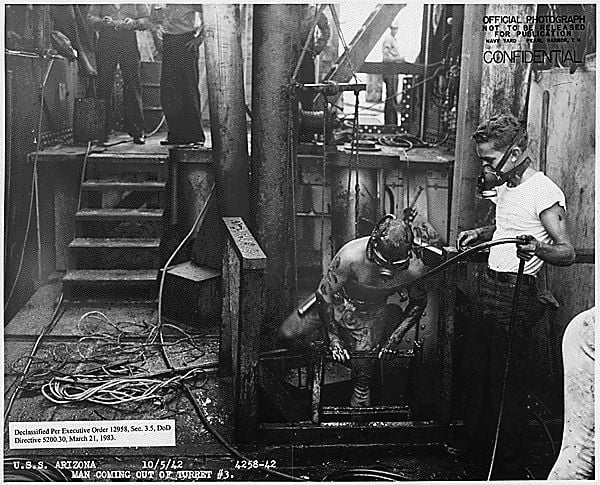
USS Arizona 4358-42; Man coming out of turret #3 in 1943. Department of the Navy. Fourteenth Naval District. Pearl Harbor Naval Shipyard. Fleet Salvage Unit. ca. 1941-1947

The USS Arizona's sister ship, the USS Pennsylvania (BB-38) leading USS Colorado (BB-45) and the cruisers USS Louisville (CA-28), USS Portland (CA-33), and USS Columbia (CL-56) into Lingayen Gulf, Philippines, in January 1945.

USS Arizona, Submerged off Ford Island, Pearl Harbor, Honolulu, Honolulu County, HI

Aerial of Pearl Harbor and Ford Island with salvage operations of USS Arizona underway on Oct. 27, 1942.
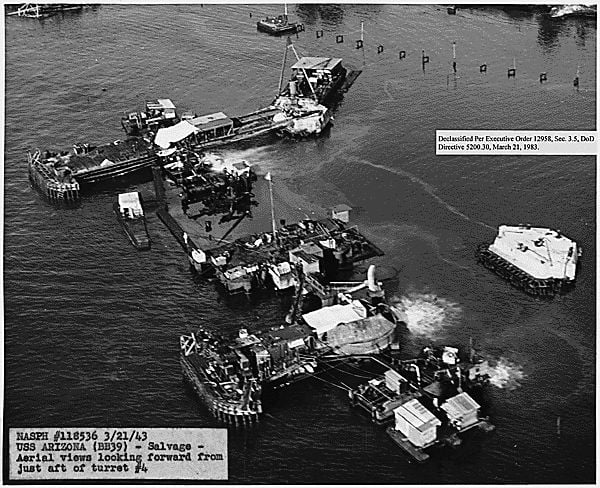
Aerial of Pearl Harbor and Ford Island with salvage operations of USS Arizona underway on Oct. 27, 1942. View is just aft of the gun turret #4.

USS Arizona, Submerged off Ford Island, Pearl Harbor, Honolulu, Honolulu County, HI
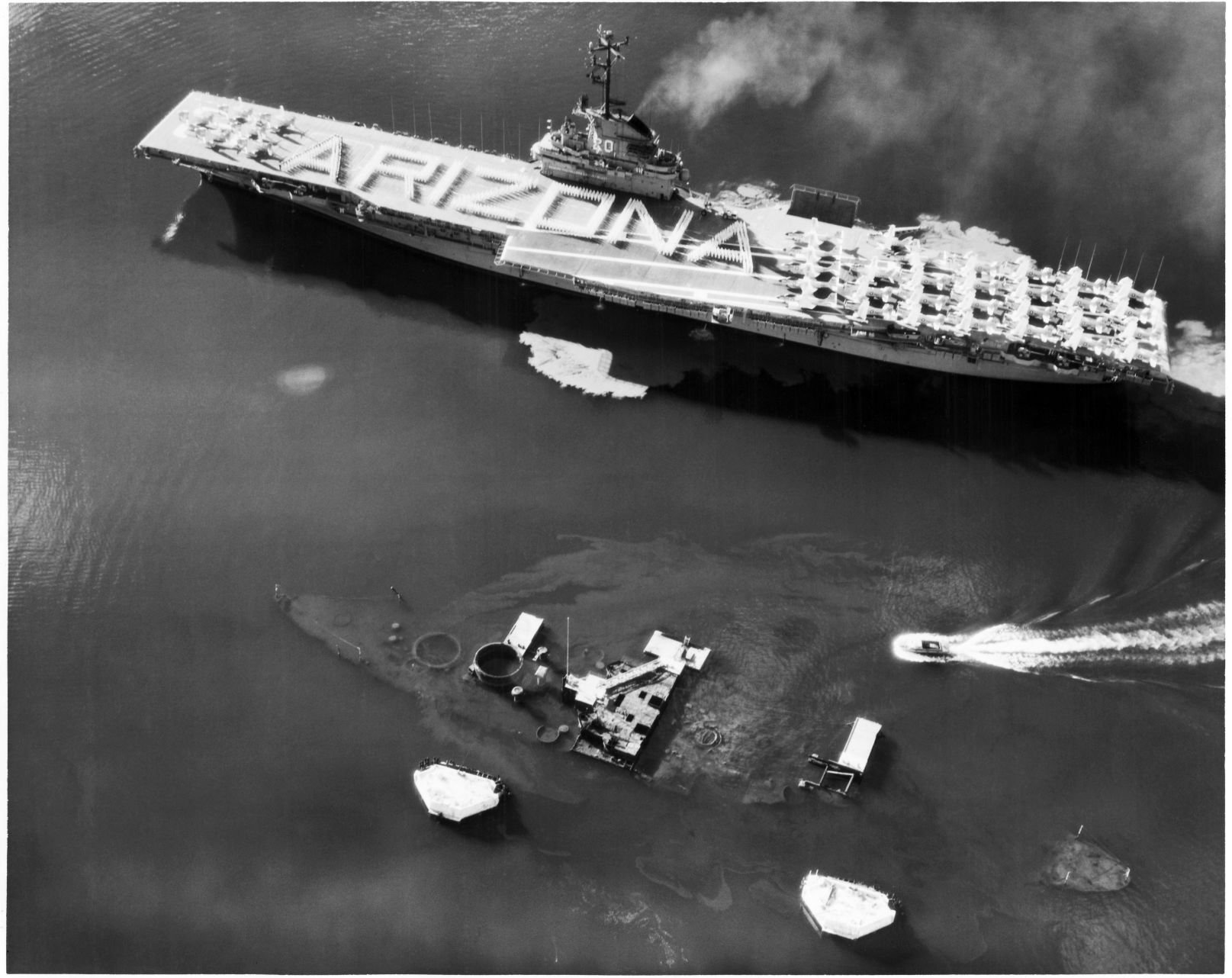
Passes the wreck of USS Arizona (BB-39) in Pearl Harbor, Hawaii, on Memorial Day, 31 May 1958. Bennington's crew is in formation on the flight deck, spelling out a tribute to the Arizona's crewmen who were lost in the 7 December 1941 Japanese attack on Pearl Harbor. Note the outline of Arizona's hull and the flow of oil from her fuel tanks. Official U.S. Navy Photograph.

A starboard quarter view of the battleship USS NEW JERSEY (BB 62) passing the USS ARIZONA Memorial in 1986.

Tugs move USS MISSOURI (BB 63) to her berth at Ford Island (background). This berth is roughly where the battleships MARYLAND (BB 46) and OKLAHOMA (BB 37) were moored on 7 December 1941. The 184 foot-long USS ARIZONA Memorial in the foreground spans the mid-portion of the sunken battleship USS ARIZONA (BB 39).

An aerial view of the USS Arizona Memorial with a US Navy (USN) Tour Boat, USS Arizona Memorial Detachment, moored at the pier as visitor disembark to visit and pay their respects to the Sailors and Marines who lost their lives during the attack on Pearl Harbor on December 7, 1941.

Elgin clock that is reported to have been recovered from the Admiral’s bridge aboard the battleship USS Arizona (BB-39) following its loss on December 7, 1941.

USS Arizona cruise album (P130) with open pages titled “Memory Leaves” signed by friends/shipmates, listing their hometowns.

The Smooth Log from the Life and Legacy of the USS Arizona exhibit at the University of Arizona Special Collections in Tucson., on Nov. 23, 2016. The log is a source reference for historical data of all weapon system aboard the ship. It is used for inspections, material readiness and operation documentation.

Construction Mechanic 3rd Class Ben McCallum (left) and Hospital Corpsman 1st Class James Aldridge, with Underwater Construction Team (UCT) 2 Construction Dive Detachment (CDD) Alpha, swim toward the USS Arizona Memorial at Pearl Harbor, Hawaii, to conduct an indoctrination dive for future work May 20, 2016.

Steel Worker 1st Class Jesse Hamblin (left) and Builder 2nd Class Justin Lieder, with Underwater Construction Team (UCT) 2 Construction Dive Detachment (CDD) Alpha, examine a ladder well of the USS Arizona in Pearl Harbor, Hawaii, during an indoctrination dive for future work May 20, 2016.

USS Nimitz (CVN 68) passes by the Arizona Memorial as Sailors spell out "FREEDOM" and man the rails of the ship as the ship pulls into Pearl Harbor for a liberty visit in 2001. The stop is the first port call for Nimitz following a transit around South America while on the way to the her homeport of San Diego, Calif.

The USS Port Royal (CG 73) commanded by Capt. Pat Allen, prepares to pass in review and render honors to the USS Arizona Memorial with the sunken battleship's gun turret number three protruding from the water during the Dec. 7th commemoration ceremony hosted by Commander, Navy Region Hawaii.

Aviation Structural Mechanic 2nd Class Jennifer Usenick, assigned to the Golden Eagles of Patrol Squadron (VP) 9, reads the list of fallen military members following colors aboard the USS Arizona Memorial in Pearl Harbor, Hawaii in 2014. The memorial marks the resting place of more than 1,000 Sailors and Marines who were killed aboard the battleship USS Arizona (BB 39) during the 1941 attack on Pearl Harbor.

Sailors salute as USS John C. Stennis (CVN 74) passes the Arizona Memorial on Dec. 2, 2016, and arrives at Joint Base Pearl Harbor-Hickam to participate in National Pearl Harbor Remembrance Day events. Dec. 7, 2016, marks the 75th anniversary of the attacks on Pearl Harbor and Oahu.
NATICK, Mass. — A World War II museum in Massachusetts is displaying artifacts commemorating the Pearl Harbor attack ahead of the Dec. 7 anniversary.
The International Museum of World War II says it recently acquired a life ring from the USS Arizona.
The battleship was among those destroyed in the surprise attack by Japan on the U.S naval base in Hawaii that prompted the U.S. to enter the war in 1941.
The ship's sunken remains are now a national memorial.
The museum, located in the Boston suburb of Natick, also displays many other artifacts related to the attack.
Among them is Japan's formal declaration of war against the U.S., pieces of Japanese planes shot down at Pearl Harbor and women's panties that read: "Remember Pearl Harbor, Don't Get Caught with Your Pants Down."
The ceremony will begin with an invocation and the national anthem and end with a taps bugle call and a bell ringing to honor the 1,177 sailors and Marines from the Arizona who died in the Japanese attack on Dec. 7, 1941.
The commemoration will be followed by the fourth annual Remember the Arizona 5K Run and Walk, organized by the university’s ROTC and Veterans Education and Transition Services programs in partnership with Arizona Online and U of A Outreach, Distance and Continuing Education.
People are also reading…
Also Saturday morning, Bear Down Field will host a dramatically scaled-down, flag-football version of the Army-Navy game, featuring local Army and Navy ROTC members.
All of the events are free and open to the public. Registration for the 5K starts at 8:30 a.m.

Midshipman 1st Class Dominic Estevez and members of the University of Arizona Navy ROTC are reflected in a memorial plaque for the USS Arizona Mall Memorial in 2019. A ceremony Saturday morning will mark the 83rd anniversary of the Pearl Harbor attack.
“Community members and visitors are invited to attend the memorial ceremony, participate in the 5K and watch the football game as part of this meaningful day of remembrance and unity,” said Blaze Smith, director of the U of A’s VETS and ROTC programs.