The U.S. Department of Homeland Security is telling a federal court that a new double-layered border wall will not trespass on the Tohono O'odham Nation.
And an attorney for DHS, Christopher Anderson, says in the new filing that the department's claim goes beyond the disputed question of who owns the first 60 feet along the international border.
He is telling the Court of Appeals for the District of Columbia that it doesn't matter even if the project does spill over, north of that strip, onto property that even the federal government concedes does belong to the tribe. He said the Tohono O'odham Nation still has no legal right to go to court to stop the work in the first place.

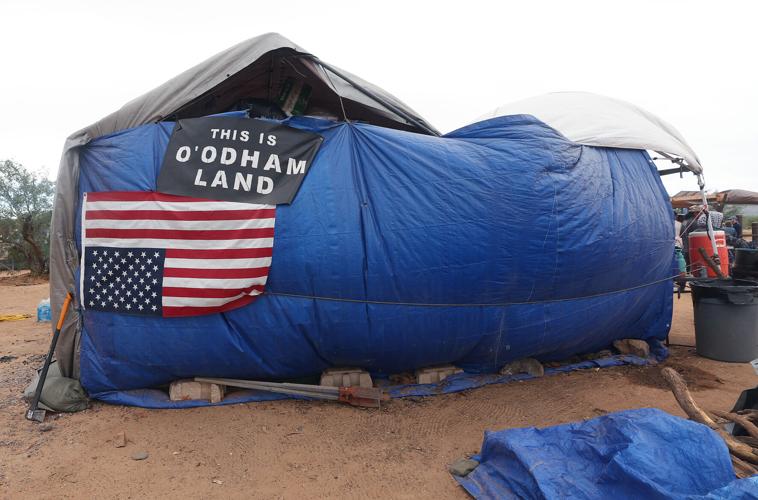
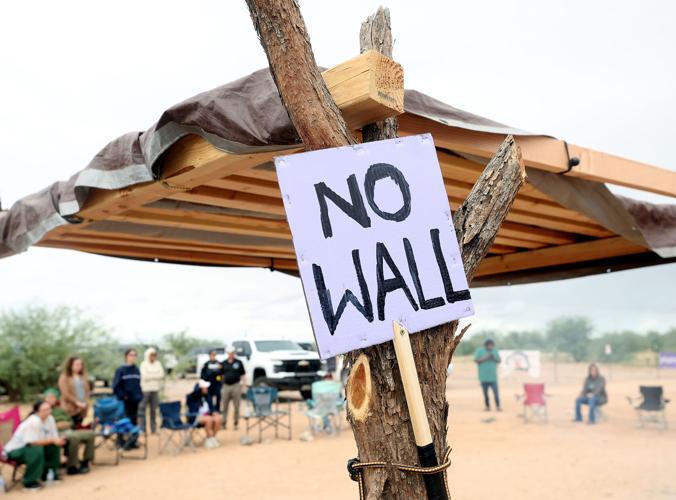
Members of the Tohono O'odham Nation who oppose the planned border wall have set up a prayer camp and fire circle at the San Miguel U.S./Mexico border gate on the Tohono O'odham Nation. They have gathered there to keep tabs on federal contractors' construction activity.
"To the government's knowledge, no court has ever recognized a federal common-law cause of action for trespass against the United States with respect to tribal trust property,'' Anderson said in a filing Thursday with the appellate court.
People are also reading…
Anderson, representing Homeland Security Secretary Markwayne Mullin, acknowledged that there have been lawsuits where courts have allowed tribes to sue those who trespass.
"But those cases are inapplicable to actions against the United States, which stands in a unique relationship to Indian tribes,'' he told the three-judge panel.
All this comes as the Tohono O'odham Nation, having lost its bid in federal district court to halt construction, seeks an emergency injunction from the appellate judges to give it more time to make its arguments that the construction is illegal.
"The secretary is poised to begin destroying the reservation landscape in furtherance of his wall project,'' attorney for the tribe Riya Kanji told the appellate court last week. "The nation asks this court to pause such irreversible and profoundly harmful activity until the court has the opportunity to rule on the merits of the nation's claim.''
But at this point, the appellate court is not set to decide on the tribe's request until after Oct. 28, meaning that, for the time being, there is nothing stopping the federal government from proceeding.
Much of the legal fight is over who owns the land on which the double-layered 30-foot fence of steel and concrete is going to be built along the 62 miles of international border on the reservation's edge.
Tribal attorneys say that property is the Tohono O'odham Nation's and that what the government is doing amounts to shrinking the size of the reservation, something they contend can be done only by Congress.

Tohono O'odham Nation members who oppose the U.S. plans to build a new border wall have set up a prayer camp and fire circle at the San Miguel U.S./Mexico border gate on the Tohono O'odham Nation.
Homeland Security, by contrast, cites a 1907 proclamation by President Theodore Roosevelt declaring that all public lands within 60 feet of the international boundary are under the exclusive control of the federal government. DHS contends that trumps any claim by the tribe, whose reservation was not established by Congress until 1917.
Anderson also told the judges that the walls will be contained within that 60-foot area.
But even assuming the Tohono O'odham have no right or control over that space — something the tribe is not conceding — Kanji is telling the court that contractors hired by Homeland Security are now or will be trespassing on lands that even the U.S. government agrees is tribal land.
"Wall construction will require extensive staging areas, material storage, equipment parking, and portable concrete batch plants that extend hundreds to thousands of feet beyond the immediate border,'' he said. That will "result in substantial and long-lasting disturbances to the soils, hydrology, desert pavement, and vegetation communities,'' which could take centuries to repair, Kanji said.

Warren Mattias sings a song as members of the Tohono O'odham Nation perform a dance around a fire that has been burning since Aug. 10 inside a prayer camp at the San Miguel U.S./Mexico border gate on the Tohono O'odham Nation, where they oppose the U.S. plans to build a new double-layered border wall.
Anderson is telling the appellate court to ignore the claim that the project will spill beyond the 60-foot zone.
"The secretary has instructed the contractor to confine the project footprint, which includes, among other things, the alignment of the barrier system and temporary staging areas, to the 60-foot Roosevelt Reservation,'' he wrote in the new filing.
But Anderson told the appellate judges that, no matter what happens and no matter how much land is needed for the project, it really doesn't matter — at least not legally.
"Even if the tribe were proved right, and construction of the barrier were to require access to land outside the Roosevelt Reservation, that would not mean that construction of the barrier would inevitably result in a trespass,'' he said.
The secretary has authority, Anderson said, stemming from a 2006 federal law specifically directing Homeland Security to construct new border barriers. That was reinforced just last year when Congress appropriated $46.5 billion for "the border infrastructure and wall system," he added.
"The court should therefore presume that if the secretary needs to access lands outside the Roosevelt Reservation, he will secure the lawful access to do so,'' Anderson said.
He said that means, at least at this point, that the tribe is not entitled to the immediate injunction it seeks to halt any work on the wall while its underlying claims about who owns what play out in front of a trial judge.
There currently is no court order blocking the contractors hired by Homeland Security from continuing the work they already are doing in preparation for construction.
There also is no indication that the appellate court will act soon.
In fact, on Thursday the judges gave the tribe through Oct. 28 to respond to the government's latest filing. That means there will be no decision on an injunction before then.
Separate efforts by tribal police to stop construction, including "no trespassing'' signs, also have failed to stop the work. Tribal leaders said that about 20 masked and armed agents from Customs and Border Protection came onto the reservation to allow contractors to do pre-construction activities.
Howard Fischer is a veteran journalist who has been reporting since 1970 and covering state politics and the Legislature since 1982. Follow him on X, Bluesky and Threads at @azcapmedia or email azcapmedia@gmail.com.