A tree-sitting protest on the Arizona border has become an international affair with the addition of an activist in a second tree on the Mexican side of the line.
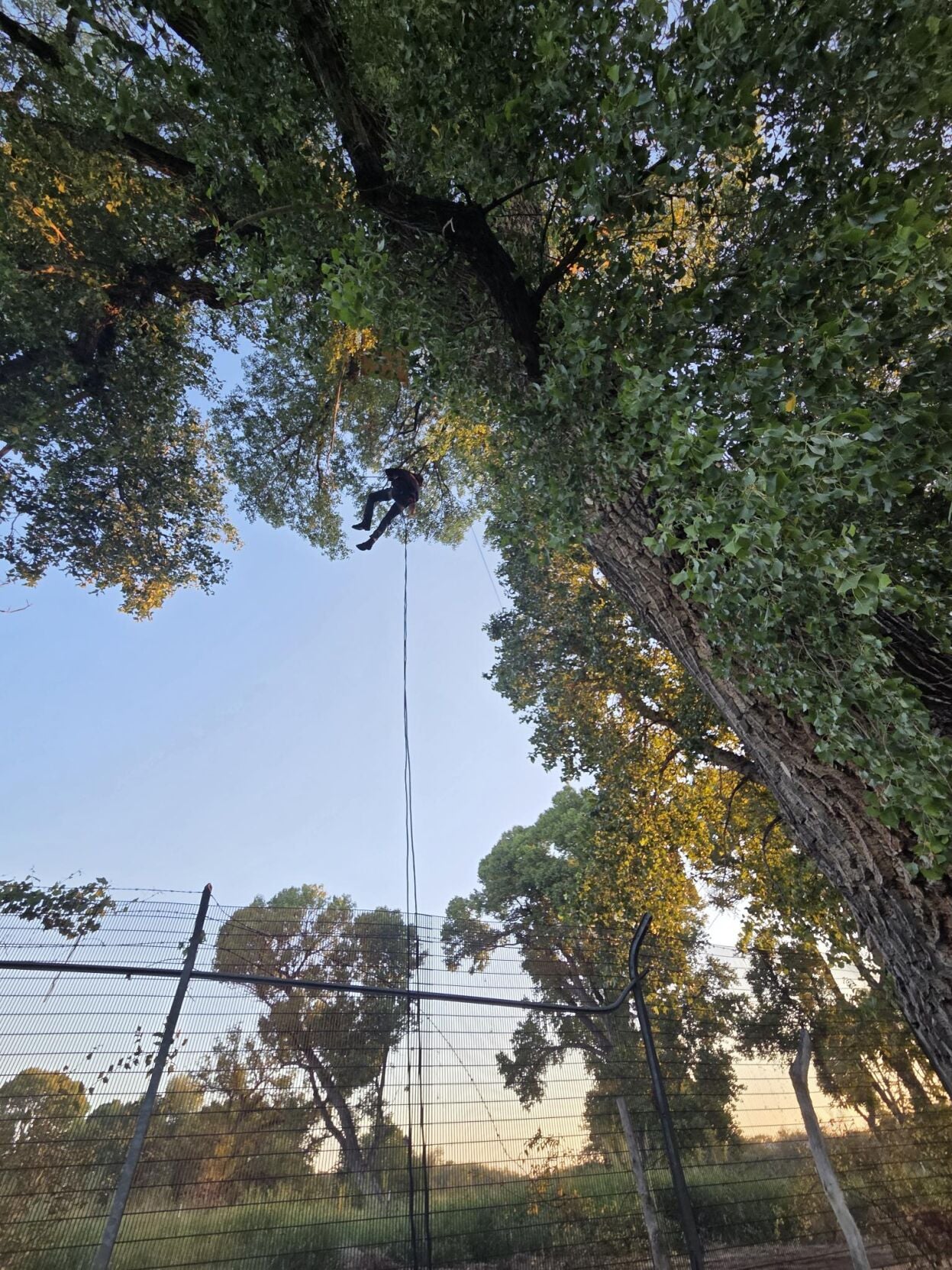
Federal contractors arrived at their border-wall work site in the San Rafael Valley, about 20 miles east of Nogales, on Tuesday to find someone camped out in the branches of another Fremont cottonwood in the path of construction.
According to a news release from the protest’s organizers, the new demonstrator is a Mexican national who joined in hopes of halting the wall project and keeping the second giant tree from being knocked down.
“It’s a binational tree-sit now,” said Russ McSpadden, Southwest conservation advocate for the Tucson-based Center for Biological Diversity, after visiting the site of the protest on Tuesday.
The demonstration just entered its fourth week in the almost-ghost town of Lochiel, where workers brought in by North Dakota-based border wall contractor Fisher Sand and Gravel used heavy machinery to knock down three towering cottonwoods along the international boundary on July 27.
People are also reading…

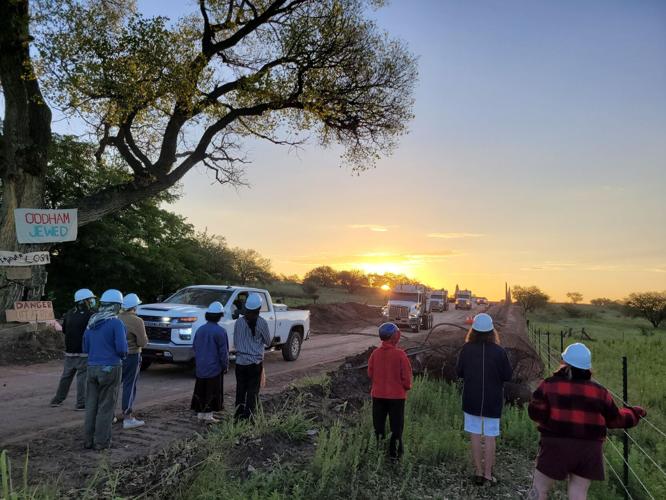
Demonstrators in hardhats hold a sunrise prayer ceremony, as border wall construction vehicles line the road nearby in Lochiel, Arizona, on Tuesday.
The trees were believed to be at least a century old but were growing within the so-called Roosevelt Reservation, a 60-foot-wide strip of land along the border that is owned by the federal government. That put them directly in the path of the primary and secondary border walls the Trump administration wants to build through this quiet grassland and along the entire southern border, from San Diego to the Rio Grande.
To stop the contractors from knocking down a fourth cottonwood, nicknamed the “Grandmother Tree,” a handful of activists have been taking turns sitting in its branches about 60 feet above the ground for the past three weeks and counting.
"This resistance isn't new, but there's new energy behind our binational community, gathering together against this physical and social attack on our home," said Zach Palma, a resident of both Naco, Sonora, and Naco, Arizona, in a statement from the protest group. "If this wall is built, history will show that it was done against the will of the people who call this land home. And we have a specific long-term agenda item: to bring this wall down."
Activists have been camped among the cottonwoods off and on since June, when U.S. Customs and Border Protection confirmed in a letter to the Sierra Club that the trees would be cut down to make way for the double border wall.
Organizers said hundreds of concerned people have since rotated through Lochiel to support the tree sit. Their growing protest camp on the north side of the border has now been joined by a sister camp on the Mexican side.
The new tree the activists are defending is located mostly in Mexico, though its roots and part of its canopy almost certainly extend into the U.S., McSpadden said. “That tree is right on the line, so it’s an interesting situation.”
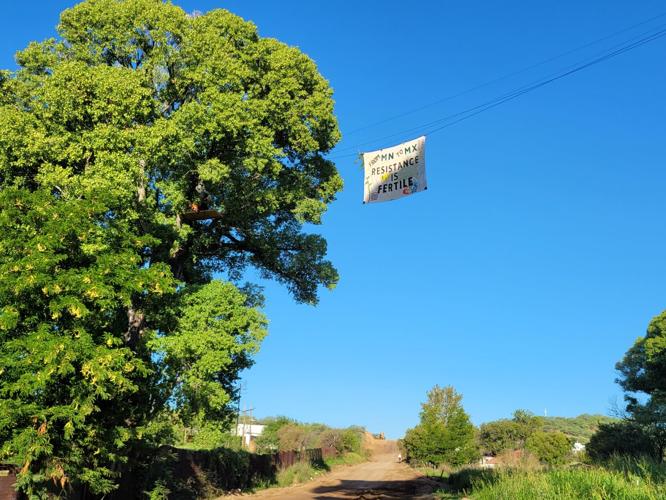
The two cottonwoods are close enough that demonstrators were able to string a banner between them that read “Resistance is fertile.”

Before a giant cottonwood tree was toppled Monday on the U.S. side of the border for wall construction, a banner hung between Fremont cottonwood trees on both sides of the U.S.-Mexico border at Lochiel, Arizona, as part of a tree-sit protest.
The protest has drawn support from one of America’s best-known tree-sitters, Julia Butterfly Hill, who in the late 1990s spent 738 days camped in a 200-foot-tall redwood tree in Northern California that she ultimately saved from loggers.
Hill told the British newspaper The Guardian earlier this month that the protesters in Lochiel were shining a light on the destruction caused by the border wall with the sort of direct action that only becomes necessary when “every other system has failed.”
The wall work in the San Rafael Valley is part of a $1.5 billion contract Fisher Sand and Gravel won in December to build 21 miles of primary barrier and 91 miles of secondary barrier from west of Sasabe to Coronado National Memorial south of Sierra Vista.
CBP has awarded more than 30 construction contracts since September, as the agency races to spend $46.6 billion Congress approved last year to wall off the southern border.