Federal authorities have closed all the nearby roads, so Russ McSpadden had to walk through miles of desert in triple-digit heat to document early work on the second border wall through Organ Pipe Cactus National Monument.
The Southwest conservation advocate for the Center for Biological Diversity hiked roughly 15 miles on Sunday and Monday to photograph several swaths of public land that have been cleared so far for the massive construction project.
“It was a scorcher,” McSpadden said, but it was the only way to find out for sure what was really going on at the 330,000-acre National Park Service site 150 miles southwest of Tucson.
On Tuesday, his Tucson-based environmental group released the first photos of the work at Organ Pipe, where federal contractors are now building a second, 30-foot-tall, bollard-style barrier parallel to the first border wall constructed there during President Donald Trump’s first term.
People are also reading…

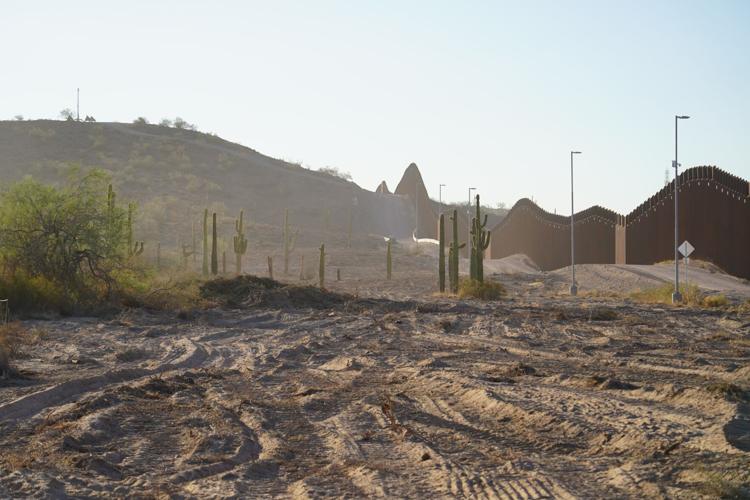
A photo taken Monday shows saguaros left standing in a patch of desert recently cleared for construction of a second border wall at Organ Pipe Cactus National Monument, about 150 miles southwest of Tucson.
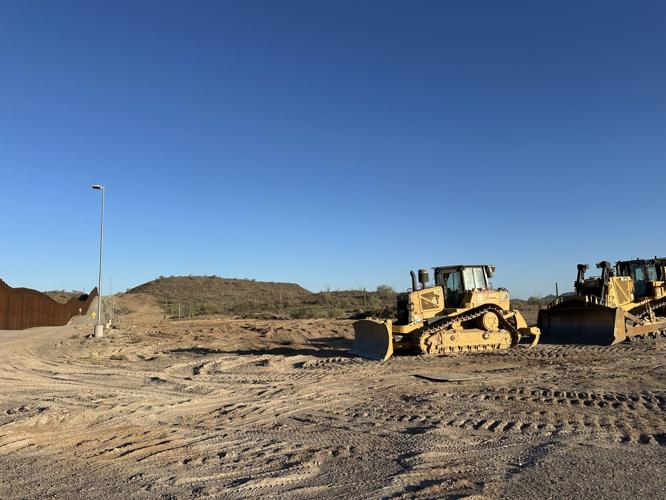
One set of images shows a pair of heavy construction vehicles parked in a staging area that McSpadden said is being expanded, probably as a “laydown yard for bollards and equipment.” Another set of images, taken about a mile to the west, shows a strip of Sonoran Desert land roughly 100 feet wide that has been scraped clean of everything except for a handful of saguaro cactuses to make way for the second wall.
“That’s a treasured Sonoran landscape that has been bulldozed,” he said.
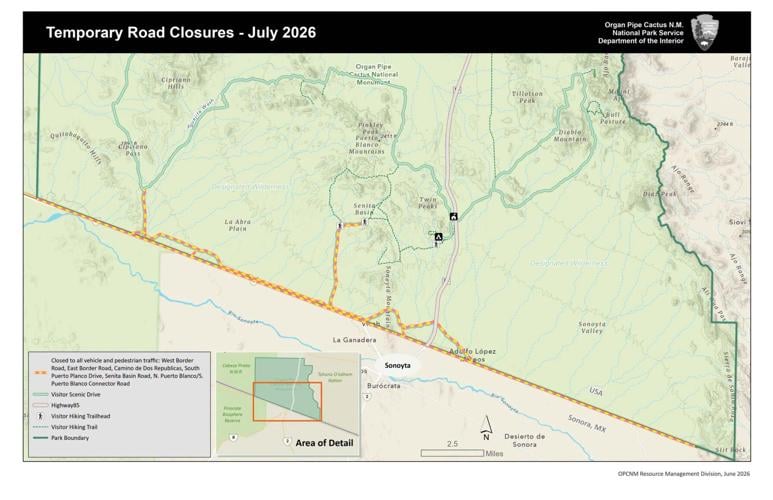
To reach the sites, McSpadden had to park just outside the closure area announced by the Park Service on July 31 and find his own way across the desert, since all monument roads near the border are also off limits to pedestrian traffic until further notice.

A National Park Service map shows the roads that closed to the public starting July 31 to accommodate border wall construction at Organ Pipe Cactus National Monument.
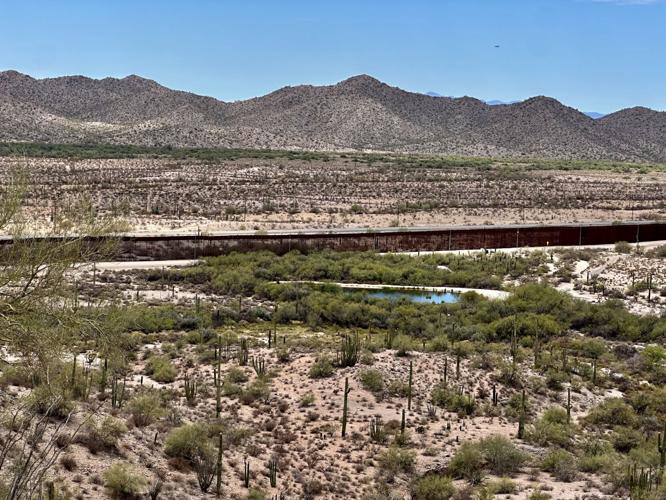
He began his reconnaissance mission on Sunday by hiking about four miles to check on Quitobaquito Springs, a desert oasis less than 100 yards from the international boundary that is home to several rare aquatic species found nowhere else in the U.S.
He didn’t find any signs of new construction activity there, he said, so he sat by the water and watched the endangered Sonoyta pupfish and Sonoyta mud turtles swim.
“There’s nothing going on there yet,” McSpadden said. “It’s still as beautiful as ever.”
Under a $443.1 million contract with U.S. Customs and Border Protection, Tempe-based Sundt Construction is slated to build 13 miles of primary barrier and 45 miles of secondary barrier along the southern edge of Organ Pipe and neighboring Cabeza Prieta National Wildlife Refuge.
Eventually, the Trump administration wants double walls stretching across the entire border from California to Texas, including all 373 miles in Arizona.
Last year, Congress allocated $46.6 billion for the project, which CPB officials have called “a critical investment in national security.”
In a written statement to the Star in April, the agency said both border walls are needed to create a “secure space” in between and “help agents funnel illegal traffic through ports of entry for detection and law enforcement resolution.”
Critics dismiss it as a colossal waste of taxpayer money that will needlessly scar the landscape, block wildlife movement and destroy cultural and historic sites.

Quitobaquito Springs at Organ Pipe Cactus National Monument as it looked on Sunday, with construction activity for the second border wall just getting underway less than 3 miles to the east.
Conservationists are particularly worried about Quitobaquito Springs, a site considered sacred by O’odham people and where the secondary wall poses a threat to endangered species habitat and the water source on which it relies.
University of Arizona freshwater biologist Michael Bogan heads up the multiagency Sonoyta Mud Turtle Recovery Team.
He said the all-volunteer group has finalized an emergency salvage plan for the endangered turtles, just in case the construction activity puts their survival in jeopardy. Some plastic kiddie pools and other “rescue materials” have already been staged at the site.
“We’re on standby,” Bogan said. “We’re in the same kind of wait-and-see, wait-and-watch mode that everyone else is.”
Though the roads leading to Quitobaquito are closed to the public, the Park Service can still drive there, as can anyone with an active permit to conduct research at the springs, Bogan included.
Organ Pipe staff members typically visit the site several times a week, he said. “They’re kind of being our eyes and ears so to speak.”

Construction vehicles wait Monday at a staging area that is being cleared for construction of a second border wall through Organ Pipe Cactus National Monument.
While CBP has not publicly disclosed any specifics about what it plans to build at Quitobaquito, agency officials have said they are working with the Interior Department to avoid the springs and minimize any impacts to “sensitive resources” there.
But with waivers in hand that exempt border wall construction from federal environmental, endangered species and historic preservation laws, McSpadden said there is “nothing really to stop them” from doing as they please and little recourse in the event of some catastrophic mistake by the contractor.
“I’ve heard the reports that they’re going to do this in a sensible way, but I’ll believe it when I see it,” he said.
He means that literally, too. Though McSpadden said he wouldn’t wish long hikes in 108-degree heat on anyone, he intends to make regular return trips to Quitobaquito and elsewhere at Organ Pipe to monitor work on the secondary wall there.
“I think the public deserves to know what’s happening on public lands,” he said. “When no one’s looking, that’s when the mayhem occurs.”



 Organ Pipe monument closes roads to clear path for 2nd border wall construction