An open letter signed by 120 people housed at the Eloy Detention Center says a range of "human rights abuses" are taking place at the Arizona facility, including verbal and physical abuse by guards who send detainees who complain about poor conditions to solitary confinement called "The Hole."
The open letter says that detainees are often confined in prison-like cells for the majority of the day, and the prolonged confinement interferes with their ability to conduct legal research for their immigration cases.
The prolonged confinement is among the repressive policies intended to break detainees psychologically so they abandon legal battles to seek protection in the U.S., the open letter states.
The open letter also says detainees only have access to tap water for drinking that causes stomach illness and diarrhea, and receive non-nutritious meals consisting mostly of potatoes and sometimes frozen and raw food.
People are also reading…
The facility's air conditioning system is not properly maintained and blows out dusty air from vents that causes respiratory infections and chest coughs, the open letter states.

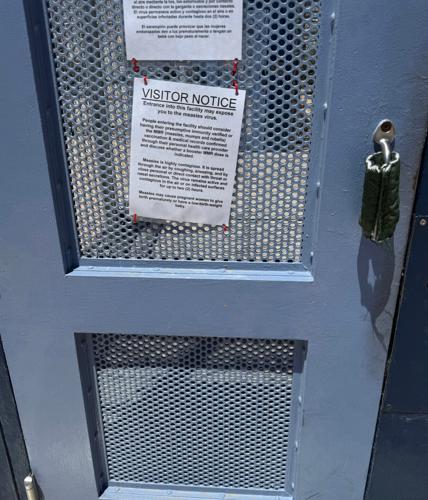
A sign warns people arriving to the Eloy Detention Facility about possible measles exposure.
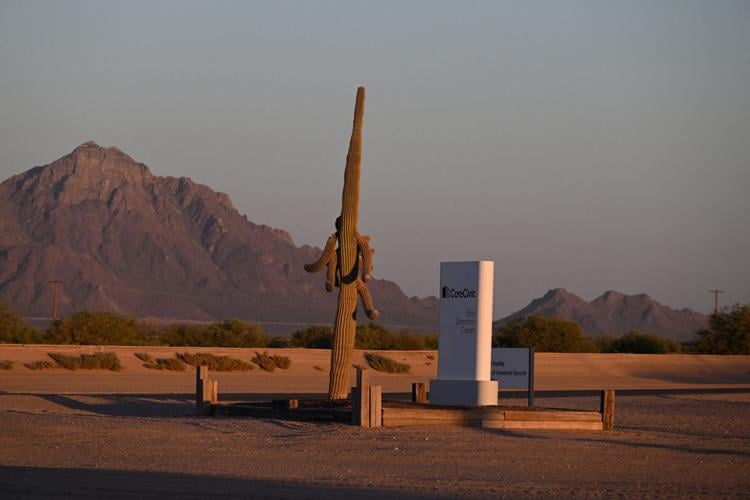
The Eloy Detention Center, located about an hour south of Phoenix, is operated by CoreCivic, a for-profit private prison company based in Nashville under a contract with Immigration and Customs Enforcement, part of the Department of Homeland Security.
"The human rights situation at the Eloy Detention Center is appalling and utterly deplorable, with high levels of discrimination by the Core-civic employees responsible for custody at the center," the letter states, "many of the Core-civic employees are unfit for their jobs because, having a degree of authority over us, they abuse the power through malpractice and policies that harm the detainees."
Immigration and Customs Enforcement takes allegations of misconduct "very seriously," ICE spokesperson Fernando Burgos-Ortiz said in a written statement in response to the letter. The agency provides "safe, secure, and humane conditions" for all people in custody, he said.
CoreCivic did not respond to a request for comment.
Complaints ramp up
The Eloy Detention Center was built in 1994 as a prison for criminals but was later converted into an immigration detention center, with space to hold 1,500 people, according to a 2024 report by three advocacy groups: The Detention Watch Network; the Florence Immigrant & Refugee Rights Project; and Trans Queer Pueblo.
Detainees have complained about conditions at the facility for over a decade, the report said.
But the complaints at the facility have gotten worse in the past year after the Trump administration ramped up immigration arrests as part of a mass deportation campaign, said Liz Casey, the advocacy social worker at the Florence Immigrant & Refugee Rights Project, who has written several reports documenting detainee complaints about detention conditions.
"I've been here for almost 11 years, and these are complaints that we've heard since then," Casey said.
However, "we definitely have heard of things getting worse since the Trump administration, especially within the last year or a year and a half, such as like abuse by guards and medical neglect and food," Casey said. But in general, immigration detention "is inherently violent. Like there's not a way to make immigration detention humane. So these are things we've heard for a long, long time."
The Trump administration has gutted oversight of ICE detention, which means complaints of abuse and inhumane conditions are not being addressed, Casey said.
"The fact that ICE and guards know that there's like little to no oversight and really no consequences for violating people's rights, for abuse, for medical neglect (means) as of right now, there doesn't seem to be any type of accountability or consequences. So I think that definitely leads to guards and ICE being able to act and do whatever they want to," Casey said.
The open letter comes amid rising complaints about inhumane conditions at immigration detention facilities throughout the country.
The complaints have risen as the number of people being held in ICE custody has soared to over 60,000 as the Trump administration has expanded immigration arrests as part of a wide-scale effort to remove from the country millions of immigrants convicted or accused of crimes, ordered deported or in the country illegally.
In April, three Democratic House members from Arizona said they witnessed severe overcrowding and inhumane conditions during a surprise oversight visit to an ICE staging facility to briefly hold migrants waiting to board removal flights at Mesa Gateway Airport.
Elsewhere, detainees recently have staged labor and hunger strikes over conditions at Delaney Hall, an immigration detention center in Newark, New Jersey, run by the private prison company, The Geo Group. The detainees have been joined by protests outside the facility, some of which have resulted in clashes with the police.
Since the start of the Trump administration in 2025, ICE has reported at least 53 deaths of people in ICE custody, according to USA Today's tracker.
The ICE custody deaths include Emmanuel Damas, a 56-year-old Haitian asylum seeker who died at a hospital in Scottsdale on March 2 after receiving inadequate medical care for a severe dental infection that spread to his body, according to a relative, advocates and Democratic U.S. House members.
Who is the letter writer?
The open letter detailing allegations of abusive detention guards and dire conditions at the Eloy Detention Center was written by Andres David Torres Chirino.
In a phone interview, Torres Chirino provided additional details about the allegations of human rights abuses described in the letter.
Torres Chirino said he is a 29-year-old migrant from Venezuela who arrived in the U.S. in August 2023 to seek asylum in the U.S. He said he has been held at the Eloy Detention Center since Nov. 1, 2025, after being arrested by Phoenix police during an argument with his partner and then turned over to ICE.
Torres Chirino said on Jan. 27 he won his asylum case in front of an immigration judge at an immigration court inside the detention center, but he remains locked up because ICE appealed the ruling to the Bureau of Immigration Appeals. He said the Eloy Detention Center is filled with other detainees who won their asylum cases but are still being detained after ICE appealed their immigration rulings.
Burgos-Ortiz, the Phoenix ICE spokesperson, confirmed that the Department of Homeland Security appealed the immigration court’s decision on Feb. 20. Torres Chirino will remain detained pending the appeal process, Burgos-Ortiz said.
Torres Chirino was taken into ICE custody on Oct. 22 at the Maricopa County Sheriff's Office processing facility after his arrest by Phoenix police on an assault charge, Burgos-Ortiz said.
He was first encountered by the Border Patrol's El Paso sector on Aug. 6, 2023, and placed in removal proceedings, Burgos-Ortiz said. An immigration judge on April 4, 2024, ordered Torres Chirino removed to Venezuela but reopened his case on April 17, 2024, Burgos-Ortiz said.
Torres Chirino was granted work authorization in March 2025, but work authorization does not grant permanent legal status or protection against deportation, Burgos-Ortiz noted. Torres Chirino was again ordered removed in January, Burgos-Ortiz said.
Detainees locked in cells the majority of the day

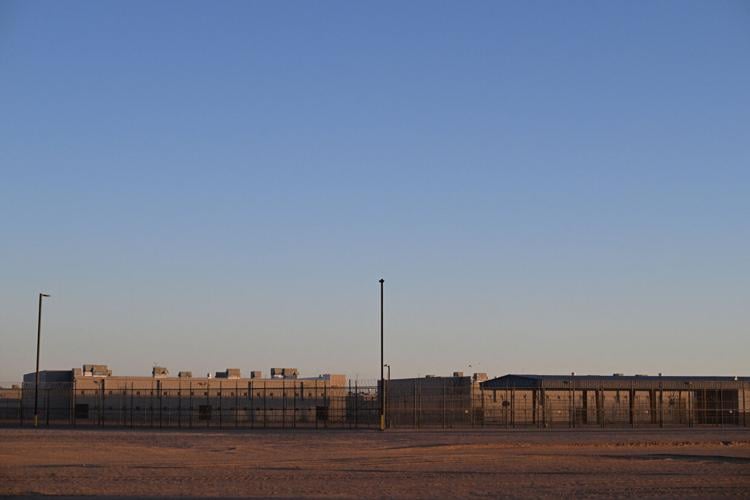
Eloy Detention Center as the sun sets on June 28, 2026.
Torres Chirino said the detention facility’s manual says guards are supposed to conduct eight “head counts” a day, but guards often add a ninth head count to prolong the amount of time detainees are locked up in their cells.
“This directly interferes with our immigration cases, especially for people like me who represent ourselves,” Torres Chirino said.
Each headcount last about an hour and 15 minutes, which adds up to 13 hours a day, Torres Chirino said. As a result, detainees are often locked up in their cells the majority of the day, he said.
While locked up, detainees do not have access to the library, telephones or electronic tablets, which detainees use to research their case or translate information from English to Spanish, he said.
“Physically, it interferes with your ability to prepare your immigration case, which requires time and concentration. It’s also psychological pressure designed to wear you down until you give up your case."
The Eloy Detention Center is also "severely understaffed," which leads to frequent lockdowns, especially on holidays, when detainees are confined to their cells, Torres Chirino said.
Burgos-Ortiz did not address staffing shortages or frequent lockdowns in his statement. But he said, "ICE detention is a choice," and the agency encourages "illegal aliens to take control of their departure" through a government app called CBP Home.
"The United States is offering illegal aliens $2,600 and a free flight to self-depart now," Burgos-Ortiz said in his statement. "We encourage every person here illegally to take advantage of this offer and reserve the chance to return to the U.S. lawfully, to pursue the American dream. If not, you will be arrested and deported without a chance to return."
'The Hole'
Torres Chirino said some of the detention guards at the Eloy Detention Center are “decent,” but others are abusive.
He described a personal experience he had with a guard who he said grabbed him and pulled him out of his dorm and shoved him. Torres Chirino said he told the guard he was going to report him to his supervisors.
The guard laughed and said he would show him who was in charge, Torres Chirino said. The guard filed a report that Torres Chirino had touched him, he said. Torres Chirino said he was sent to solitary confinement for three days. The area designated for solitary confinement is called "el hoyo," which in Spanish is "the hole," Torres Chirino said.
Detainees sent to "the hole" spend 23 hours a day alone in a cell and are only allowed one hour of recreation on Mondays, Wednesdays and Fridays, Torres Chirino said.
Surveillance video later proved he hadn't done anything wrong, and he was released, Torres Chirino said. The guard was not disciplined and continues to harass him, Torres Chirino said.
“He should have been fired,” Torres Chirino said.
Guards also threaten to send detainees to "the hole" for complaining about conditions or poor treatment, Torres Chirino said. Guards can also write disciplinary reports against detainees to hurt their immigration case.
"In effect, the guards are saying, 'If you don't do exactly what I tell you, I'll write you up.' And that can hurt your case," Torres Chirino said. "Yet when guards are the ones who act disrespectfully or abuse their authority, there are often no consequences for them."
Torres Chirino said when detainees are sent “the hole” guards gather their belongings “and a lot of things end up missing, whether it's documents or things you've bought at the commissary. When you ask for them back, you often never get them again,” he said.
Burgos-Ortiz said ICE "does not use or place detained individuals in solitary confinement."
He acknowledged, however, that ICE does use segregation, which he described as "a distinct practice to ensure the welfare of detained individuals and staff."
"Unlike conditions generally associated with solitary confinement, detainees in segregation experience basic living conditions akin to those provided to the general population,” Burgos-Ortis said.
These include: regular access to supervisory, management, program and health care staff, same meals and portion sizes, access to recreation, and the same ability to send and receive mail and correspondence, Burgos-Ortiz said.
Detainees placed in segregation also have access to telephones and programs and services, such as commissary, library and religious guidance, Burgos-Ortiz said.
Tap water quality
Torres Chirino said the only drinking water detainees have access to comes from the tap, and that water is undrinkable.
Drinking the tap water causes stomach illnesses, throat infections and diarrhea, Torres Chirino said.
He said he developed a tooth infection from drinking the tap water and had to undergo an emergency extraction at a hospital. Torres Chirino said if detainees want drinkable water, they must buy it in bottles at the commissary, or they ask for ice in cups and wait for it to melt.
Burgos-Ortiz did not address complaints about drinking water in his statement
'Potatoes, potatoes with more potatoes' at meals
Torres Chirino said detainees do not receive nutritious food. They only receive chicken once a month, “more like every five weeks,” he said.
He said meals are mostly made up of “potatoes, potatoes with more potatoes.”
Detainees have also received food that is cold or raw, including cold pasta and bologna that was still frozen. He said detainees with food allergies like himself must renew diet authorization every three months.
Claims that detainees are not properly fed, “or that they are treated cruelly, or like animals, are false and abhorrent,” Burgos-Ortiz said in his statement.
ICE provides three nutritious meals daily; supporting specialized, religious, and therapeutic diets, with menus reviewed regularly by a registered dietitian,” Burgos-Ortiz said.
“While detention is not a destination resort, ICE remains committed to maintaining appropriate conditions of confinement and rejects baseless smears about the treatment of those in its care,” Burgos-Ortiz said.
Inadequate or slow medical care
Torres Chirino said detainees can be seriously ill but must wait for days before being seen by medical staff.
When he got a tooth infection that caused his face to swell up, it took about seven days before he received treatment, Torres Chirino said.
He said it was very difficult to get pain pills for his tooth infection. He had to go through multiple levels of approval and then had to wait four or five days before he received the medication.
Torres Chirino said the medical staff at the facility does not provide vitamins, pain ointments and other over-the-counter medicines. Instead, detainees must buy them at the commissary, where prices are “outrageously high,” Torres Chirino said.
ICE ensures detainees receive appropriate medical care, Burgos-Ortiz said in his statement. Medical care includes medical and mental health screenings within 12 hours of arrival, full assessments within 14 days, and emergency care available 24/7, Burgos-Ortiz said.
“Detainees have access to a robust grievance process and clear channels to raise and resolve concerns about their confinement,” he added.
Detainees getting sick from dirty air

The Eloy Detention Center, located about an hour south of Phoenix, is operated by CoreCivic.
Torres Chirino said the facility's air conditioning system is not maintained properly and blows dust out of vents. As a result, detainees are constantly getting sick with colds.
Earlier this year, the air conditioning broke down in some areas, and detainees were without air conditioning for five days, he said.
Burgos-Ortiz of ICE did not respond to this complaint in his statement.
Exposure to raw sewage
Torres Chirino said in March that a pipe broke, spilling raw sewage in the housing unit Echo 400. Detainees were forced to endure the stench. “Black water came out everywhere,” Torres Chirino said.
Burgos-Ortiz of ICE did not respond to this complaint.
Non-criminal detainees housed with convicts
Torres Chirino said detainees with no criminal records are being housed with convicted criminals. He said the Echo 400 housing unit is supposed to be only for detainees with criminal convictions, “but over 80%” of the unit’s population are people with no criminal records.
Although ICE detention is civil confinement, “many detainees are violent and dangerous criminals with documented offenses, such as homicide, transnational gang membership, child sexual exploitation, assault, identity theft and repeated drunk driving, etc,” Burgos-Ortiz said in his statement.
“When needed, segregation is a measure taken to promote safety and security of a facility, and can help protect other detainees as well as facility staff,” he said.
Transgender detainees housed with male detainees

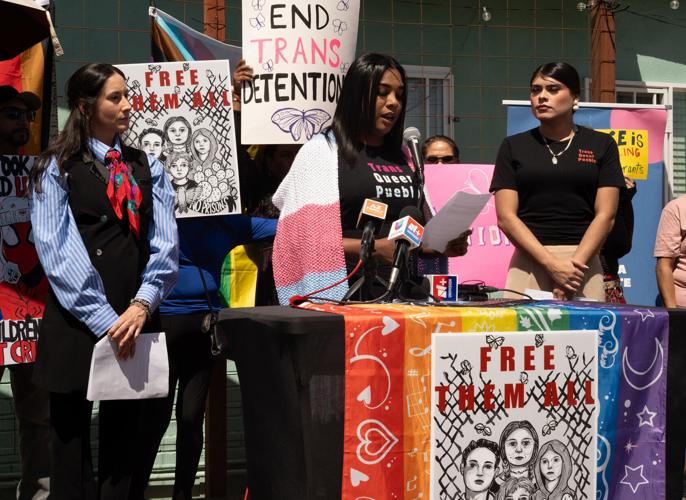
Karla Saenz, a trans woman who was placed in an all-male unit at the Eloy Detention Center, speaks about her experience during an April 28, 2026, news conference after she was released from ICE detention.
Torres Chirino said transgender women were being housed with male detainees.
“That invades both people's space and can create problems,” Torres Chirino said.
Burgos-Ortiz acknowledged that detainees are housed by biological sex and not gender identity.
He cited President Trump’s Jan. 20, 2025, executive order, “Defending Women from Gender Ideology Extremism and Restoring Biological Truth to the Federal Government.”
“ICE facilities typically adjust staffing and operational resources in response to population changes,” Burgos-Ortiz said.
What was the goal of the open letter?
Torres Chirino said he wrote the letter and circulated it among other detainees because he wanted conditions to improve. He said he used the tablet to send the official grievances to ICE and has called the DHS line in the past to report grievances. He said the complaints have had no effect.
“Nothing has changed. Everything is the same,” Torres Chirino said.
ICE takes allegations of misconduct “very seriously,” Burgos-Ortiz said.
The agency holds personnel and contractors “to the highest standards of professional and ethical behavior,” he said in the statement.
ICE investigates complaints “thoroughly to determine its veracity, and to ensure strict compliance with the comprehensive standards that ICE is required to follow under various national detention standards,” Burgos-Ortiz said.