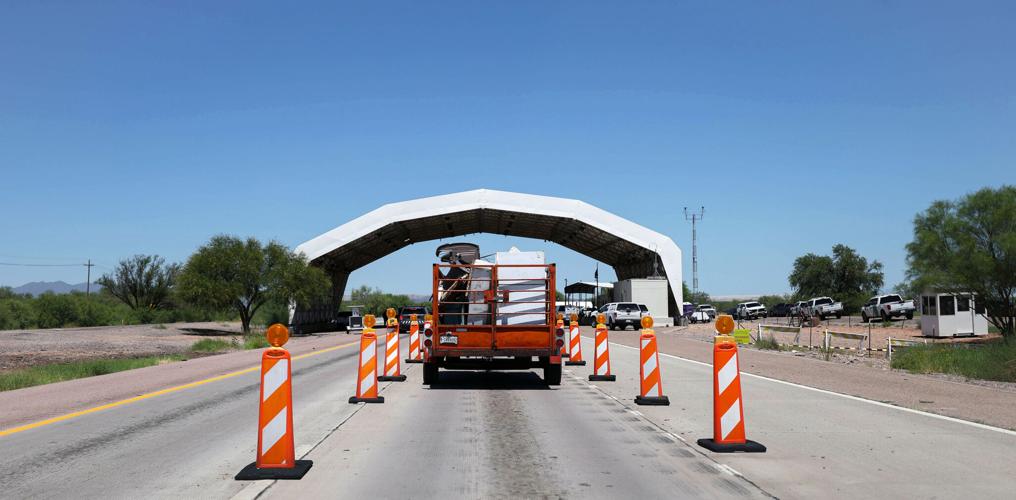
U.S. Customs and Border Protection has quietly awarded a $63 million contract for a major expansion of the Border Patrol checkpoint on Interstate 19, near Amado, despite releasing scant details on the secretive project, and without yet conducting required environmental assessments or offering the public a chance to comment.
CBP awarded the contract for the expansion project to Alabama-based Brasfield & Gorrie LLC on Sept. 28, according to a listing on USAspending.gov, which was first reported by the Nogales International.
The award listing, which identifies the checkpoint location as in Nogales, does in fact refer to the I-19 checkpoint project, despite it being located 25 miles north of Nogales, between Amado and Tubac, CBP confirmed to the Arizona Daily Star Friday.
People are also reading…
Many residents of the communities near the checkpoint, especially the historic artist town of Tubac, have been pushing back against CBP's plans to expand the temporary tent structure on northbound I-19 into a 17-acre checkpoint facility, east of the highway.

Residents of the communities near the current U.S. Border Patrol checkpoint on Interstate 19, near Amado, say they're strongly opposed to expanding the checkpoint into a permanent facility on 17 acres near the current checkpoint site.
Locals say the expansion is unnecessary and would devastate Tubac's tourism industry, harm the environment and threaten Tubac's international "dark skies" designation, with the new checkpoint's anticipated lighting structures.
CBP has been unusually secretive about the contract award, and local residents in the Tubac and Amado communities say they're fed up with the lack of transparency from CBP regarding a massive project they believe will permanently alter their community.
Tubac resident Clem Shute is a retired environmental attorney and board member of the 500-member Santa Cruz Valley Citizens Council, which for months has been trying to get more information on the project.
Shute said locals support Border Patrol and "generally agree the agents standing there at the checkpoint might be safer with a gatehouse." But residents are upset by the way the project is being carried out, he said.
"People are upset really at two levels. One is the total lack of any transparency about what they're up to, the rush, the inability (of the community) to talk to anybody or find out anything," he said.
Many are also concerned about the expected negative impacts on the local economy, culture and environment, Shute said.
"Generally, there's huge consensus in Tubac that this is not well thought-out," he said. "There’s no justification presented for it, and it's kind of shocking that there's so little that we've learned about it."
CBP: Contract for 'design services'
CBP claims that awarding the contract already doesn't mean the agency is ignoring the public opposition.
In an after-hours email sent Friday, an unnamed CBP spokesman said the $63.4 million contract awarded to Brasfield & Gorrie is for "design services," but it includes "an option for future construction."
CBP said officials will comply with the requirements of the National Environmental Policy Act and "other applicable environmental requirements," according to the statement.
The Department of Homeland Security has not waived environmental laws for the project, so "no construction will begin until the environmental review process is complete," CBP said. "The design work will help identify potential project impacts and inform the environmental review process. ... CBP sent scoping letters to potential stakeholders in July 2026 and has received comments on the proposed project.
"Once preliminary analysis is complete, CBP will publish a draft Environmental Assessment on CBP.gov and provide an additional opportunity for public comment."
The Star has struggled to get details on the project. Contractor Brasfield & Gorrie was told by CBP not to respond to the Star's query about the checkpoint expansion project, said spokeswoman Carla Jean Whitley by phone on Friday.
Whitley said she was restricted from confirming or denying the company's involvement, despite the public listing. Another employee at the company hung up after a Star reporter identified herself.
An official in the office of Border Patrol's Tucson Sector Acting Chief Patrol Agent Henry Laxdal referred the Star to the agency's community liaison for the I-19 checkpoint project, Agent Jose "Lu" Maheda. But Meheda was on vacation Thursday and unavailable, another CBP media officer said.
Tubac resident Kathleen Vandervoet told the Star that many in Tubac are wondering how CBP's potential contractors could have accurately bid on the project without a detailed plan from CBP.
"No business could submit a bid without knowing how much is required," she said. "So again, we all feel very disgusted and angry that they won't show the community what the plans are, but the builder can see them.”
Replacing 'aging' facilities
CBP has not publicly announced the contract award, nor secured the land to build the proposed 17-acre permanent checkpoint facility.
The I-19 checkpoint project is one of several Border Patrol facility expansions planned or underway across the Southwest. That includes $500 million worth of planned spending in Arizona alone on planned checkpoint expansions and three new Border Patrol stations, as CBP tries to spend down billions allocated by Congress in 2025.
The One Big Beautiful Bill allocated $5 billion for updating and constructing CBP checkpoints and facilities.
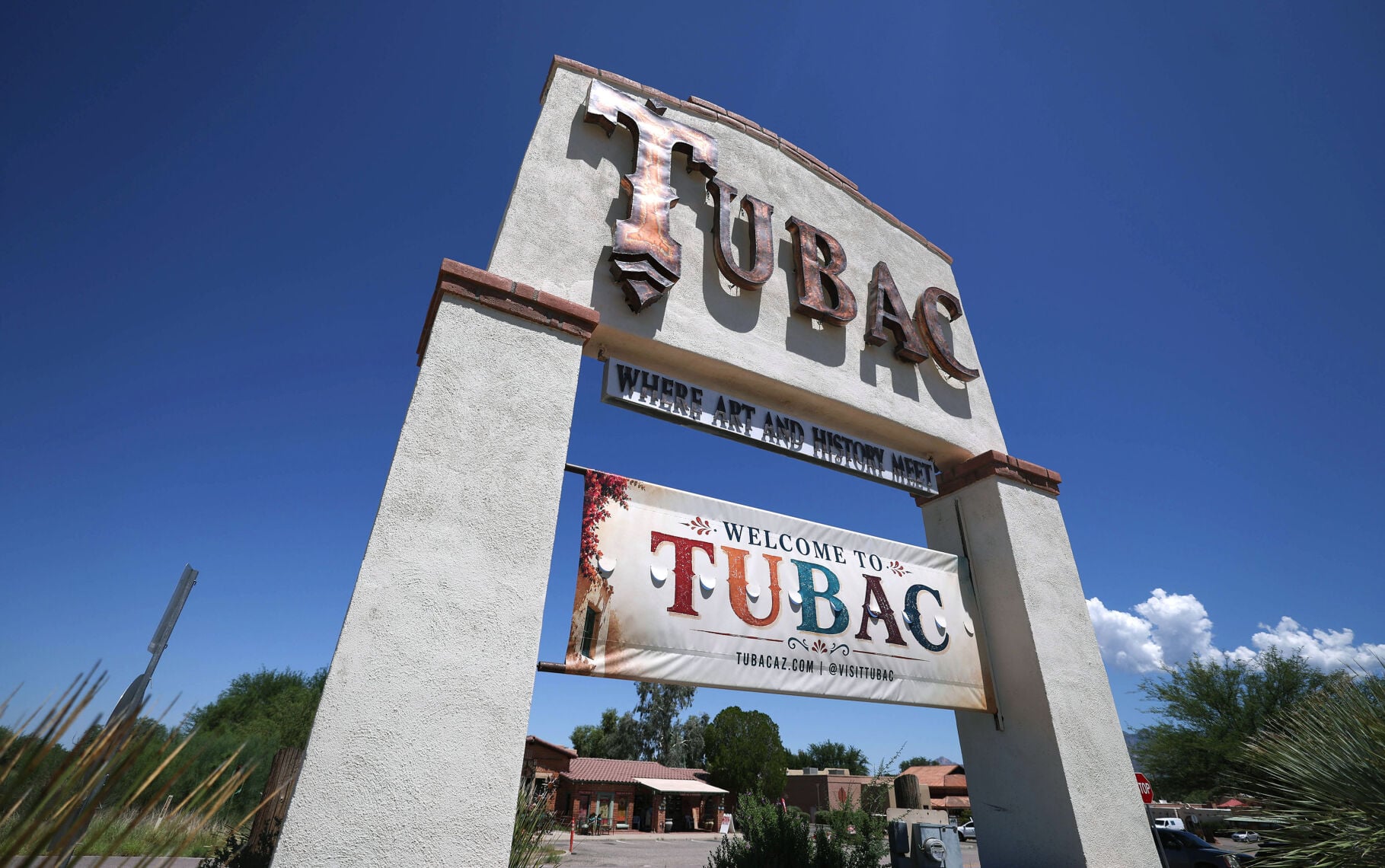
Opponents of the proposed expansion of Border Patrol's I-19 checkpoint say the project's large footprint would cause unnecessary environmental and economic damage, and would also threaten Tubac's international "dark skies" designation.
Last month a CBP spokesman sent an emailed statement in response to a list of questions from the Star on the I-19 project.
"Funding from the One Big Beautiful Bill will allow CBP to make long-overdue improvements to border security infrastructure. We are in the early planning stages for new and modernized Border Patrol stations and checkpoints across the Southwest border," the statement said. "These investments will replace aging facilities, strengthen operations in key locations, and give our agents the resources they need to stop human and drug smugglers."
CBP still hasn't responded to the Star's September request for any data or studies that demonstrate the need for a major expansion of the I-19 checkpoint.
In response to the Star's Wednesday request for such data, CBP said in the email: "CBP bases the need for an expanded I-19 checkpoint on several factors, including the safety of agents and motorists, projected traffic volume increases, and operational alignment."
The agency intends to widen the inspection lanes, add traffic control and barriers "to make the checkpoint a safer environment for CBP’s operators and the traveling public."
CBP said officials commissioned a traffic analysis in late 2025 "to assess the appropriate number of inspection lanes at the checkpoint based on projected traffic through 2040."
"This study supports an increase in commercial lanes from one to two, and an increase in non-commercial lanes from one to four," the CBP statement said. "The land port of entry in Nogales, which feeds I-19, has been expanded in recent years to accommodate heavier commercial traffic. Aligning port of entry and downstream checkpoint capacities helps to facilitate safe and efficient trade and travel."
The statement didn't address why a 17-acre expansion was necessary to accommodate expected increases in traffic.
Locals call for transparency
Locals say even now, agents operating the checkpoint don't make use of all the existing lanes. The checkpoint has been unmanned often in recent weeks, local residents said.
CBP has approached a private landowner and Santa Cruz County officials about purchasing their land adjacent to the highway.
Both Santa Cruz County officials and the private landowner — longtime rancher Laurinda Oswald — have said they would refuse to sell to CBP and are expecting the federal government to seize the parcels anyway.
Oswald said she would have been willing to sell a couple of acres to CBP to upgrade the current checkpoint. But she refused the agency's request to buy 18 acres from her.
Resources for border security should be focused on the southern border, she said.
"Put your money and your people where it’s necessary," Oswald said. "I just don't think it's necessary at this checkpoint to expand it like that."
Oswald said she's braced for the U.S. government to take steps to seize her land using eminent domain. Eminent domain is a process the government can use to seize private land for public use if it provides fair compensation to the owner.
During a March meeting with CBP officials about the project, Oswald was shown renderings of the project that included multiple traffic lanes, a place for secondary inspections of trucks, kennels for dogs, a holding facility for people who have been detained and "lights all over the place," she said.
Oswald was not allowed to keep the documents.
Oswald told the Star she has the resources to hire lawyers and fight any effort to take her land.
On Friday, CBP would not say if the agency planned to seize private or county land against the owners' will.
"CBP is continuing to evaluate the project footprint and potential property needs," CBP said in the email. "Because final project boundaries have not been determined and discussions with prospective landowners are ongoing, CBP cannot comment on potential acquisition methods at this time."
In the meantime, residents' frustration is growing, Vandervoet said.
"We feel like we're being taken for children who don't know what’s best for them, whereas of course we have lived here for many decades, and we do know what works in this community," she said.
Contact reporter Emily Bregel at ebregel@tucson.com. On X, formerly Twitter: @EmilyBregel

Emily Bregel
Border reporter


 Flush with cash, CBP plans more Border Patrol stations, expanded checkpoints in AZ