Officials with U.S. Customs and Border Protection are touting decreased illegal border crossings and substantial drug busts over the last year, at the same time as fentanyl seizures in Arizona have declined significantly in recent years.
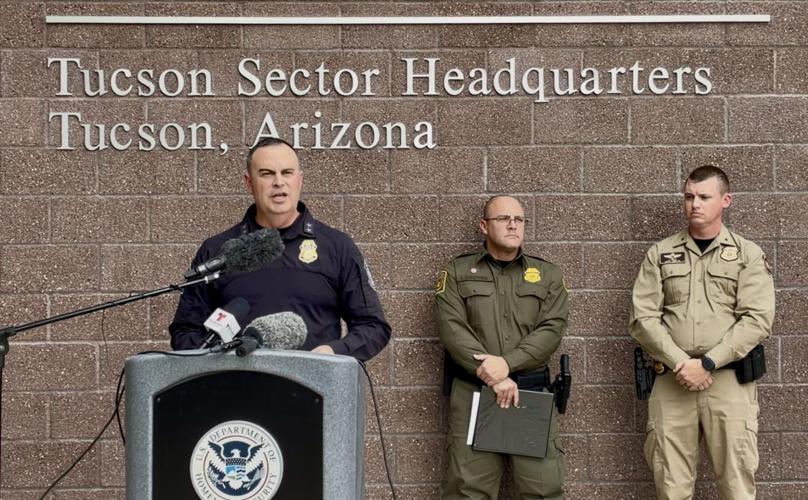
"Cartels are losing money because of our efforts," said Stephen Cristinzio, acting deputy chief patrol agent for the Border Patrol's Tucson Sector, speaking to media Wednesday at the Border Patrol's Tucson headquarters, on South Swan Road.
Over the fiscal year that ended Sept. 30, Tucson Sector agents encountered 16,135 migrants, a 96% drop from the more than 463,500 migrants encountered in all of fiscal year 2024, said Cristinzio, who started his career with CBP in the border town of Naco in 2001.
"Illegal immigration crossings have dramatically decreased as consequences under Title 8 immigration laws have been applied in the last two years," he said, also crediting the deployment of Department of Defense troops to the U.S. borderlands, assisting border agents in detecting and deterring illegal crossings.
People are also reading…
Tucson Sector border agents conduct anti-smuggling operations to "target and disrupt stash houses, transportation cells and online facilitators," as part of the inter-agency Homeland Security Task Force, established in 2025, he said.
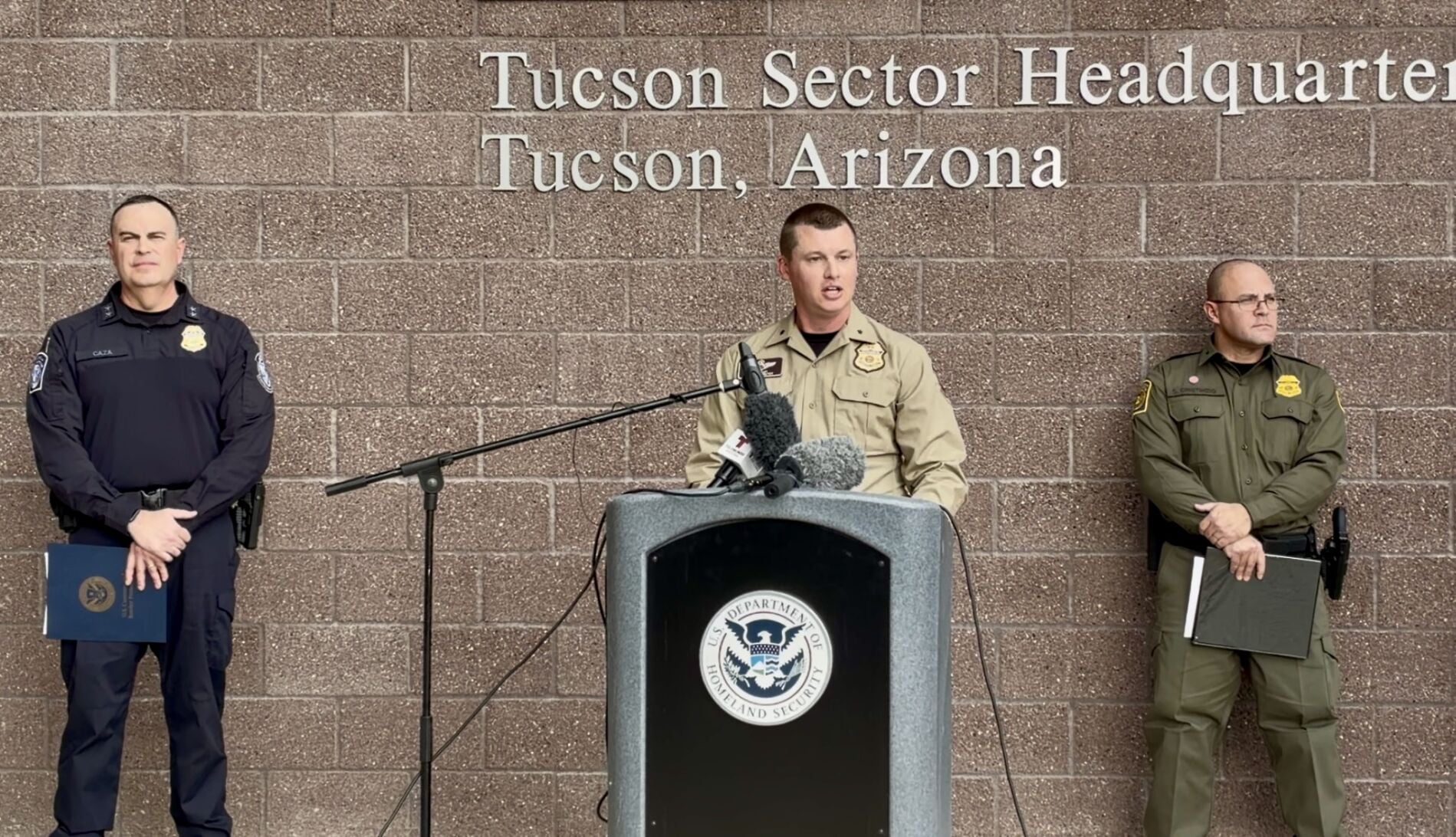
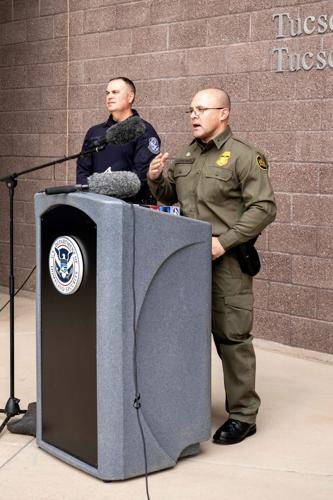
Greg Tolley, center, deputy director of Tucson's Air and Marine Operations branch of U.S. Customs and Border Protection, speaks to media Wednesday at the Border Patrol's Tucson headquarters on South Swan Road.
"The cartel narrative of the border being open, or that there are no consequences, is false," Cristinzio said.
Cristinzio also pointed to a 50% decrease in "failure-to-yield" events — when a suspect vehicle flees, instead of complying with an attempted stop — "which cause a huge danger to the motoring public in Southern Arizona."
Migrant arrivals at the U.S. southern border — including families, children and elderly people, in addition to the more typical crossings of single men seeking work — increased dramatically in fiscal year 2023, in part driven by the U.S. post-pandemic economic recovery and a global surge in displaced people fleeing economic and political instability, experts say.
Migrant arrivals at the southern border have dropped dramatically since President Donald Trump took office in January 2025. But the decrease began in 2024, under former President Joe Biden.
Migrant arrivals slowed significantly as the Biden administration imposed controversial restrictions on access to asylum protection, and as the administration pressured Mexican authorities to slow the northward movement of migrants through Mexico.
Fentanyl seizures down overall
Border Patrol's Cristinzio also cited a 61% decrease in fentanyl seizures over the last two years in Arizona, outside U.S. ports of entry.

Roque Caza, left, is director of field operations for CBP's Tucson field office, overseeing the six land ports and two international airports in Arizona. "We're putting continued pressure on cartels. We're making it harder on them to get those drugs in the United States," he said Wednesday.
"We're just not seeing it come across," Cristinzio said. "We've seen a drastic decrease in fentanyl in the (Tucson) area of responsibility. We're not seeing it at checkpoints, we're not seeing it that much backpacked out in the desert."
At Arizona's ports, there was a 30% reduction in the weight of fentanyl seized between fiscal years 2025 and 2026, said Roque Caza, director of field operations for CBP's Tucson field office, overseeing the six land ports and two international airports in Arizona.
"We're putting continued pressure on cartels. We're making it harder on them to get those drugs in the United States," he said.
While the ports saw about 10% more individual seizure events, the seizures were generally low weight, Caza said. "So we're seeing it in smaller quantities, deeper concealment, primarily through passenger vehicles" at land ports of entry.
"If one ounce of fentanyl gets through, we have more work to do," he added.
A national decline in fentanyl seizures began in 2023, which experts have attributed to numerous factors, including lower demand — as U.S. fentanyl overdoses have declined since their 2022 peak — as well as disruption in the supply chain for precursor materials from China, used by processors in Mexico to make fentanyl.
In April 2024, CBP officials in Nogales announced a new operation focused on disrupting fentanyl-manufacturing supply chains. The so-called "Operation Plaza Spike," a collaboration with the U.S. Drug Enforcement Agency and Homeland Security Investigations, or HSI, also targeted Sinaloa Cartel-affiliated criminal leaders south of Nogales, Sonora.
Heightened enforcement against leaders of the Sinaloa Cartel, as well as internal conflicts within factions of the crime group, could be another explanation for the drop, experts say.

Stephen Cristinzio, right, is acting deputy chief patrol agent for Border Patrol's Tucson Sector. He spoke to media Wednesday at Border Patrol's Tucson headquarters on South Swan Road.
But some of the decrease in fentanyl seizures could reflect missed opportunities, as ICE shifted resources from criminal investigations to immigration enforcement, according to an August audit by the U.S. Department of Homeland Security's Office of Inspector General.
HSI's resources "did not effectively enable it to counter fentanyl entering the United States, based on our audit, which included interviews with 100 HSI agents across the country," the audit said. "As ICE shifted priorities toward immigration enforcement, HSI’s level of effort on fentanyl declined from fiscal years 2024 to 2025."
Fentanyl investigations decreased by 24%, investigative hours spent countering fentanyl decreased by about 30% and fentanyl seizures dropped by 39%, the audit said.
"At one office, approximately 99 percent of HSI’s work was dedicated to immigration, leaving almost no capacity for fentanyl investigations," the audit said.
AZ fentanyl seizures lead nation
Even as overall seizures decline, Tucson was the leader nationwide in air-wing operations' fentanyl seizures, with 488 pounds intercepted in FY2026, said Greg Tolley, deputy director for CBP's Tucson air branch, at the press event.
CBP's Air and Marine Operations, or AMO, provides agents with aerial intelligence and reports suspicious activity to help agents direct resources to threats, he said.
While that was 20% less fentanyl intercepted by AMO compared to the prior fiscal year, the figure still equates to more than 100 million potentially lethal doses, he said.
"That number is more than a statistic," Tolley said. "It represents families protected, communities made safer and countless lives potentially saved," and denies profits to organized crime groups.
Overall, the Tucson air branch seized 1,869 pounds of narcotics in fiscal year 2026, with increased cocaine and meth seizures, Tolley said.
Arizona ports of entry accounted for more than 30% of all fentanyl seized by CBP nationwide in the last fiscal year, said Caza, of the Office of Field Inspections.
Arizona port officers intercepted more than 15,000 pounds of fentanyl, methamphetamines, heroin and cocaine in fiscal year 2026, he said.
Ammunition seizures increase
Arizona's Office of Field Operations also boosted its seizures of ammunition destined for Mexico by more than 400% over the last year, with 250,000 rounds of ammunition seized in the last year, Caza said.
Coordination with Mexico has been "incredibly important" to fight organized crime, Caza said, including daily communication with Mexican authorities.
The Trump administration's designation of specific drug cartels as foreign terrorist organizations "provided CBP with additional leverage and capabilities to further degrade and dismantle these adversaries," Caza said.
Tolley said the Tucson air branch's work has been strengthened by the inter-agency Homeland Security Task Force focused on transnational criminal organizations.
"That coordination is essential," Tolley said. "Cartels do not recognize jurisdictional boundaries, and neither do the threats they pose."
No comment on border wall
Cristinzio acknowledged more lives will be at risk, including U.S. citizens' lives, due to federal land agencies' decision to force Humane Borders, a nonprofit humanitarian group, to remove 12 of its life-saving water stations in remote areas of the borderlands, including in Organ Pipe Cactus National Monument.
Humane Borders' volunteers say their water is for anyone, including migrants attempting the dangerous crossing of the Sonoran Desert, American hikers or U.S. border agents in distress.
U.S. Department of the Interior agencies, not CBP, made the decision to remove the water stations, Cristinzio said.
Asked about the loss of the water stations putting both migrant and American lives at risk, Cristinzio said, "I can't argue with you. Water, any aid that is provided to anybody in distress anywhere, is an absolute must."
The CBP officials declined to comment on border wall construction projects in Arizona, saying details on those projects come from officials in Washington, D.C.
Asked about CBP's plans to expand Border Patrol checkpoints, including a controversial plan to expand to 17 acres the current tent structure on I-19 near Amado, Cristinzio said CBP officials will meet with community members in early November.
But he could not share details on the secretive project, which is largely opposed by locals in Tubac and for which DHS already awarded a $63 million contract to an Alabama company.
"We need to enhance that footprint," Cristinzio said. "We are absolutely planning to purchase land to move the checkpoint. At the end of the day, it's a safety issue. ... If you're playing football, you're playing soccer, you don't want all your people in one spot. One short pass over the top, and you lose. So it's a layered approach for us."
Citing northbound traffic increasing out of Nogales, "it needs to be revamped, it needs to be modernized. We need to get the traffic off the highway, we need the space to operate, we need to put the NII (non-intrusive inspection) technology out there," he said.
Cristinzio disputed locals' observations that other Border Patrol checkpoints in the area, such as on West Arivaca Road, are usually unmanned.
"We do pulse and surge the checkpoints," in terms of staffing levels, he said. "It's not accurate that they're never used. ... From my perspective, I'd love to be able to revamp every checkpoint we have in the Tucson Sector. They're run down, they're in need of modernization."
Non-intrusive inspection technology is being deployed at ports throughout the southern border, officials said.
Within the next 30 days, CBP will deploy "low-energy portals" — a type of drive-through nonintrusive inspection system — at the ports in Nogales and San Luis for vehicle inspections, Caza said.
A commercial inspection facility at the Douglas port of entry will have a "full suite" of NII capabilities, Caza said.
"It's an incredibly important tool for our ports of entry," Caza said, noting the technology also makes inspections more efficient. "The quicker we can look at vehicles, persons and things coming through our ports of entry, that allows us to focus and use risk management on those we really care about the most."
Contact reporter Emily Bregel at ebregel@tucson.com. On X, formerly Twitter: @EmilyBregel

Emily Bregel
Border reporter



 Saguaros marked for removal on Tohono O'odham Nation as tribe fights wall