

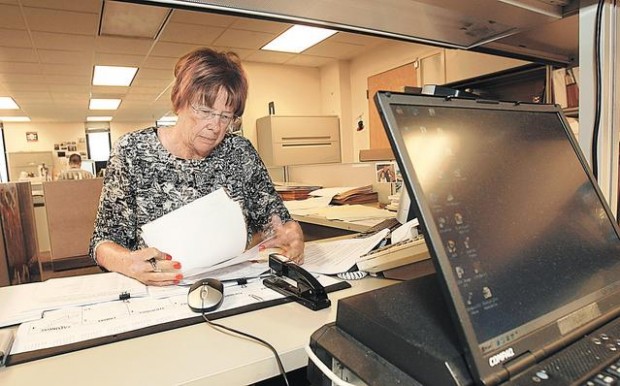
A federal grant has brought fresh eyes and additional resources to a Tucson Police Department effort to solve cases that have languished in some cases for years.
The work of two civilian cold-case investigators hired under the $449,000 grant to work for the Tucson Police Department's cold-case unit already has paid dividends, including the recent arrest of a suspect in a killing that took place nearly two decades ago.
One of the investigators, Margo Panke, brings a unique perspective to the Police Department.
Instead of attending the police academy and patrolling the streets, Panke has worked as a manager for a telephone company, a hiring assistant for a technology company, a 911 operator and a private investigator.
Panke relies more on attention to detail and the organizing skills she learned during her 32 years at Qwest Communications than on any law-enforcement prowess.
People are also reading…
She and the other investigator, a retired TPD police sergeant, were hired to help the cold-case unit after the Police Department received a Department of Justice grant in April 2008, said Sgt. Kevin Hall, supervisor of the TPD homicide unit.
The grant ends in April 2010, Hall said.
Hall is researching other federal grants and stimulus programs so he can keep the investigators beyond next year, he said.
In addition to the investigative help, TPD has used $200,000 of the grant to send DNA evidence to an outside lab for analysis, he said.
Hall said help from the civilian investigators is badly needed by the department's cold-case detectives, who are currently working on numerous cases, he said.
"It frees up detectives to actually work on cases," he said. "They were so overwhelmed with the cases they were working, there was no time to review."
The two civilians review cold-case homicides, write case summaries, search for possible suspects and witnesses, and identify items for DNA testing.
They also handle some clerical duties.
Once a case is reviewed, Hall prioritizes and assigns the cases to detectives.
Panke has reviewed 82 cases since she was hired last year, including the one that led to the arrest of Jorge Luis Diaz-Alonso.
Diaz-Alonso was arrested on June 22 in connection with the November 1990 shooting death of 30-year-old Angel Pena.
Several people were in the room when Pena was killed, and several possible suspects were identified after the slaying, including Diaz-Alonso, but police were unable to make any arrests.
Panke started reviewing the case last September, she said.
"We had a number of obstacles to overcome to find suspects. It was challenging, but we were tenacious," she said.
Diaz-Alonso was taken into custody after detectives gathered witness statements, physical evidence and DNA results.
The case was presented to a grand jury in April. It indicted Diaz-Alonso, who was arrested last month.
This case illustrates the many challenges encountered by the investigators and the detectives.
"You really have to look at the information in a neutral way and follow the thread of evidence," Panke said. "It's very much like what detectives do, except we don't have contact with the individuals."
There have been 12 indictments since the cold-case unit started in 2006, with about half of those indictments occurring since the civilian investigators were hired, Hall said.
Panke may not have the police training, but she offers a perspective that differs from that of a commissioned officer.
"I look at things differently. I've been told that has value," she said.
Hall agreed.
"We kind of get into a group-think mode as police officers," he said. "It's nice to get into an outside mode and bring in questions we would never think of."
Panke's interest in the job was sparked by her stint as a 911 operator, she said.
"When I worked with the 911 operators, I really enjoyed working with the people of the Police Department," she said. "The only reason I left was because I was too old to work the hours that I needed to work."
Panke worked with a private investigator for about three years before applying for the cold-case position. She also has worked for IBM, she said.
She describes this job as the best one she's ever had.
"To me, it's like a calling. I'm doing work that's worthwhile," she said.


