

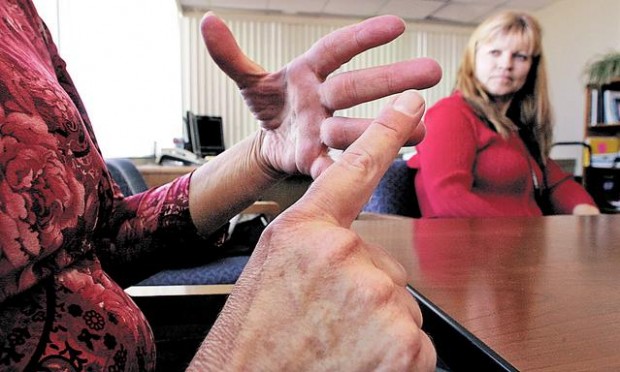
Pam was in the middle of making dinner when she got the call.
Minutes later, she was racing to a close friend's house, terrified and in tears, her chicken, broccoli and rice dinner in the garbage.
The caller was Michelle Araneta, the prosecutor assigned to her former boyfriend's armed-robbery case.
"She said, 'You have to trust me. I can't tell you everything, but you could be in jeopardy . . . and I want you to leave the house,'" Pam said.
Ten minutes after arriving at her friend's house, her phone rang again. It was Irene Hazzard, one of 24 detectives who work for the Pima County Attorney's Office.
She is also the detective who was assigned to keep Pam, 53, alive.
Although it's not well known, the detectives who work in County Attorney Barbara LaWall's office do more than investigate cases, track down witnesses and collaborate with other law-enforcement agencies. They provide security for witnesses and victims who have been threatened by defendants or people closely associated with defendants, said Ken Janes, chief of detectives.
People are also reading…
Their assignments run the gamut from picking witnesses up and escorting them to court to staying with victims around-the-clock until the danger is over, Janes said, sometimes putting them up in secret locations.
Over the last three years, nearly 130 people have been provided some sort of assistance, Janes said, with most assignments lasting no more than a few days.
Detectives most frequently watch over victims or witnesses in gang-related cases, but they often help domestic-violence or sex-crime victims, too, Janes said.
Who qualifies for protection depends on who makes the request, the perceived validity of the threat and the severity of the case, Janes said. The requests can come from the victims or witnesses themselves, prosecutors or judges.
In Pam's case, an inmate at the Pima County jail told Araneta he had been hired to kill Pam by Pam's former boyfriend, Stephen Calaway.
The Star is withholding Pam's surname because she is a victim.
Calaway, upset that Pam wouldn't provide him an alibi, told the inmate he'd give him $3,000 and a Suburban for the hit.
The inmate told Araneta and detectives Calaway provided him Pam's phone numbers, address and place of work. Araneta was convinced the inmate was telling the truth because he knew things about Pam that only Calaway could have told him.
Unsure whether Calaway would try to find another hit man, Janes, Hazzard, Araneta and Deputy County Attorney Susan Eazer, quickly devised a plan to keep Pam safe.
They found a safe place for her to stay, searched her house before she was allowed to pack, followed her from place to place and took other security precautions they'd rather not share, Hazzard said.
At the jail, officials cut Calaway off from other inmates, the mail and the telephone.
Once they were confident Pam was no longer in danger, she was allowed to return home after four days.
"I went to work every day because I felt I needed to keep my life as normal as possible, and when I was at work I was able to think about other things," Pam said.
The evenings were torturous, though. Not wanting to put her friends and family in danger, Pam kept to herself.
"I was pretty lonely," Pam said. "There were lots of tears and not much sleep. I was pretty isolated, except for Irene."
Hazzard not only kept her safe, but she provided a lot of moral support, Pam said.
Even after she was allowed to go home, Pam said Hazzard continued to call her and pop into work to check on her.
During Calaway's trial, Hazzard was sitting in the courtroom.
"It was like she had a big sign saying, 'Yeah, you can do this!' " Pam said.
Calaway was sentenced to 44.5 years in the armed-robbery case. Facing a potential life sentence for solicitation to commit first-degree murder in Pam's case, Calaway pleaded guilty to influencing a witness. He was sentenced to a concurrent prison term of six years.
Having already testified against Calaway once, Pam was content with the plea agreement.
She, Hazzard and Araneta remain close. "I had never been involved in anything like this. I'd never known any criminals before," Pam said. "I'm just totally impressed with every single one of the people who helped me —Irene, Michelle, Susan and the other detectives."
"She had a great deal of fear in her voice when I called her that night, but she was willing to let us take the lead," Araneta said, giving Pam much of the credit for Calaway's conviction.
When dealing with some of Tucson's most callous thugs and killers, witnesses aren't the only ones who sometimes need protection.
In the late 1980s, the Pima County Attorney's Office tried one of Tucson's most notorious drug lords, Jaime Javier Figueroa- Soto, on money-laundering charges.
During the trial, Janes said prosecutors were escorted out back doors to nearby cars and driven to their office building — which is only a block away from the courthouse — and escorted up back stairs.
And prosecutor Teresa Godoy was provided protection for more than a year after the office heard murder suspect Jason Paul Doty, an Aryan satanist, had put out a hit on her.
During that entire time, Godoy wasn't allowed to drive herself to work, and she wore body armor.
"I couldn't go to court on my own; someone always drove me or walked with me," Godoy said.
At one point, detectives received information Godoy was going to be killed at one of the courthouse's staging areas during a fire alarm.
Days later, a fire alarm went off during a Doty hearing, Godoy said. She didn't go to any of the staging areas.
"I really think this guy was going to try to do something, but it's scarier to me now when I look back at it," Godoy said.
"Back then, I wouldn't allow myself to think about it. It's hard to wrap your mind around the fact that someone actually wants you dead."
Doty died of cancer in October 2003 while serving a life sentence.
No one being watched over by Janes' detectives has ever come to harm, he said. "There have been times when detectives have seen suspicious cars in the area, but it usually turns out to be nothing."
If someone has a legitimate threat made against him or her and that person still is willing to testify, Godoy said she will always ask for help from Janes' team. "I think we owe it to them," Godoy said.


