

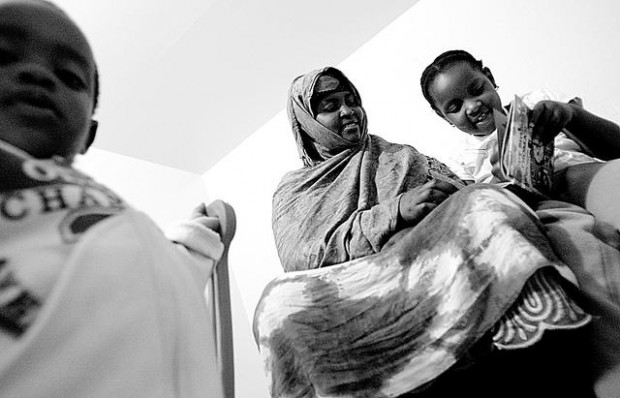
When Tucson resident Mohamed Bare fled civil conflict in Somalia in 1991, he left behind brothers he thought he might never see again.
The last time he saw them, he said, they were running from gunfire and became separated. His older brother was killed, Bare said, and for nearly 15 years he didn't know if his younger brothers were alive.
What he never imagined was that he would learn their fate only after escaping the squalor of a Kenyan refugee camp and establishing a new life in Tucson.
Bare said he is now a hopeful man. He found a welcoming community in Tucson, where a growing number of Somali refugees are living — more than 2,000 by recent estimates.
Bare, 30, wants to make the most of his new opportunities by attending college and helping his children succeed.
People are also reading…
"They come here when they were young. They will be real Americans," he said of his 7-year-old daughter and two toddler sons.
After Bare fled Somalia, he lived in neighboring Kenya for years with little chance of leaving. Then, in 2002, the United States began accepting more Somali refugees. Bare and his family arrived here last February.
"In the camp, refugee camp, sometimes it's a very bad life. Sometimes there is no water, little food," said Bare, who managed to survive by working as a mechanic.
It was several months after his arrival here that Bare learned through a chance meeting with a fellow Somali refugee that his brothers were alive and still in Somalia.
"I was not believing until he gave me the address and the telephone number and I contact them. Then I believe him," said Bare, who spoke to his brothers for the first time two weeks ago.
He hopes his brothers will one day join him in Tucson.
English helped him cope
Mursal Abokar, 27, arrived in Tucson with some advantages over other Somali refugees. He could speak English relatively well and had learned about Western culture at a Cairo university.
But Abokar, now an honors student at Pima Community College, said he could see how many Somali families were struggling to cope with a new language, a new city and a new way of life.
He volunteered as an interpreter with Tucson Unified School District, hoping to influence the Somali people he met and "to help children understand the value of education."
He is now studying political science and wants to continue helping Somali refugees as part of a future career.
Abokar also works with Tucsonan Jonathan Levy on a new television program called "Somali Tucson Television." The show is broadcast in Somali and airs at 5:30 p.m. on Saturdays and 7:30 p.m. on Tuesdays on Access Tucson, Cox 99.
Levy said the programs, which started in August, are meant both to educate the Somali viewers and to provide them with a sense of connection to their new community.
"They don't have any representation in the community right now," said Levy, whose company, Source Language Solutions, provides interpreter services training throughout the country.
In addition to the show, Levy and Abokar are also working together on an initiative called Making Tucson a Global Language Community. Levy said a June survey by TUSD showed that 84 different languages and second languages were being spoken by the district's students and their families.
The idea behind the initiative is to help coordinate city and county language services, including interpretation and translation for agencies working with non-English-speaking Tucsonans.
The benefits, Levy said, would include providing services more readily for non-English-speaking people and providing better coordination among local, state and federal governments for security and emergency response.
They would also be able to more readily provide bilingual people to serve as interpreters and translators for the police, emergency workers and the courts, he said.
Interpreting for Somalis
Maandeeq Osman, 26, is one of a handful of Somali interpreters in Tucson. She works for TUSD and also helps refugees in Tucson.
Refugees receive assistance in everything for the first three months, she said. After that, they are expected to do more on their own, such as holding a job and getting acclimated to the community.
Osman said the change can be very challenging, especially for Somali people who lived in rural parts of their country. For example, she said, the concept of time is difficult to get across at first. "A couple of times they'll miss the bus and then they miss appointments," she said.
Learning about calling 911 or how to shop at an American grocery store can be quite challenging, she said. "It's not easy; it's very tough."
Maandeeq said the Somali students have the most problems during their first years here, but often adjust more readily than their parents. The parents often look to their children as the ones who will learn the language and be the ones to succeed, she said.
Levy said that while learning English is critical, it is also important for children to retain their own language.
"We need these other languages in order to build a robust work force here in Tucson," he said. And it is also important for the United States to have people who speak foreign languages for its own security.
Areawide


