
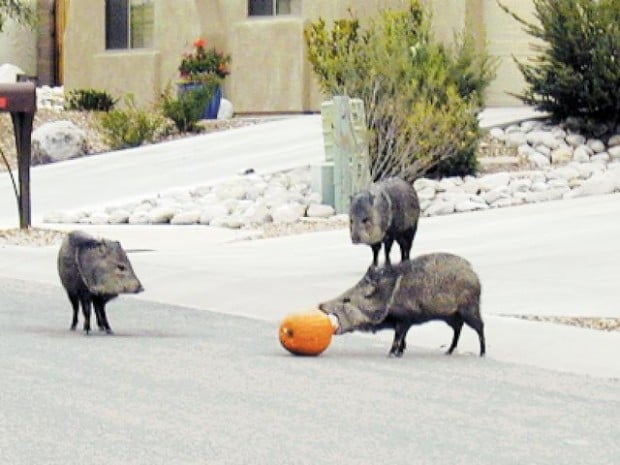
Arizona's wildlife is just that — wild.
Opportunities to catch a glimpse of Tucson's wildlife — which includes bobcats, javelina, coyotes, rattlesnakes and sometimes mountain lions — will increase as temperatures soar, rain stays away and animals' wariness of humans gives way to hunger and thirst.
Although it is fun to watch javelina, coyotes and snakes, it's important to handle encounters appropriately.
For humans and wildlife to safely coexist, wildlife must remain wild and not lose their natural fear of people, said Elissa Ostergaard, an urban wildlife specialist in the Arizona Game and Fish Department's Tucson office.
"If they lose that fear, they are more likely to get into trouble," Ostergaard said.
Tossing rocks and making noises can get a wild animal to back off, Ostergaard said.
People are also reading…
"It is really up to all of us to not just sit and watch wildlife," she said. "Just ignoring them, watching them or taking pictures can be an indication to them that people are not to be feared."
Encounters occur when wildlife come looking for food, water and shelter. But people should never make an effort to accommodate them, officials said.
"The first thing we tell people is 'Don't feed wildlife,' " said Tom Whetten, an information and education program manager with the Game and Fish Tucson office. "Don't leave pet food out at night, and bring the water in."
Whetten said the department does not track the number of calls it receives in reference to wildlife sightings because most are anecdotal.
The department will respond only if it's a public safety issue, Whetten.
There are agencies that will respond if wildlife is injured, orphaned, abandoned or killed.
Tucson Wildlife Center is a nonprofit rescue and rehabilitation facility on Tucson's far East Side that rescues, rehabilitates and releases large birds and mammals back into their natural territory.
Executive Director Lisa Bates opened the center in 1998. Today, the center fields about 5,000 calls each year and admits about 350 animals every year.
People who spot injured wildlife should always approach with caution.
"Rule No. 1: An injured animal is very unpredictable," said Vern Alexander, the center's development director. "They are in pain and are going to lash out."
Bates, who roamed the desert as a child searching for injured animals, said people need to understand a few things about wildlife.
First, don't assume that baby birds are abandoned.
"Baby birds spend a week on the ground learning to fly," she said. "They are rarely injured. Don't pick them up."
She also noted that a chimney needs to be capped to keep raccoons out. The critters can give birth in them — and that can attract bobcats.
Finally, she advised people to keep their small pets — especially domesticated cats — inside.
"Domestic cats are devastating to the small wild animal population."
But wildlife can be just as unkind to small pets.
"It is a tough lesson for people to learn when they move out into the desert," Bates said about pets being preyed on. "They have to learn the hard way."
What to watch out for
Here's what you should keep an eye out for when it comes to wildlife.
Bobcats: If food is available, bobcats will venture into urban areas — especially around sunset or sunrise. It is not uncommon to find bobcats in backyards abundant with shrubs and brush. Bobcats rarely attack people, but the carnivorous animals seek out small mammals and birds, lizards, snakes and small pets. Walls are usually no obstacle for bobcats — they can jump as high as 12 feet.
Coyotes: Not one to be displaced, a coyote can easily adapt to changes in environments. They live in cities, suburbs, rural areas and agricultural areas. Golf courses, parks, preserves and open spaces are coyote stomping grounds. And they are not too picky when it comes to their diets; they'll eat everything from pet food to garbage.
Javelina: Don't confuse the hoofed mammal with a wild pig. Javelina are part of the peccary family tree and frequent most of Tucson. What they lack in poor eyesight, they make up in sense of smell. Their scent trail often ends where plants grow. Javelina dine on cacti, succulent plants, bulbs and tubers, and beans and seeds. If you live near a wash or dense vegetation, a sighting is likely. They use those areas to get around and prefer being active at night.
Mountain lion: North America's largest native cat is found in most of Arizona — with the exception of of the state's farthest southwest corner. Sightings are not very common because mountain lions — also called cougar, puma, catamount and panther — are shy. Quite the leapers, mountain lions can jump 20 feet vertically and 40 feet horizontally in one single bounce.
Raptors: Hawks, eagles, owls and falcons are effective predators that help control the rodent, rabbit and bird population. But they will swoop down and swipe small pets or domestic animals, too. Red-tailed hawks, Harris' hawks and great horned owls are found in Tucson. Perched atop telephone poles, trees, signs or billboards, raptors have excellent eyesight.
Rattlesnakes: These venomous reptiles are most likely to be out and about from March to October. If the weather is tolerable, rattlesnakes appear during daylight. As the temperatures begin to heat up, they wait until dark to come out. Because they don't dig their own holes, they rely on abandoned burrows, brush or woodpiles, rock crevices or tight places for shelter.
Source: Arizona Game and Fish Department and the Tucson Herpetological Society