

June 3
Sax-percussion pairing seems odd, sounds good
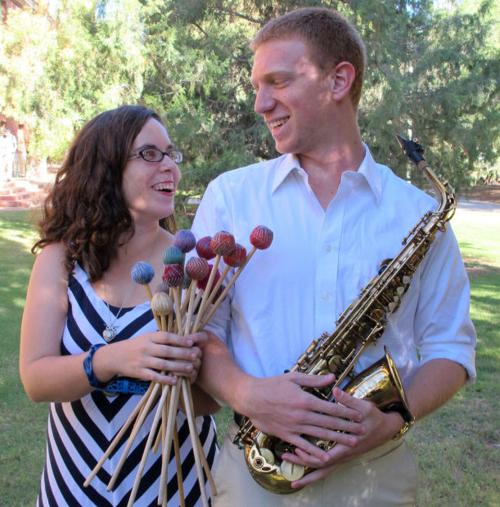
What might sound like an unlikely combination of saxophone plus percussion is in fact the very mix that will be heard at the Arizona Senior Academy when saxophonist Michael Weiss teams up with percussionist Elizabeth Soflin for a duo recital at 11:30 a.m. Tuesday.
Weiss and Soflin began exploring the saxophone-percussion repertoire after first playing together in the music department at the University of Arizona in 2012, and have delighted in vibrant music that ranges in style from lyricism and introspection to ferocity and aggression.
For the academy concert on Tuesday, they will be featuring some of the music they have performed together over the past year and some new projects for this summer. Weiss will play any of three different saxophones: soprano, alto and tenor, while Soflin’s percussion instruments will include marimba, vibraphone and a variety of drums.
People are also reading…
Their program will include music by James Fusik, Brian Hulse, Eckhard Kopetzki and Andy Scott.
Weiss has been playing saxophone for nearly 15 years and has experience on the soprano, alto, tenor and baritone saxophones in the jazz, classical, salsa and rock idioms. He has studied with Greg Fishman, Ben Schachter and Brice Winston, and has performed with jazz greats Michael Davis, Rufus Reid and Bobby Shew. He is studying with Kelland Thomas at the UA as a saxophone performance major.
Soflin holds music degrees from the University of Tennessee-Knoxville and Central Michigan University, and is working toward her doctorate in percussion performance and pedagogy at the UA, studying with Norman Weinberg. She has performed in various venues around the U.S., Canada, China and Europe.
Leslie Nitzberg
June 4
Academic examines risks
of ‘fracking’ for oil, gas
A major discussion in today’s news is about hydraulic fracturing, a technique being used to extract petroleum and gas from rock formations that formerly were inaccessible via standard drilling methods.
Although “fracking” has been shown to be very successful and financially rewarding to people and companies involved in the process, it is also very controversial because of the potential danger to humans and animals on the surface and to the rock formations through which drilling takes place, sometimes resulting in earthquakes.
Jennifer McIntosh, an associate professor in the Department of Hydrology and Water Resources at the University of Arizona, will discuss the process in a lecture at the Arizona Senior Academy at 3:30 p.m. Wednesday.
McIntosh earned a bachelor’s degree at Whitman College in Walla Walla, Washington, and a doctorage in geology at the University of Michigan.
Her primary focus is on elemental and isotopic chemistry of surface waters, ground waters, saline fluids and natural gas to better understand their sources and related biogeochemical processes. Her research involves extensive field sampling, laboratory analyses, and geochemical and hydrologic modeling.
She became interested in fracking because it is a commercial application that is very much related to her other research interests.
Hydraulic fracturing is the fracturing of rock by a pressurized liquid. Some hydraulic fractures form naturally — certain veins or dikes are examples.
Induced hydraulic fracturing, or hydrofracturing, is a technique in which water is mixed with sand and chemicals, and the mixture is injected at high pressure into a wellbore to create small fractures (typically less than 1 millimeter) in the surrounding rock, along which fluids such as gas, petroleum and water may migrate to the surface via the wellbore when the pressure is released.
Charles Prewitt
June 5
Arctic tundra research linked to desert
Although individual microorganisms are too small to be seen, they are estimated to exceed in mass and number the plants and animals on our planet.
Indeed, all plant and animal life on this planet is dependent on the chemical activities of microbes — a fact often overlooked when we humans focus heavily on the few that cause disease.
Next Thursday’s speaker at the Arizona Senior Academy will reveal a fascinating aspect of the potential power of microbes to alter the earth’s environment. Virginia Rich, an assistant professor in the Department of Soil, Water and Environmental Science at the University of Arizona, will tell how an international collaboration of scientists, led by the UA, has discovered a microbe that may play an increasingly significant role in our changing environment.
Her talk, which will begin at 3:30 p.m., is a fascinating story because it deals with how events in the frozen tundra of the Arctic can influence future life in the Sonoran Desert.
Rich is just back from work on the melting permafrost soils of northern Sweden. She will describe the circumstances that make this area of the globe a significant player in the environmental health of our planet.
Massive stockpiles of organic matter in the peat permafrost of this region can potentially be converted to large amounts of the greenhouse gases carbon dioxide and methane.
Rich received her undergraduate education at the University of California, Berkeley, and her doctorate from a joint program of the Massachusetts Institute of Technology and the Woods Hole Oceanographic Institute. Her recent work has been published in prestigious scientific journals, but her talk will be geared to a general audience.
Fred Neidhardt
Jennifer
McIntosh
Virginia Rich


