

The next stage of reopening Buffalo Public Schools will begin March 15 when another 5,000 students will be phased back into classrooms amid the Covid-19 pandemic.
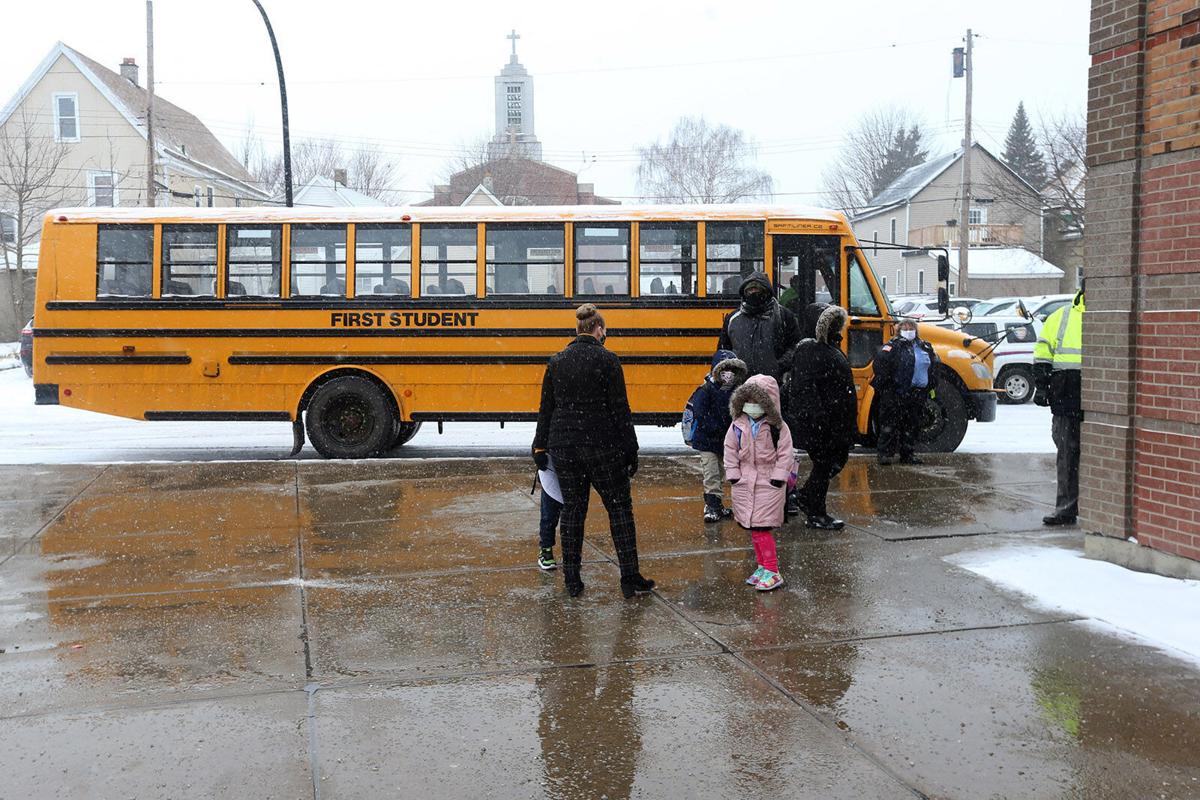
Superintendent Kriner Cash was eyeing next week for their return, but the district needs more time to work out routes for the yellow buses picking up and dropping off elementary students.
“We can absolutely do it by the 15th,” Cheryl Kennedy, the district’s director of transportation, told the Board of Education on Wednesday. “This will give us enough time to route really well and send out parent notifications in a timely manner.”
However, it’s becoming clearer that transportation will be one of the major hurdles for the district with each new phase of reopening.
Under Covid conditions, the general rule is one child per seat. So, a standard-sized school bus that would normally carry 50 to 60 kids is now seating 26, Kennedy said.
People are also reading…
That means the district needs 358 yellow buses to transport the students currently attending in-person and another 100 to accommodate the additional students returning on March 15, Kennedy said.
“What I think is really important to realize, while we’re bringing roughly 40% of our student population back to in-person instruction, we are utilizing 70% of our capacity with buses,” Kennedy explained.
In previous years, the school district relied on no more than 620 or 630 buses. When they used more buses in the past, they ran short of drivers.
“So, we really have to look at 620 being our max capacity,” Kennedy said.
Board members began to see the problems ahead as more students return to classrooms.
“I see this as a roadblock – and as a challenge,” said West District Board Member Jennifer Mecozzi.
Central District Board Member Paulette Woods tried to pin down Cash on a date when he expects to return all students who want to be back in the classroom.
Cash said his goal would be the end of April, but added that it’s “very clear how complex this issue is” for a large district where the majority of students ride the bus to school.
“If we’re at 70% capacity with our buses, but we’re only at a third capacity with our students, where is the millions of dollars going to come from to get those additional bus routes – and the drivers to go with it?” Cash said.
Buffalo Public Schools was the last local district to reopen for in-person instruction on Feb. 1, when high school seniors, students in grades pre-K through second and those with the highest needs were invited back into the schools, some on a part-time basis and others five days a week.
This second phase will, for the most part, return third and fourth graders, as well as students in grades nine and 11. It brings to roughly 12,000 the number of students returning to some form of in-person learning, Cash said.
“While these grades were the general rule, schools had the flexibility to choose outlier grades,” said Casandra Wright, an associate superintendent. “For example, some schools chose to return students at the seventh and eighth grade levels because the data and the needs of students indicated those would be the best groups to return to school.
“The same is true at the high school level,” Wright said. “The grade levels selected were either ninth or 11th or ninth and 11th. Based on student need and the school data, the principals and their teams made decisions that were best for that individual building.”
Cash said the school district will continue to randomly test 30% of students, teachers and staff for the virus each month, a number that totaled roughly 2,400 for February. Only three came back positive, Cash said, suggesting low transmission in school when protocols are strictly followed.
In addition, the district plans to test student athletes and their coaches for the virus on a weekly basis during the season. That testing will begin soon.
District officials also said city schools have been seating students 8 feet apart in the classroom as opposed to the standard 6 feet recommended by health officials. Scaling that distance back to 6 feet could fit two, three or maybe four more students into each classroom, depending on its size, said Juan Perez, an associate architect with the school district.
“I do think as we head into phase three and beyond we have to pull that in a little bit, because we’ll still be within the guidelines,” Cash said.


