

The evolutionary answer to how human brains got to be so big had as much to do with the hips as it did the head, research released on Thursday shows.
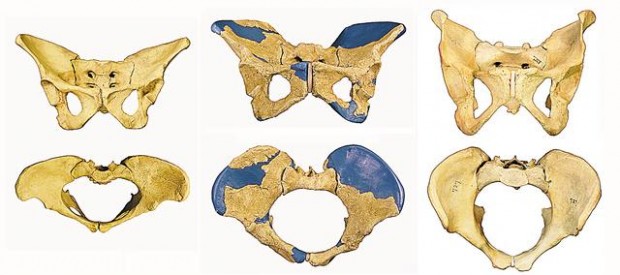
A fossilized human-like female pelvis that was discovered by researchers and dated by a University of Arizona scientist shows that our primitive predecessors' offspring likely had bigger brains than had been originally thought, according to results published Thursday in the journal Science.
The 1.2-million-year-old pelvis, which belonged to a human precursor known as Homo erectus and was found in Ethiopia, provides a critical evolutionary link between less-developed brains of even older ancestors and those of humans, said Scott Simpson, an anatomy professor at Case Western Reserve University who led the research.
While it might seem odd, the size of the human head — and by extension the brain inside it — is governed by the size of the female pelvis, Simpson said.
People are also reading…
Because babies push through the pelvis during birth, large-headed offspring must be able to fit through the birth canal.
"One of the restrictions to increased brain size was the fact that our human ancestors had small pelvises," Simpson said. "If you have a small birth canal, then you have a small brain. What we're finding here is that the brain and pelvis were co-evolving."
Key to researchers being able to make their findings was unlocking the age of the fossil, Simpson said.
"For us to find the link in the geology was crucial," he said. "If the fossil doesn't have any context in time and space, then it's not really worthwhile."
The work fell to UA geosciences professor Jay Quade, who said the team of scientists trying to date the fossil worked like detectives.
Analyzing ash deposits from both above and below the pelvis — the area in Ethiopia experienced a lot of volcanic activity at the time — scientists were able to pull out certain chemical signatures.
The signatures acted like a fingerprint, which scientists used to estimate that the fossil was between 750,000 and 1.6 million years old, Quade said.
But because of the potential implications of the discovery, scientists wanted to be doubly sure that they had found the fossil's correct age, so they used another verification method.
Roughly every million years, the Earth's magnetic field flips. Knowing that the planet's polarity had been flipped about 800,000 years ago, Quade and other researchers decided to test the magnetic charges of particles in the sediment found near the pelvis.
The particles' charges were reversed, which allowed the researchers to not only confirm their initial finding, but also to home in on the age of the fossil, Quade said.
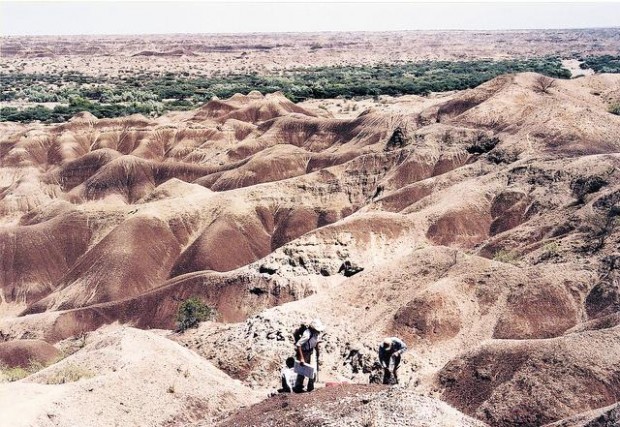
The more exact age also allowed Quade to get a sense of the type of environment Homo erectus lived in, which he said was remarkably similar to Eastern Africa today.
"I feel like I could stand up on a hill there 1.2 million years ago and see the same thing because the modern landscape emerged in the last 1.5 million years," Quade said. "This was a time of major environmental change.
"Before that, there was more forest, and it was much wetter."
While the pelvis has helped expand scientific understanding of how the human brain grew larger, the findings also complicate theories formed from earlier discoveries, Simpson said.
Previously, researchers had only one other Homo erectus pelvis — that of an adolescent male — that they used to make theories about human evolution.
Because the male had a small pelvis, scientists estimated that the babies of Homo erectus had smaller brains in the womb that grew rapidly after birth.
The fossilized pelvis discovered by Simpson and other researchers in Ethiopia complicates that theory, showing that the species was capable of giving birth to large-brained babies.
It also shows that the differences between male and female Homo erectus were possibly more extreme than the distinctions between human males and females, Simpson said.
While the male Homo erectus was close to 6 feet tall, the female was probably about 4.5 feet tall. The female also probably had a more diamond-shaped body, compared to the hour-glass figure of female humans.
The two different fossils show that male descendants were developing hips well-suited for running long distances, while females appeared to be developing hips capable of giving birth to offspring with bigger brains.
"We see that the species was engaged in a balancing act," Quade said. "Compared to other animals, we're not good swimmers and we're not good runners.
"We're not good at much of anything but thinking. That was a trade-off that hominids were prepared to make early on."