

NASA has chosen the University of Arizona to head up an $800 million robotic space mission that will visit an asteroid and extract a sample that could provide clues to the origin of life on Earth.
The ancient asteroid, dating from the beginning of our solar system 4.5 billion years ago, should be brimming with the precursors of organic life, said Michael Drake, principal investigator on the OSIRIS-REx mission and head of the UA's Lunar and Planetary Laboratory.
It will be the largest project ever led by the UA and will keep generations of researchers and students engaged in uncovering clues to the beginnings of life, Drake said.
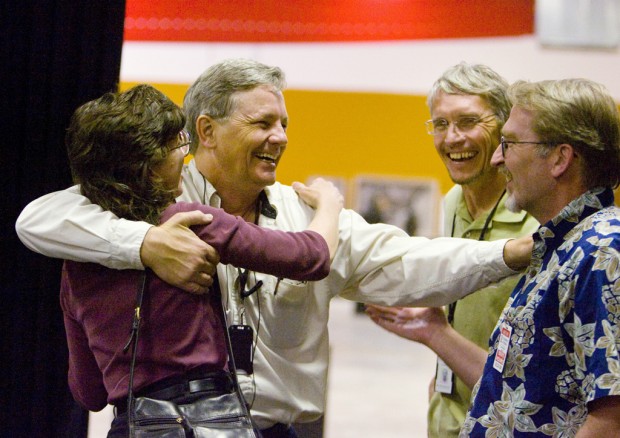
"I just about hit the ceiling with joy," UA President Robert Shelton said. Shelton and the team toasted with champagne after a news conference Wednesday.
"It's extraordinary," said Joaquin Ruiz, UA dean of science. "It solidifies the reputation of our department of planetary science as being a leader in space exploration missions. We just finished Mars Phoenix. This is bigger."
People are also reading…
The $428 million Phoenix Mars Lander - also led by a team from the UA Lunar and Planetary Lab - was the first NASA mission led by a public university. This mission has already moved into that mission's offices in the UA Science Operations Center, 1415 N. Sixth Ave.
"Having the facility was a major head start," Drake said. "No other university has this capability."
Optical cameras onboard the craft will be built by a UA team led by Peter Smith, who was principal investigator on the Phoenix Mars Lander.
Launch of the rocket carrying this latest UA-developed spacecraft is scheduled for 2016.
Return of its cargo - samples of Asteroid 99RQ36 - is planned for 2023.
Studies of the asteroid should also help NASA develop plans for shifting the course of large asteroids bound for Earth, Drake said.
This particular asteroid, about a third of a mile in diameter, will approach the Earth in 2186 and has been given a one-in-1,800 chance of entering Earth's atmosphere.
Drake said the mission will be able to address humanity's origin and its destiny.
"The origin is, 'Where did the organics come from that led to us?' The destiny is, 'Will we go the way of the dinosaurs?' "
Drake and his team, which includes deputy principal investigator Dante Lauretta, have been developing this mission for nearly a decade. It was first submitted for a NASA grant in 2004 but was deemed too costly for that earlier program.
The resubmitted proposal was chosen as one of three finalists for a NASA New Frontiers grant in December 2009, and the UA was given $3.3 million to flesh out its proposal.
Researchers know from telescope studies that the asteroid is "carbonaceous," said Drake - the type of asteroid that may have seeded Earth with the carbon-based building blocks of life.
"These types of asteroids are kind of a time capsule from 4.5 billion years ago when the solar system formed," Drake said.
Drake said planets such as Earth repeatedly "sterilized themselves" during formation in oceans of liquid lava. "Yet here we are with a complex organic environment. Those organics had to come from somewhere," he said.
"This particular object is very rich in organic material. You cannot tell from telescopes what they are, but they are likely to be amino acids."
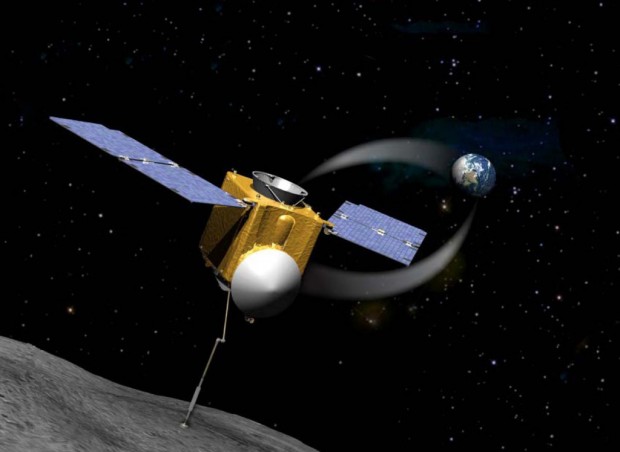
The most technically challenging part of the mission, Drake said, will come when the spacecraft goes close enough to "kiss" the surface of the asteroid, using a robotic arm with an elbow and shoulder joint to gather at least 60 grams of matter.
First, the spacecraft will slowly catch up to the asteroid and match its speed before going into orbit around it. The small asteroid has virtually no gravity. Landing on it is impossible.
The spacecraft will spend a year mapping the asteroid's surface with a variety of instruments. It will match the asteroid's rotation and descend in stages to a safe spot for that "kiss." Its arm will disturb the surface with a blast of pure hydrogen and suck up the sample rocks and dirt that it disturbs.
Drake described the arm as a pogo stick with a sample collection device on the end that "looks a bit like a car's air filter."
The spacecraft will then head back to Earth's orbit and release its sample return capsule, before heading back into space, where NASA may find other things for it to do.
Specifications call for gathering at least 60 grams of material, but Drake said the team hopes to get closer to the capsule's capacity of 2 kilograms (2.2 pounds).
At any rate, it will be enough material for generations of researchers to study, he said. He noted that moon samples from the Apollo mission are being studied today by scientists who weren't even alive in 1970.
The science of this mission won't have to wait for that return, Drake said.
It begins when the instruments aboard OSIRIS-REx begin sending data, providing the closest glimpse of an asteroid ever.
Those instruments include the OSIRIS-REx Camera Suite (OCAMS), being developed by the University of Arizona; a visible-Infrared spectrometer supplied by NASA Goddard; a thermal emission spectrometer from Arizona State University; and a laser altimeter from the Canadian Space Agency.
Students at MIT and the Harvard-Smithsonian Astrophysical Observatory, winners of a NASA competition for an additional instrument, will develop an X-ray imaging spectrometer for the spacecraft.
Business reaction
Business leaders gathered downtown for a Tucson Regional Economic Opportunities forum on economic development cheered the news Wednesday afternoon when TREO President Joe Snell interrupted the meeting to break the news.
Snell said the NASA mission validates Tucson as a science leader. "People ask me all the time: What do you sell most often? It's the science coming out of the U of A," he said.
Besides the trickle-down effect of the money the mission will bring to Tucson, Snell said OSIRIS-Rex, like the UA's Phoenix Mars Lander mission, will help efforts to sell the community as a major destination for high-tech companies.
What's with the name?
OSIRIS-REx stands for Origins Spectral Interpretation Resource Identification Security-Regolith Explorer.
Regolith is a layer of loose, heterogeneous material, such as dust, soil and broken rock.
Mission facts
Launch:
2016
Rendezvous with asteroid:
2020
Sample return:
2023
Cost:
$800 million
($1 billion with rocket cost).
Spent locally:
$200 million
(estimated).
Partners:
NASA's Goddard Space Flight Center, Arizona State University and the Canadian Space Agency.
Be a friend
OSIRIS-REx is on Facebook.
To contact reporters: Tom Beal, tbeal@azstarnet.com or 573-4158; Becky Pallack, bpallack@azstarnet.com or 807-8012.


