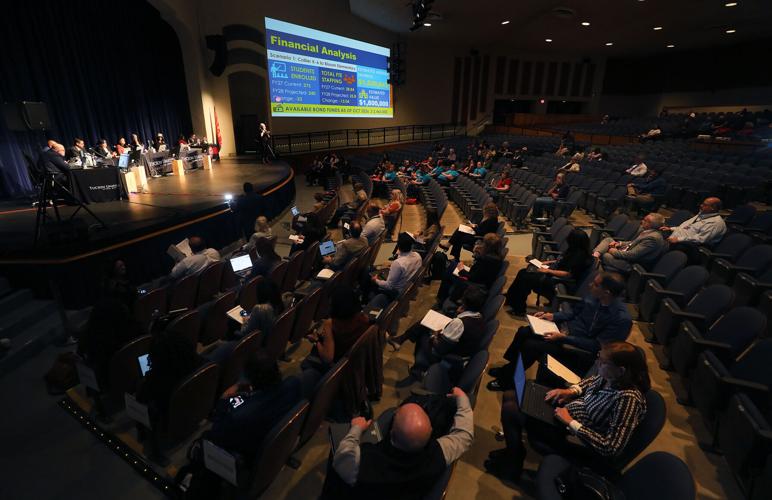
Under the dim lights of a scant auditorium, the Tucson Unified School District governing board held its first public review of school closure proposals Tuesday evening.
The meeting drew a crowd of less than 200 people at Palo Verde High School on Tucson’s east side. Despite the low attendance, criticisms of the closure proposals and meeting were high.
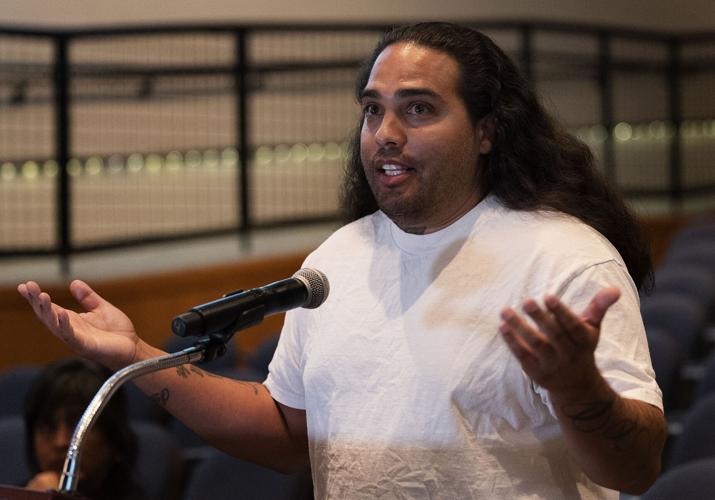
“I think you probably would have found better presentations in high school classes,” Jabril Thomas, a parent at Ford Elementary School told the Star after the meeting.

Jabril Thomas speaks during the call to audience at a Tucson Unified School District governing board meeting Tuesday night regarding school closure proposals.
The near five-hour meeting focused on the idea that the proposed changes were an “opportunity for the district to grow” and attract more students, not just a way for TUSD to solve financial hardship, Superintendent Gabriel Trujillo said.
He told reporters in a press conference before the meeting that the changes could bring new programs that can bring families into TUSD.
People are also reading…
“That is hard to do when we’re spending millions of dollars on buildings that are under-utilized,” he said.
The meeting started with a historical review of two rounds of school closures from the past 20 years: one in 2009-10 and the other in 2012-13. The review included the schools that closed, the schools that absorbed students from closures and an estimate of how many students the district lost during the process — about 15%. The estimate of how much money the district saved by closing schools was unclear.
“It was difficult to find records from my predecessors in terms of trying to determine if the savings that they were trying to achieve actually were achieved,” Chief Financial Officer Ricky Hernandez told the board. “At the time, my predecessor determined that the closures of those campuses would yield about four and a half million dollars in savings to the district ... there's no evidence to really trace the specific four and a half million to say these costs actually did not come back.”
District officials were able to confirm, however, the 2012-13 closures accomplished a fixed-cost reduction and capacity alignment. The closures did not reverse enrollment decline or completely solve budget issues.
The meeting then moved into a summary of community input that came from four engagement meetings held towards the end of September and early October.
Bill de la Cruz, a consultant the district hired in a $70,000 contract, told the board five key concerns included maintaining quality instruction, school safety and culture, specialized programming, such as special education services, transportation services and student support services, including counselors and interventionists.
De la Cruz’s presentation also stressed that financial savings should be considered alongside potential ongoing costs, such as transportation, staffing and student services. He urged the board to weigh quantitative data alongside families’ and employees’ experiences, and to assess proposals consistently while recognizing that some communities and student groups may be more affected than others.
Board member Jennifer Eckstrom asked for more detail in the summary, saying she felt it provided more positive feedback than negative.
“I just want to know all of the information that was given to you all by the families and the people that were there. That it’s not just positive,” she said. “I appreciate your opinion. I'd like to see more data of what was actually said.”

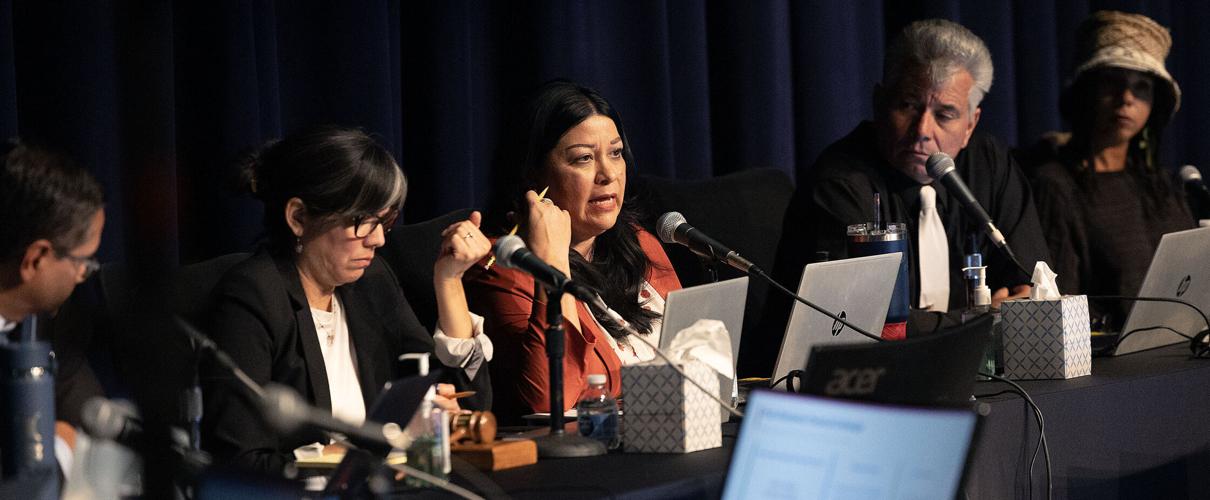
Jennifer Eckstrom, center, speaks during a Tucson Unified School District governing board meeting Tuesday night regarding school closure proposals.
Board member Sadie Shaw agreed, adding she heard community members raising more concerns than what she was hearing from the engagement summary.
“I want to be really clear, I'm not sharing my opinion. I'm sharing what I heard from your community,” de la Cruz told Eckstrom.
About two hours into the meeting, Trujillo began laying out the consolidation proposals announced last week.
As of Tuesday, the district recommended Hudlow, Dunham, Craigin and Collier elementary schools and Magee Middle School for closure. Students from those schools would be absorbed into Sewell, Marshall, Blenman and Bloom elementaries and Sabino High School.
On Monday, Secrist Middle School was also recommended for closure, consolidating into Santa Rita High School; however, it and every other 2028-29 closure will be presented in a November continuation meeting.
District officials presented each scenario with enrollment data, available space, transportation, school programs, building conditions and prior bond investments.
— The first proposal would consolidate Collier Elementary School, which has 93 students, into Bloom Elementary School, which has 280 students. District projections show the combined schools’ enrollment declining from 373 students this school year to 340 next school year. The district estimates annual savings of $1.03 million.
— The second proposal would consolidate Cragin Elementary School, with 177 students, into Blenman, with 288 students. District projections show the combined schools’ enrollment declining from 465 students this school year to 424 next school year. The district estimates annual savings of about $661,000.
— The third proposal would consolidate Dunham Elementary School, with 124 students, into Marshall, with 199 students. District projections show the combined schools’ enrollment declining from 323 students this school year to 284 next school year. The district estimates annual savings of almost $700,000.
— The fourth proposal would consolidate Hudlow Elementary School, with 132 students, into Sewell, with 125 students. District projections show the combined schools’ enrollment declining from 257 students this school year to 231 next school year. The district estimates annual savings of almost $500,000.
— The fifth and most dramatic proposal would consolidate Magee Middle School, with 266 students, into Sabino High School, with 767 students. District projections show the combined schools’ enrollment declining from 1,033 this school year to 992 next school year. The district estimates annual savings of about $514,000.
Trujillo the board that schools absorbing students will prioritize filling open positions with incoming staff. Any remaining teachers will be reassigned to similar roles elsewhere in the district.
“You don't need two office managers, right? So you have to do something with that position,” Trujillo said during the press conference. “We also have open needs throughout the district, so we have a responsibility to look at vacancies where schools (for example) don't have a custodian, and so as much as we want to keep the beloved custodian together with the students and the families, we actually have to look at what the needs of another campus.”
Every absorbing school would also provide free after-school childcare and offer transportation to any families who needed it, Trujillo said.
For consolidations like Magee into Sabino — normally a 15-minute drive — a standard bus route with multiple stops could take 45 minutes. To fix this, Trujillo proposes adding express bus routes.
“We want to make this as convenient for parents as possible, and we also want to make sure that we are sensitive to that early morning commute,” Trujillo said.
Trujillo said special programs at schools, such as exception education or GATE programs, would also follow students to their new schools. Trujillo clarified to the board that while some positions might not directly consolidate into a new school, Individualized Education Program, or IEP, aides and case workers would not be separated from students.
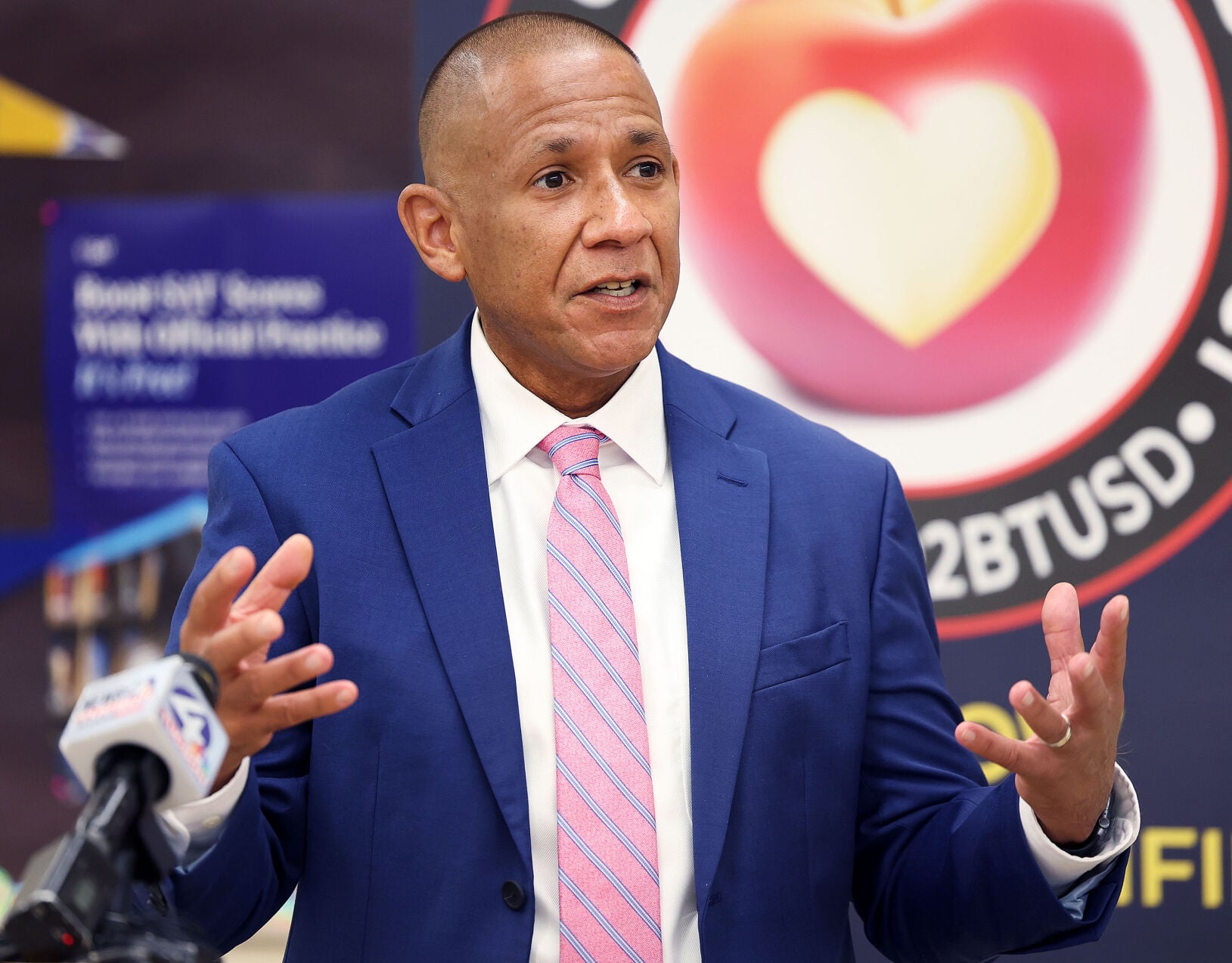
Superintendent Gabriel Trujillo discusses school closure proposals prior to the start of a Tucson Unified School District governing board meeting Tuesday night at Palo Verde High School.
Residents raise concerns during public comment
During the call to the audience, community members questioned the district’s process, the information provided to the governing board and the potential consequences for students and neighborhoods.
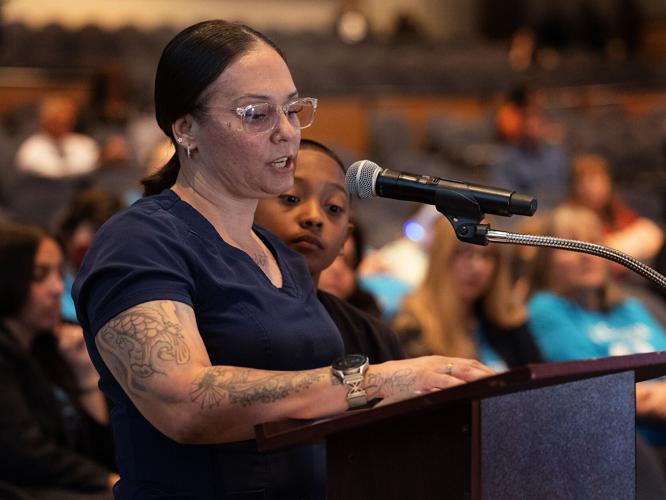
Erica Maske, a parent of 9-year-old Castiel at Cragin Elementary, told the board her son has spastic quadriplegic cerebral palsy and has attended the school since preschool. When he first began attending, he needed a walker to navigate the hallways, but today he walks those same hallways independently.

Erica Maske, a parent to a student at Cragin Elementary, told the TUSD governing board Tuesday night that her son has flourished at the school, which could be closed.
“While Castiel’s determination and hard work have been extraordinary, his success is a direct reflection of the consistent support, resources, accommodations and encouragement he has received at Cragin Elementary,” she said. “Craigen has never just been a place where my son receives an education; it is a place where he has been given the space, resources and encouragement to flourish.”
Betts Putnam-Hidalgo, a former governing board candidate and parent during a previous round of school closures, told the board, “to be calling this not a financial issue is to insult the intelligence of every person who's sitting here. It is a financial issue primarily,” referring to Trujillo’s “reimagining” campaign.
“If the district is now trying to revision itself in order to combat the hemorrhaging of students from the charter schools, that's great. It's 10 years too late,” she said. “This is about economics. This is not about helping students with more projects. I don't even understand where the money is actually going to come from.”
She said the district should look at selling old properties, such as the former TUSD headquarters, 1010 E 10th St., before closing schools.
Sara Reicher, a Hudlow Elementary School neighbor who has volunteered at the school since 2018, told the Star as she left three hours into the meeting that she didn’t feel confident in the governing board’s knowledge of issues at the affected schools.
She questioned why Hudlow, which has a strong neighborhood connection, would be consolidated into Sewell instead of vice versa and raised concerns about safety and walkability. She also pointed to a planned housing development of more than 120 homes nearby.
“It makes no sense to take our bigger school and put it into Sewell, which is smaller,” she said.
Kathleen Shooshtari, a parent at Cragin, told the Star after the meeting she was angry at the amount of information wrong on presentation slides with data on the school.
“I'm furious. I am completely taken aback by some of those numbers,” she said. “(District officials) said that Cragin did not have an after-school program. We are a part of a federally funded program, 21st Century, which is no cost to students.”
Governing board’s thoughts on the proposals
Eckstrom was the most opposed governing board member to the closure process thus far Tuesday evening.
“I've asked this governing board to take a pause about considering these school closures for this year. We are moving way too fast,” she said towards the end of the meeting. “We need to be cautious about what we're doing here.”
Shaw told the Star after the meeting she’s not “convinced that any of these scenarios are going to help the issues that we have currently.”
“In fact, I think they will make them worse,” she said.
Board member Val Romero defended the closure process, emphasizing the need for financial responsibility to avoid state takeover due to the district's high-risk status. In January, the Arizona Auditor General classified TUSD as at highest financial risk.
“If the auditor general of the state takes over our district, it doesn't matter what board members say here when it comes to finances,” he said. “We have that opportunity to make some choices. If we are under the state’s control, those choices are not ours.”
Board clerk Natalie Luna Rose said the coming discussions would be difficult and drew on her own experience with a past proposed school closure when she was a student. She saw some potentially promising scenarios, but said she had not heard enough concrete solutions.
Ravi Shah did not state a clear personal position on the closures in his closing remarks; he focused on the upcoming proposal reviews, public hearing and expected December vote.

Fewer than 200 people attended a TUSD governing board meeting Tuesday that provided more details about the district's plan to close and consolidate schools.
What’s next?
The governing board will review the next round of proposed closures, set to take place in the 2028-29 school year, on Nov. 10. Those announcements, Trujillo told media, will be coming out in the next 10 days. A public hearing will take place on Nov. 17, and a vote is still expected on Dec. 8