The Arizona State Schools for the Deaf and the Blind may have graduated 25 students who did not meet graduation requirements, a September report from the Arizona Auditor General says.
The school also could not provide background-check documentation for multiple employees and did not efficiently investigate some complaints, which included safety issues, in recent school years, the report showed.
The Arizona Auditor General contracted Sikich CPA LLC, an independent contract auditor, to assess ASDB’s student outcomes and operations in a performance report. The 180-page report that resulted found the agency may have graduated students it shouldn’t have, could not provide background-check documentation for multiple employees and did not efficiently investigate some complaints, which included safety issues, in recent school years.
People are also reading…
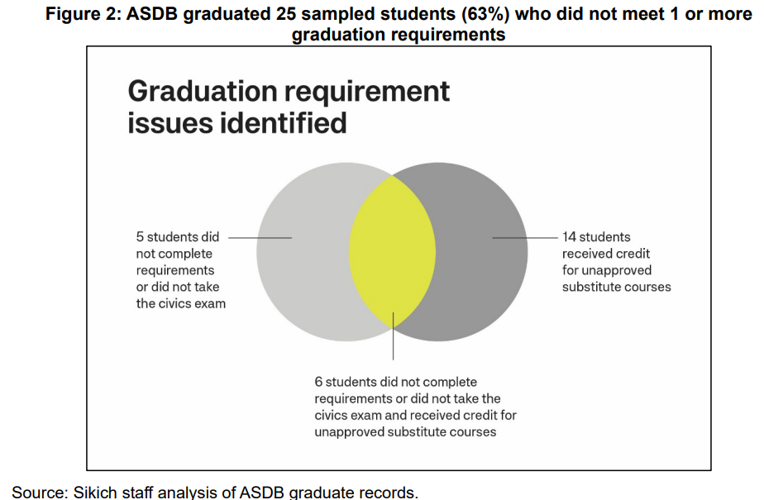
Sikich’s review of a sample of 40 ASDB graduates from the 2023-24 and 2024-25 school years found that 25 of the graduates’ student records did not contain sufficient evidence that they met all graduation requirements.
According to the report, five students did not complete a required civics exam, 14 students received credit for unapproved substitute courses, and six students fell under both areas.

The report also says ASDB did not maintain consistent records of graduates in the two school years, risking the misreporting of student information. One Arizona Department of Education report showed ASDB had graduated 53 students in the two school years, whereas another report showed that 63 students graduated, the report says.
“We were not able to independently reconcile the differences between these four sources to determine that the graduation information ASDB reported to ADE was accurate,” the report says.
In its response to the audit, ASDB agreed with the findings and said that while IEP teams could waive requirements like the civics test, everything should be properly documented.
Sikich’s review of a random sample of 45 employees found that ASDB also failed to retain detailed documentation or maintain complete records for 30 of 45 selected employees. As a result, the auditor could not confirm whether ASDB verified that all 30 employees had no arrests, charges or convictions before and following their hire.
ASDB failed to show that it had background-check records for 19 of these 30 employees who worked for the agency at any time during fiscal years 2022-24, the report says. Five certificated employees applied for a fingerprint card within seven working days of their hire date, contrary to statutory requirements, and five non‑certificated staffers’ cards expired after hire. For one non‑certificated employee in a card‑required position, ASDB couldn’t show proof the employee applied for a card within seven working days of hire.
ASDB disagreed, saying in 2020, human resources switched from paper to digital fingerprinting through the Arizona Department of Public Safety portal, which lacks employer-reporting features; ASDB instead uses an internal tracking spreadsheet to confirm completions.
“ASDB Human Resources will transition their records retention practice from DPS to Personnel File,” ASDB’s response letter says. ASDB also said the audit misinterpreted statutory time requirements for getting fingerprint cards.
A third finding was that ASDB did not investigate all complaints it received, including some complaints involving harassment and assault, in a timely manner, potentially affecting student and staff safety.
The report states ASDB missed deadlines on 12 of 15 complaints received between August 2024 and June 2025, taking six to 172 days beyond required timeframes to resolve cases including harassment, assault and sexual harassment.
ASDB disagreed, saying it acknowledges challenges with timely completion of complaint resolution, but ensures that staff and student safety is prioritized during any investigation.
The three issues were included in a list of nine problems flagged in the report. Other issues included:
— ASDB could not demonstrate that all its staff met required qualifications, including licensing and certification requirements, relevant education requirements such as a bachelor’s degree, relevant experience requirements and additional requirements such as ASL fluency, braille proficiency, defensive driver training and post-offer physicals.
— ASDB could not demonstrate that it consistently assigned qualified substitutes for teacher absences or vacancies, instead combining classrooms, asking staffers to cover for absent teachers or assigning students to a teacher who is not certified for the specific subject being taught.
— ASDB did not complete 22% and 97% of the staff evaluations required for permanent and probationary employees in fiscal years 2022 through 2024, and its staff evaluations are not aligned with state requirements for public school district staff.
— ASDB has established student-teacher ratio goals but lacks a process for determining when class sizes can exceed its goals, has not conducted a required annual review of its ratios, and has not updated its goals since 2007.
— ASDB leadership has not established or maintained an effective internal control system for managing its operations, including missing and/or inadequate policies and procedures and insufficient records retention.
— Prior to announcing its decision to relocate its Tucson campus, ASDB did not assess student risks and impacts, solicit input from stakeholders or obtain formal ASDB Board approval.
ASDB agreed with five of the nine findings; it disagreed that it failed to investigate complaints promptly, lacked some employee background-check records and had ineffective leadership controls. ASDB also disagreed that it failed to assess student risks, obtain board approval, notify stakeholders, or update capital plans before announcing the Tucson campus move.
While ASDB disagreed with nearly half of the findings, it agreed to implement or implement in a different manner, all 47 recommendations from Sikich.
Sikich advised ASDB to conduct a thorough review of student records, graduation requirements, and staff qualification files to fix errors, fill gaps and resolve inconsistencies. It also recommended implementing improved systems to track student records, complaint investigations, background checks and more.
The contractor also recommended the ASDB board of directors require Superintendent Annette Reichman to submit to the board a corrective action plan to address the internal control deficiencies identified in the audit and require her to provide an update on the progress toward completing the corrective action plan at each board meeting.

Superintendent Annette Reichman gives a tour last month of the new Arizona School for the Deaf and the Blind Oro Valley campus. The school might have graduated 25 students who did not meet graduation requirements, could not provide background-check documentation for multiple employees and did not efficiently investigate some complaints, the Arizona Auditor General says in a report.
“ASDB leadership is committed to strengthening governance, internal controls, fiscal accountability, and operational effectiveness,” Reichman said in the agency’s response to the audit. “We have carefully evaluated the audit findings, and the corrective actions outlined in the attached response reflect our commitment to addressing identified deficiencies, strengthening organizational systems, and establishing sustainable processes for ongoing accountability and improvement.”
The Auditor General’s Office plans to follow up with ASDB in six months to assess its progress.
ASDB failed to collect millions in revenue
ASDB failed to bill and collect money for services it provided, including an estimated $2.1 million in revenue it did not collect for the 2021-22 through 2023-24 school years, according to a forensic audit.
The 116-page forensic audit conducted by Forensic Strategy Solutions, on behalf of the Arizona Auditor General, examined ASDB’s financial activity from the 2021-22 through 2023-24 school years. The audit also found problems with payroll, purchasing and public records.
Despite the deficiencies, auditors said they did not identify evidence or circumstances that warranted further investigation for possible fraud in the areas reviewed.
The largest finding involved service-related revenue. Auditors estimated ASDB failed to collect $2.07 million in voucher and fee-for-service revenue during the three-year period. The agency also had about $2.58 million in denied Medicaid claims that were identified as correctable but were not resubmitted in a timely manner, potentially leaving additional money uncollected.
Auditors attributed the problems in part to inaccurate and incomplete student records. After ASDB moved enrollment information to its new student information system, the agency did not check the converted data properly. There were 112 instances where students had been enrolled, attended and billed for services, but their enrollment was recorded only in the old system, the report says.
ASDB agreed with all of the audit’s findings and said it would implement the auditor’s recommendations.