

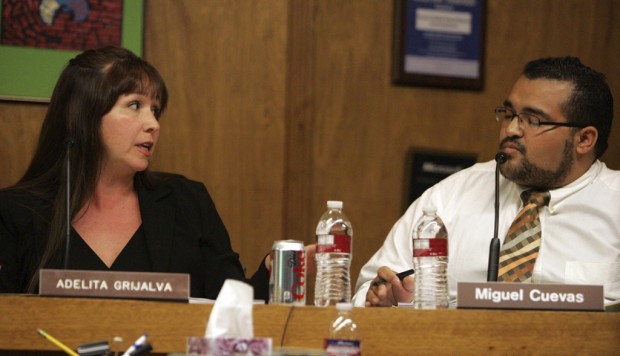
Miguel Cuevas didn't ask to be in this spot. But the freshman Tucson Unified School Board member is in the crucible of the district's cultural and educational debate.
He is the swing vote on a proposal by board president Mark Stegeman to diminish Mexican-American Studies. But 24-year-old Cuevas appears unfazed even in the midst of the highly charged debate that has attracted national attention.
"I have to do what I think is right," he said.
But in Tucson's history, his right could be wrong for Tucson's Chicano community.
Stegeman wants to eliminate some Mexican-American courses from the high school's core curriculum of classes that satisfy graduation requirements. Instead, the ethnic studies classes would become electives, making it less likely students would have time to take them.
People are also reading…
The proposal appears to be on hold, so far thwarted by a diverse coalition of supporters led by high school and college students. But if Stegeman doesn't withdraw it, Cuevas will break a 2-2 tie on the board.
Being in the middle of highly contested political fight is an unsettling position, especially for a young, untested public figure.
"There's immense pressure," said Cuevas, a University of Arizona senior majoring in public management policy.
Some of that pressure became personal. At the boisterous May 3 board meeting, which resembled a military camp with more than 100 police officers, several Mexican-American Studies supporters yelled at Cuevas.
"Vendido" - traitor - some called him. "Do the right thing," demanded another.
In an interview last week, Cuevas talked about a lot of things - but not how he'll vote on ethnic studies. He didn't wince when asked if the personal attacks hurt.
"They're more hurtful to the people who raised me and nurtured me," he said.
One of those people was a math teacher at Cholla High Magnet School, from where Cuevas graduated in 2005. He said the teacher, during his freshman year, recognized his talents.
"She saw my potential. She wasn't going to let all that go to waste," Cuevas said.
He grew up in a trailer park in the ethnically diverse "A" Mountain neighborhood next to Cholla.
Both his parents were born in Mexico. His father is an electrician. His mother works at Food City. They traveled to Sonora and Baja California to visit relatives.
In his junior year he spent two months in Germany as an exchange student. That experience gave him a new outlook. He learned to appreciate "what we have," particularly in terms of diversity and history. He was especially moved by a visit to a World War II concentration camp.
At the UA he took a class in African-American Studies and another in Mexican-American Studies.
All this has helped shape him. But the one thing that did the most to develop his approach to public education was personal. An older brother dropped out of high school and yet "he's the most intelligent one in my family," said Cuevas.
Seeing that helped lead Cuevas to his present position on ethnic studies.
"While ethnic studies is important to the community, we have a bigger problem. The system continues to underserve our community," he said. "We need to hold our educational system accountable."
That's exactly what many in Tucson have been demanding for the past 50-plus years. The current tempest over Mexican-American Studies is the latest chapter to improve education for Chicano students, who continue to drop out of high school at alarming rates.
Yet Cuevas, who promises to stick by his convictions, sees Tucson's history and his role differently.
"Anyone who knows who I am definitely knows I'm not going to sell out." he said. "I'm doing right by all Latino students."
Ernesto Portillo Jr. is editor of La Estrella de Tucsón. He can be contacted at netopjr@azstarnet.com or at 520-573-4187.


