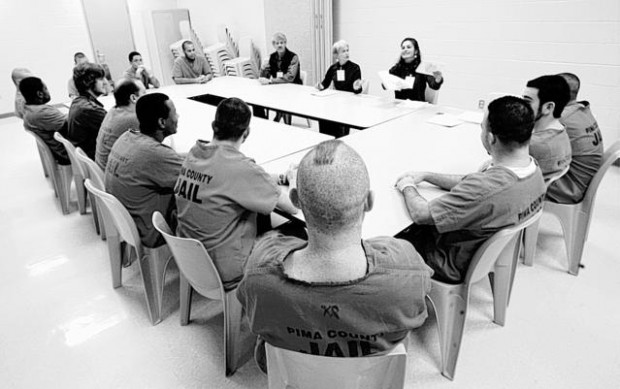
Madeline Kiser stood silently, holding across her chest a child's crayon rendering of a heart and looking out at a group of men who were wearing orange jumpsuits and shower shoes because of violence, drugs, bad decisions or bad luck — or all four.
She was there to talk about trust. How it is lost. How it is gained. How broken hearts are healed. If they heal.
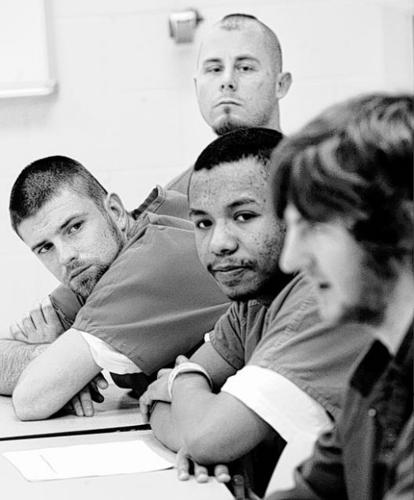
The dozen men in the Pima County jail have agreed to be part of the Inside/Out program, the equivalent of a human chain that anonymously links through poetry four groups that otherwise wouldn't interact: students in an alternative high school, juveniles in lockup, incarcerated men and University of Arizona honors students. The groups are expected to serve as extended teachers to one another, sharing poems in one long conversation.
"I liked the idea of reaching out to youth," said 22-year-old Hiycue Warrior, who is facing murder charges in connection with a slaying on the South Side last summer. "I think it's a good program to show children this is not the place to be and to put them on the right road."
People are also reading…
Inside/Out, which has roots going back a decade, started as an attempt to reach young people on the margin, to give them a voice and to encourage them to engage with their community. The program is built around a new theme each semester — focuses have included politics, the environment and the conflict in the Middle East.
Speakers have ranged from Buddhist nuns to guys who recycle bicycles, an 85-year-old veteran, the city's transportation director and an immigration activist.
Students at Pima Vocational High School and the juvenile detention center came first, with the university component born in 2006. Last week marked the second class for the fourth branch, the jail.
"You can't talk about incarceration without talking about the way we treat the planet," said Guy McPherson, a UA professor in the school of natural resources who came to a group to talk about oil consumption as a guest speaker and now serves as a co-instructor. He requires his honors students to join him at detention at least once.
"The way we abuse other people is similar to how we abuse the environment around us. If we're to overcome this history, it's because we've tapped into the voices of people who have been marginalized and typically aren't asked to help find answers."
McPherson finds power, too, in the dialogue. His UA students come away surprised that they find common ground with the girls from such different backgrounds. The girls in detention are surprised as well, he said.
"They will say: 'I'm as smart as those college students are. I can go to college.' It's as though they'd never been told that they were smart before," he said.
One of his students, Nick Jones, remembers being taken aback when McPherson told his class about the poetry and detention requirement. "When I signed up, I thought it was just a science class," said Jones, a sophomore, who acknowledges that he initially had some reservations. But he liked going so much that even after the class was over, he continued going. And this year he's helping with instruction again, both at the jail and at the juvenile center.
"I realized I've had a really privileged life," said the 20-year-old history major. "I was never spoiled, but my parents were always there for me to help me work through problems. A lot of the girls don't have that kind of supportive environment. I felt like I learned more about myself, so it is a symbiotic relationship."
He said he came to the adult jail session because it's fascinating to him. The girls in detention are younger than he is, so there's more of a teacher-student relationship. "With the jail, we're trying to get these guys to become mentors for the girls, so they're more like peers, and it's a different group dynamic."
The youth partners this semester won't get started until March, but the men in jail are getting a head start, reading out loud three poems Kiser brought in. One of the poems raised a question for Kiser: If everyone was kind, would life be boring?
That led to a discussion of good and evil, and whether that's different from the pairing of kind and mean.
Kiser told the men they are gifts, in some ways, in their role as advisers to kids and policymakers. "This raises a related question," she said. "There's some idea that the things we live through that are hard, the dark emotions, the sin, the struggle, that's what makes us useful to other people. Do you agree?"
Jeremy Korn, 27, did, saying street living translates into an easier time with legal hustling.
"If you were a street pharmacist, you'd be a hell of a car salesman," he predicted.
Korn, who is facing drunken driving charges, said he hopes his experiences can help. "Maybe if I'd had some positive influence when I was young, I wouldn't have done the things I did to get in here," he said.
Reassuring them that she places a higher mark on honesty and vividness than on perfect punctuation and spelling, Kiser prompted the men to write about about what the American dream means to them.
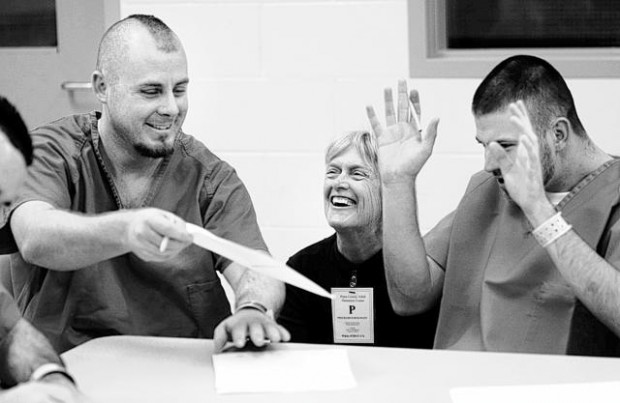
Mary Goethals, a former English teacher who tag-teams the lessons, circulated among the men, reading poems and offering critiques and encouragement. When it was time to share, she said that the men could choose not to read, have their work read anonymously or — the bravest option — read it themselves.
There was no wheedling or cajoling as the men practically jumped at the chance to share. There were few "I'm-not-a-good-writer" apologies that prefaced their readings. And there was no shortage of the raw stuff of poems, the pain and regret and hope.
One told of missing his 4-year-old daughter, who draws pictures like the ones Kiser showed at the start of class. One said that at 24, he's looking at many years in prison because of the seduction of fake friends and fake, fleeting happiness. Another described the American dream as an eight-mile walk without shoes, in the hope that it will be a better day tomorrow.
Jones, the university student, snapped his fingers at the end of each reading. He explained that's how the audience shows its appreciation at poetry slams.
And as the men tentatively tried the snapping, grinning at each other sheepishly, the links of the chain started growing.
About Inside/Out
Inside/Out is a program founded by poet Madeline Kiser, designed to foster community connections through shared writing from workshops for detained youths and adults on the "inside," as well as for students at Pima Vocational High School and the UA, who are "out."
The program relies on funding and support from the Friends of the Pima County Public Library, the library system, the UA Poetry Center and Tucson Parks and Recreation.
Go to www.library.pima.gov/teenzone/art/poetry/insideout.cfm to see work from several semesters.
Contact Kiser by e-mail at mkiser@dakotacom.net for more information.