

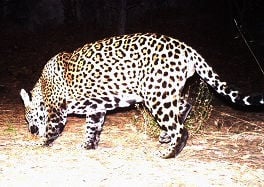
A jaguar has been caught on camera in the Huachuca Mountains twice so far this year, marking the first confirmed sightings of the endangered cat species since 2017 in the range about 90 miles southeast of Tucson.
The images of a male jaguar were captured between March and May on a remote camera or cameras operated by U.S. Customs and Border Protection, the Tucson-based Center for Biological Diversity announced Wednesday.
Wildlife officials said it could be a new cat, previously undetected north of the border, or it could be a jaguar nicknamed Sombra that has been caught on camera in the Chiricahua Mountains dozens of times over the past seven years.
According to the U.S. Fish and Wildlife Service’s online database of jaguar sightings, the images are too blurry to positively identify the animal based on its distinctive pattern of spots.
People are also reading…
“We’ve got a mystery cat,” said Russ McSpadden, a conservation advocate for the Center for Biological Diversity. “For me, every sighting of a jaguar is a moment to celebrate.”
The only other large spotted cat detected in the Huachuca range was a young male nicknamed Yo’oko, the Yaqui word for jaguar, by students at Hiaki High School in Tucson.
McSpadden said Yo’oko was caught on camera in the mountains west of Sierra Vista in 2016 and 2017 before turning up dead in Sonora, Mexico, in 2018.
Seven adult male jaguars have been documented in the Southwestern U.S. since 1996, including five in Arizona, one in New Mexico and one seen in both states. No females have been documented in the U.S. since an Arizona hunter killed one in the White Mountains in 1963.
The most recent jaguar images from the Huachucas were captured on March 22 and an unknown date in either April or May, according to the Fish and Wildlife Service database.
McSpadden said it’s unclear if the jaguar was photographed by a single CBP camera or multiple cameras at different locations.
The images have not been released to the public, but they have been examined by officials from the Arizona Game and Fish Department.
“We have seen the imagery but cannot tell whether or not it is a new individual or the jaguar that has been in the Chiricahua Mountains area since 2016,” said department spokesman Mark Hart. “That jaguar was last observed by trail cam there in October.”
McSpadden said it’s “definitely a possibility” that Sombra decided to brave the roughly 50 miles of highways and open desert to get from the Chiricahuas to the Huachucas. But it’s also possible that a young male jaguar ventured north into the range after being chased out of another cat’s territory in Mexico.
“They’re really wide-ranging. They’re really elusive,” he said. “And good jaguar habitat is good jaguar habitat. If the habitat in the Huachucas was good enough for Yo’oko, some other cat is going to find it.”
McSpadden also dangled another tantalizing possibility: Perhaps the jaguar seen earlier this year in the Huachuca Mountains is the famed El Jefe, back from his long sojourn to Mexico.
That adult male was caught on camera more than 100 times between 2012 and 2015 in the Santa Rita and Whetstone mountains outside of Tucson. Six years later, El Jefe turned up in an undisclosed mountain range in Central Sonora, more than 100 miles south of the U.S.-Mexico and 120 miles south of the Santa Ritas.
Though El Jefe would be an old cat by now, McSpadden said, maybe he decided to return to his former territory to live out his retirement.
“But that’s just speculation,” he said.
Jaguars are the largest cats in the Americas. They once ranged as far north as Colorado and Northern California and as far east as Louisiana, but they had been all but wiped out in the U.S. by the middle of the 20th century.
After legal action by the Center for Biological Diversity, the jaguar was added to the Endangered Species List in 1997. Last year, the center petitioned the Fish and Wildlife Service to dramatically expand the cat’s federally designated critical habitat, which is limited to areas south of Interstate 10 through Southern Arizona and New Mexico.
Service officials have said the so-called “sky island” mountain ranges in that area are only capable of supporting about six jaguars.
McSpadden said the timing of these most recent sightings is also significant.
Just a few months earlier, the southern slopes of the Huachuca Mountains were blocked by stacks of shipping containers, as former Gov. Doug Ducey’s $176 million border barrier was hastily thrown up and then taken back down.
“It’s exciting that the last of the containers was removed by the last day of January, and, not long after, a jaguar appears in the Huachucas,” McSpadden said.
Videos: Southern Arizona wildlife caught on camera
Playtime: Wildlife returns to backyard for some wrestling and fun
Rare ocelot caught on trail camera in Southern Arizona
Bobcat kittens play on patio furniture at Tucson home
Javelina cools off in Tucson yard
Bobcat returns to Tucson home after a year with new kittens in tow
Black bear spotted northeast of Tucson
Star reader catches glimpse of Javelina after-party at local resort
Watch as Tucson's nighttime wildlife romps around
Tucson wildlife: A peccary pumpkin party
Releasing bobcats for research
Research project continues tracking Tucson's urban bobcats
Golf course coyotes howl at sunset in northwest Tucson
Downtown Tucson got a rare visit from a wild coatimundi.
Just an ordinary bike ride ... following a bear
Bobcats play in Tucson backyard
Watch now: Bear sightings reported around Pima County
Watch now: Bobcats playing on an Oro Valley Golf Course
Watch now: Mountain Lion strolls outside home in Tucson Foothills
Watch Now: Trail cameras catch mountain lions at Tucson home.
Watch Now: Bobcat Sadie and a friend drink from a backyard fountain.
Family of bears takes a stroll in southeastern Arizona in 2022
Watch Now: Mountain lion roaming in the Coronado National Memorial
Watch now: Ding, dong! Bobcat filmed by front door camera in Tucson
Watch now: Bear captured in Sierra Vista neighborhood, released
Watch now: A cool cat takes a cool nap in the Foothills
Watch now: Young bear seen in NW Tucson captured and released
Watch now: Bear spotted rummaging through trash can in Oro Valley
Watch now: Bobcat's breakfast near Oro Valley
Watch now: Breakfast with the deer on Tumamoc
Watch now: Bobcat kitten plays with mother behind Tucson residence
Watch now: Rescued porcupine released back into wild
Watch now: Bobcat kittens play in a dry fountain
Watch now: Bobcat stops by Tucson waterhole for an overnight drink
Watch Now: Collared bobcat raises kittens in Tucson neighborhood
Watch now: Javelina family takes an evening stroll in midtown Tucson
Bobcat plays with its kitten in Tucson backyard
Watch now: Mountain lion seen up-close on camera outside Tucson home
Watch now: Bobcats in love in the Tucson area
Watch Now: Family of deer eating breakfast on Tumamoc Hill
Watch now: A hummingbird plays in the sprinkler
Watch now: Breakfast time for the Quail family in the Tucson area
Watch now: Frequent visitor to northwest Tucson home munches on meal worms
Watch now: Playful lizards visit a Tucson back yard
Watch now: Startled mountain lion at Loews Ventana Canyon
Watch now: A true lounge lizard in Tucson
Watch now: A spotted skunk threatens the worst at Saguaro National Park
Watch now: Javelina mama and babies
Watch now: Mountain lion outside a home in the Tucson Mountain foothills
Watch now: Family of bobcats spotted in Foothills back yard
Watch now: Backpacker’s intense standoff with mountain lion near Tucson
Watch now: Javelina rescued from trash can in Foothills neighborhood
Watch now: Owl takes a bath in trough on Tucson's northwest side
Watch now: Coyote pups play in front yard near Tucson Estates
Bighorn sheep scatter in Catalina Mountains during aerial survey
Watch now: Bighorn sheep enjoy post-monsoon greenery near Tucson
Watch now: Bear has a rub-a-dub in watering hole near Tucson
A male jaguar not previously detected by researchers was videotaped just three miles south of the recently constructed border wall between Mexico and the United States.
The jaguar appeared for the first time on camera traps along the riparian corridor of Cajon Bonito in Sonora, Mexico. The lands where the jaguar was recorded have been managed by the Cuenca Los Ojos foundation to preserve and restore biodiversity during the last three decades. Researchers have dubbed the jaguar El Bonito.
Credit: Ganesh Marin, the project leader, is a Ph.D. student in the School of Natural Resources and the Environment at the University of Arizona and a National Geographic Early Career Explorer. The research project is a joint effort of the University of Arizona and the University of Wyoming in collaboration with the Cuenca Los Ojos Foundation and members from Santa Lucia Conservancy, National Autonomous University of Mexico (UNAM), Phoenix Zoo and Arizona State University.
Contact reporter Henry Brean at hbrean@tucson.com or 573-4283. On Twitter: @RefriedBrean

Henry Brean
Reporter

 50,000 acres will be removed from jaguar critical habitat, judge rules


